Loading...
Done
Shaymaa Ismaa’eel, a 24-year-old Muslim woman passes by a group of angry protesters at an Islamic conference in Washington, DC on April 21, 2019. In response, she crouched in front of them and flashed a peace sign. The photo, posted on Instagram, prompted an outpouring of support. (Photo by Shaymaa Ismaa'eel/Instagram)

Shaymaa Ismaa’eel, a 24-year-old Muslim woman passes by a group of angry protesters at an Islamic conference in Washington, DC on April 21, 2019. In response, she crouched in front of them and flashed a peace sign. The photo, posted on Instagram, prompted an outpouring of support. (Photo by Shaymaa Ismaa'eel/Instagram)
Details
29 Apr 2019 00:05:00
A young girl works at a construction site in Patiala district, Rajpura, India on November 20, 2019. (Photo by Saqib Majeed/Barcroft Media)

A young girl works at a construction site in Patiala district, Rajpura, India on November 20, 2019. (Photo by Saqib Majeed/Barcroft Media)
Details
22 Oct 2022 04:39:00
Police officers detain a demonstrator as people protest to defy a ban and march on Taksim Square to celebrate May Day in Istanbul, Turkey on May 1, 2023. (Photo by Dilara Senkaya/Reuters)

Police officers detain a demonstrator as people protest to defy a ban and march on Taksim Square to celebrate May Day in Istanbul, Turkey on May 1, 2023. (Photo by Dilara Senkaya/Reuters)
Details
19 May 2023 04:21:00


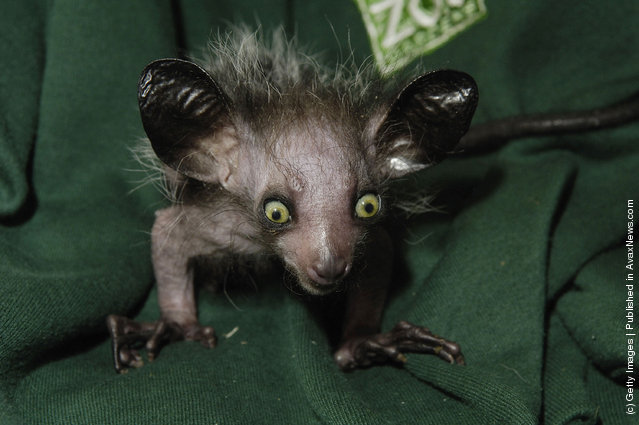
“The aye-aye (Daubentonia madagascariensis) is a lemur, a strepsirrhine primate native to Madagascar that combines rodent-like teeth and a special thin middle finger to fill the same ecological niche as a woodpecker. It is the world's largest nocturnal primate, and is characterized by its unusual method of finding food; it taps on trees to find grubs, then gnaws holes in the wood and inserts its narrow middle finger to pull the grubs out. The only other animal species known to find food in this way is the striped possum. From an ecological point of view the aye-aye fills the niche of a woodpecker as it is capable of penetrating wood to extract the invertebrates within”. – Wikipedia

Photo: In this handout image from Bristol Zoo is seen the first captive bred aye-aye in the UK named “Kintana” (meaning star in Malagasy) April 15, 2005 at Bristol Zoo Gardens, England. The zoo announced today only the second baby aye-aye to be hand-reared in the world (the first was in Jersey Zoo) and has now made his first public appearance since his birth on 11 February 2005. (Photo by Rob Cousins/Bristol Zoo via Getty Images)
Details
13 Apr 2011 13:33:00
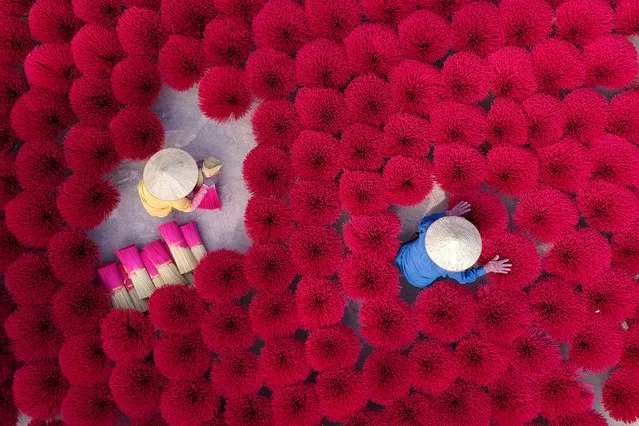
A Vietnamese woman collects dried incense sticks at a courtyard in Quang Phu Cau village on the outskirts of Hanoi on January 9, 2020 ahead of the upcoming Lunar New Year celebrations, referred to in Vietnam as Tet. (Photo by Manan Vatsyayana/AFP Photo)

A Vietnamese woman collects dried incense sticks at a courtyard in Quang Phu Cau village on the outskirts of Hanoi on January 9, 2020 ahead of the upcoming Lunar New Year celebrations, referred to in Vietnam as Tet. (Photo by Manan Vatsyayana/AFP Photo)
Details
12 Feb 2020 00:03:00
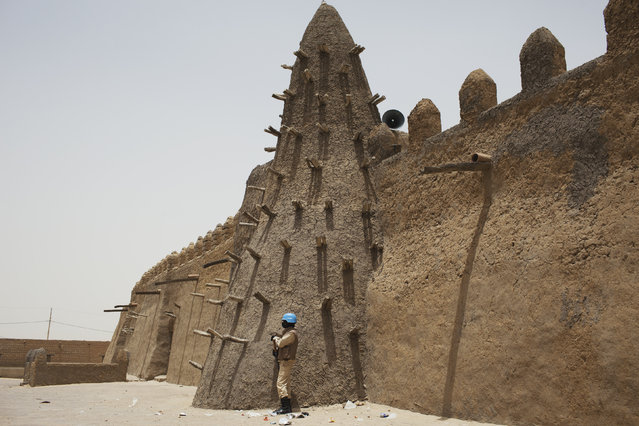
Timbuktu: A UN peacekeeper from Burkina Faso stands guard at the Djinguereber mosque, built in the 14th century, during a visit by a UN delegation on election day in Timbuktu, Mali, July 28, 2013. (Photo by Joe Penney/Reuters)

Timbuktu: A UN peacekeeper from Burkina Faso stands guard at the Djinguereber mosque, built in the 14th century, during a visit by a UN delegation on election day in Timbuktu, Mali, July 28, 2013. (Photo by Joe Penney/Reuters)
Details
08 Jul 2015 12:33:00
U.S. Army helicopters providing support for U.S. ground troops  fly into a staging area fifty miles northeast of Saigon, Vietnam, August 28, 1966. Helicopter fuel is stored in the large rubber tanks, foreground. (Photo by Henri Huet/AP Photo)

U.S. Army helicopters providing support for U.S. ground troops fly into a staging area fifty miles northeast of Saigon, Vietnam, August 28, 1966. Helicopter fuel is stored in the large rubber tanks, foreground. (Photo by Henri Huet/AP Photo)
Details
29 Aug 2015 11:05:00
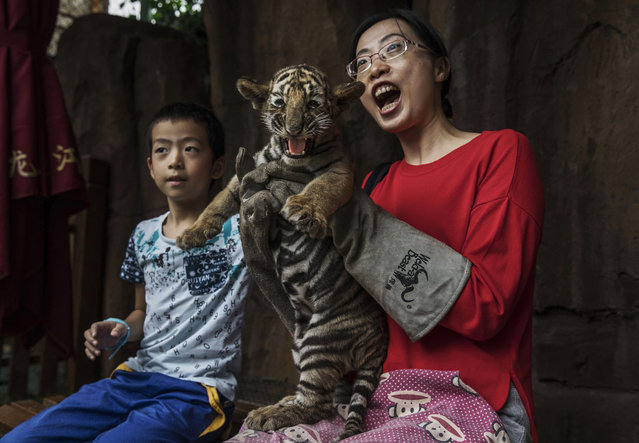
A Chinese tourist wears protective gloves as she holds a baby Siberian tiger as they pose for pictures at the Heilongjiang Siberian Tiger Park on August 16, 2017 in Harbin, northern China. (Photo by Kevin Frayer/Getty Images)

A Chinese tourist wears protective gloves as she holds a baby Siberian tiger as they pose for pictures at the Heilongjiang Siberian Tiger Park on August 16, 2017 in Harbin, northern China. The center is one of two Siberian tiger parks in the Chinese province of Heilongjiang, about 500 kilometers (300 miles) from the border with Russia. It is considered the world's largest for breeding the Siberian, or Amur, tiger which is listed as endangered by the World Wildlife Federation. (Photo by Kevin Frayer/Getty Images)
Details
23 Aug 2017 08:29:00