Loading...
Done
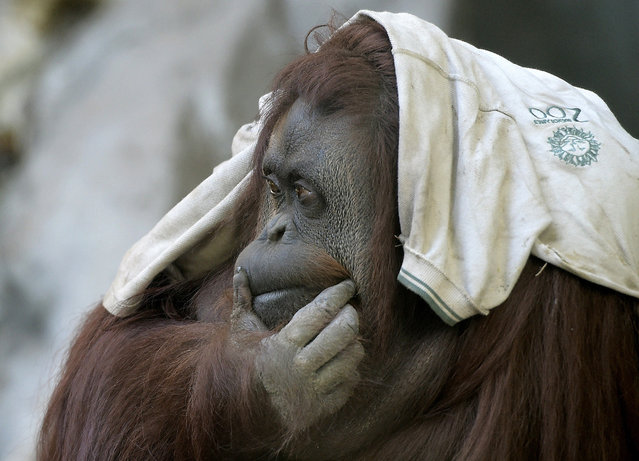
Sandra, a 29-year-old orangutan at Buenos Aires' zoo, on May 20, 2015. Sandra got cleared to leave a Buenos Aires zoo that was her home for 20 years, after a court ruled she was entitled to more desirable living conditions. (Photo by Juan Mabromata/AFP Photo)

Sandra, a 29-year-old orangutan at Buenos Aires' zoo, on May 20, 2015. Sandra got cleared to leave a Buenos Aires zoo that was her home for 20 years, after a court ruled she was entitled to more desirable living conditions. (Photo by Juan Mabromata/AFP Photo)
Details
23 May 2015 11:36:00
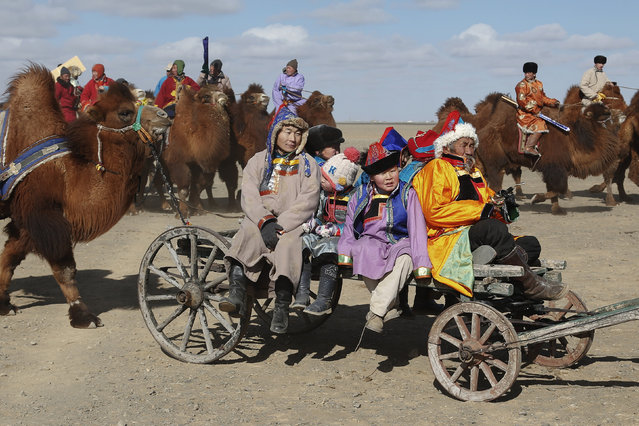
People sit on a cart with a camel tied to it during “Temeenii bayar”, the Camel Festival, in Dalanzadgad, Umnugobi aimag, Mongolia, March 6, 2016. (Photo by B. Rentsendorj/Reuters)

People sit on a cart with a camel tied to it during “Temeenii bayar”, the Camel Festival, in Dalanzadgad, Umnugobi aimag, Mongolia, March 6, 2016. On the steppes of the Gobi Desert, the crowd urges on Bactrian camels laden down with all that's needed to build and live in a traditional Mongolian tent. Guinness World Records classes the 15 km race thatÕs part of the two-day festival as the largest camel race in the world, drawing 1,108 participants. The winning camel romped home in 35 minutes and 12 seconds, according to the records website. (Photo by B. Rentsendorj/Reuters)
Details
30 Mar 2016 11:13:00
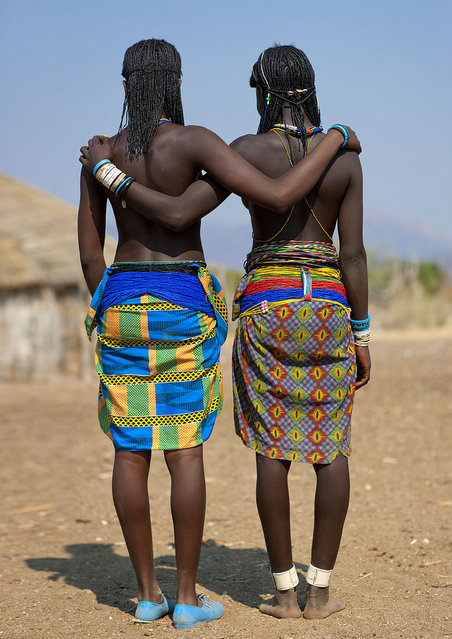
“Show us our butts! Mucawana tribe – Angola. In Soba village, the Muhacaona (Mucawana) tribe, perhaps the best place i have visited. They use cow dung and fat to make this so nice haircut, and love the beads. They asked me to make pictures of their backs... and butts to see on the camera screen if everything was perfect!”. (Eric Lafforgue)

“Show us our butts! Mucawana tribe – Angola. In Soba village, the Muhacaona (Mucawana) tribe, perhaps the best place i have visited. They use cow dung and fat to make this so nice haircut, and love the beads. They asked me to make pictures of their backs... and butts to see on the camera screen if everything was perfect!”. (Photo and comments by Eric Lafforgue)
Details
09 Nov 2012 15:04:00
Howard Jackson, a Liberian migrant, poses for a portrait in the Andalusian capital of Seville, southern Spain March 7, 2016. (Photo by Marcelo del Pozo/Reuters)

Howard Jackson, a Liberian migrant, poses for a portrait in the Andalusian capital of Seville, southern Spain March 7, 2016. Jackson escaped civil war and spent three years crossing Africa before reaching Spain. Dressed up in one of his more than 200 costumes, from Peter Pan to Little Red Riding Hood, he is a well-known figure at an intersection entering the Spanish city of Seville where he has sold tissues to motorists for over a decade. Jackson is studying law and wants to become a judge. (Photo by Marcelo del Pozo/Reuters)
Details
24 Mar 2016 12:14:00
A young woman dressed as a zombie takes part in a zombie parade as part of the Brussels International Fantastic Film Festival 2014 in Brussels, Belgium, 12 April 2014. More than a hundred of participants took to the streets of Brussels. (Photo by Ulien Warnand/EPA)

A young woman dressed as a zombie takes part in a zombie parade as part of the Brussels International Fantastic Film Festival 2014 in Brussels, Belgium, 12 April 2014. More than a hundred of participants took to the streets of Brussels. (Photo by Ulien Warnand/EPA)
Details
19 Apr 2014 12:01:00
Men eat oranges from a push cart along a road as a vehicle travels past them in Karachi January 22, 2015. (Photo by Akhtar Soomro/Reuters)

Men eat oranges from a push cart along a road as a vehicle travels past them in Karachi January 22, 2015. (Photo by Akhtar Soomro/Reuters)
Details
26 Jan 2015 12:17:00
People board a passenger bus during rush hour at a bus terminal, amidst the coronavirus disease (COVID-19) outbreak, in Mumbai, India, September 9, 2020. (Photo by Niharika Kulkarni/Reuters)

People board a passenger bus during rush hour at a bus terminal, amidst the coronavirus disease (COVID-19) outbreak, in Mumbai, India, September 9, 2020. (Photo by Niharika Kulkarni/Reuters)
Details
15 Sep 2020 00:05:00
Wedges of an orange generate enough current and electrical juice – 3.5 volts – to power an LED. The fruit’s citric acid helps electrons flow from galvanized nails to copper wire in this 14-hour exposure. This image was published in September’s Visions of Earth, a trio of photos that appear in each issue of National Geographic. (Photo by Caleb Charland/National Geographic)

Wedges of an orange generate enough current and electrical juice – 3.5 volts – to power an LED. The fruit’s citric acid helps electrons flow from galvanized nails to copper wire in this 14-hour exposure. This image was published in September’s Visions of Earth, a trio of photos that appear in each issue of National Geographic. (Photo by Caleb Charland/National Geographic)
Details
06 Jan 2014 12:09:00