Loading...
Done
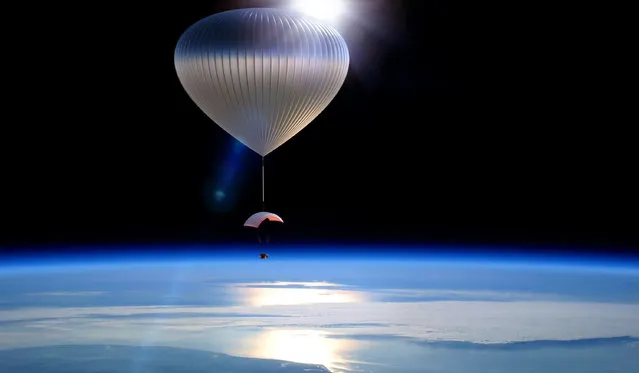
This undated image provided by World View shows World View capsule and balloon spacecraft that will rise to 100,000 feet above Earth for passengers to see the curvature of the planet and the blackness of space. (Photo by World View via AP Photo)

This undated image provided by World View shows World View capsule and balloon spacecraft that will rise to 100,000 feet above Earth for passengers to see the curvature of the planet and the blackness of space. Space tourism companies are employing designs including winged vehicles, vertical rockets with capsules and high-altitude balloons. While developers envision ultimately taking people to orbiting habitats, the moon or beyond, the immediate future involves short flights into or near the lowest reaches of space without going into orbit. (Photo by World View via AP Photo)
Details
15 Feb 2016 10:28:00
Howard Jackson, a Liberian migrant, poses for a portrait in the Andalusian capital of Seville, southern Spain March 7, 2016. (Photo by Marcelo del Pozo/Reuters)

Howard Jackson, a Liberian migrant, poses for a portrait in the Andalusian capital of Seville, southern Spain March 7, 2016. Jackson escaped civil war and spent three years crossing Africa before reaching Spain. Dressed up in one of his more than 200 costumes, from Peter Pan to Little Red Riding Hood, he is a well-known figure at an intersection entering the Spanish city of Seville where he has sold tissues to motorists for over a decade. Jackson is studying law and wants to become a judge. (Photo by Marcelo del Pozo/Reuters)
Details
24 Mar 2016 12:14:00
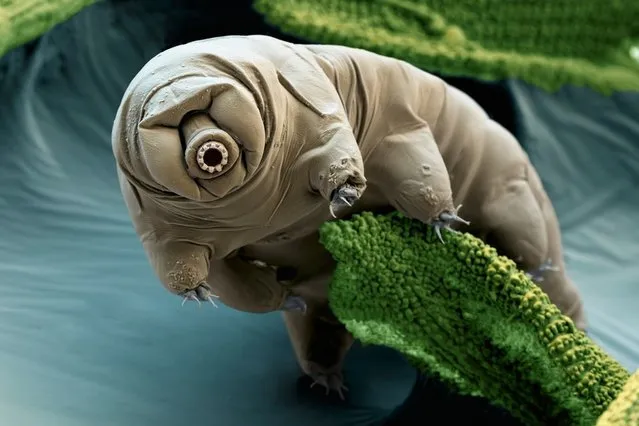
Tardigrades (commonly known as waterbears or moss piglets). (Photo by SPL/East News)

“Tardigrades (commonly known as waterbears or moss piglets) are small, water-dwelling, segmented animals with eight legs. Tardigrades were first discovered in 1773 by Johann August Ephraim Goeze, who called them kleiner Wasserbär, meaning “little water bear” in German. The name Tardigrada means “slow walker” and was given by Lazzaro Spallanzani in 1777. The name water bear comes from the way they walk, reminiscent of a bear's gait. The biggest adults may reach a body length of 1.5 millimetres (0.059 in), the smallest below 0.1 mm. Freshly hatched tardigrades may be smaller than 0.05 mm”. – Wikipedia. Photo: Tardigrades. (Photo by SPL/East News)
Details
26 Sep 2012 09:55:00
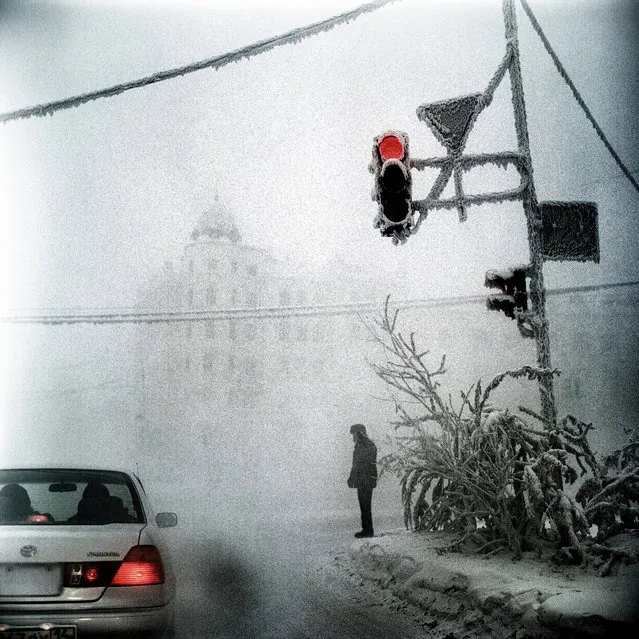
January 2013. A scene in Yakutsk, Siberia, the coldest city in the world. (Photo by Steeve Iuncker/Agence VU)

Yakutsk, a remote city in Eastern Siberia along the Lena River, is the coldest city in the world. Located 1840 km away from Irkoustk and 5000 km away from Moscow, this city founded in 1632 by the Cossacks imposes upon its inhabitants an extreme way of life. And yet, despite particularly harsh conditions, Yakutsk boasts a population of 270,000, or a quarter of the entire population of Siberia. No other place on the planet experiences the temperature extreme found here: in winter, the temperatures regularly fall to minus 40° (the coldest temperature recorded was –64°C) and in summer often reaches temperatures above 30°C. Photo: January 2013. A scene in Yakutsk, Siberia, the coldest city in the world. (Photo by Steeve Iuncker/Agence VU)
Details
29 Apr 2013 10:30:00
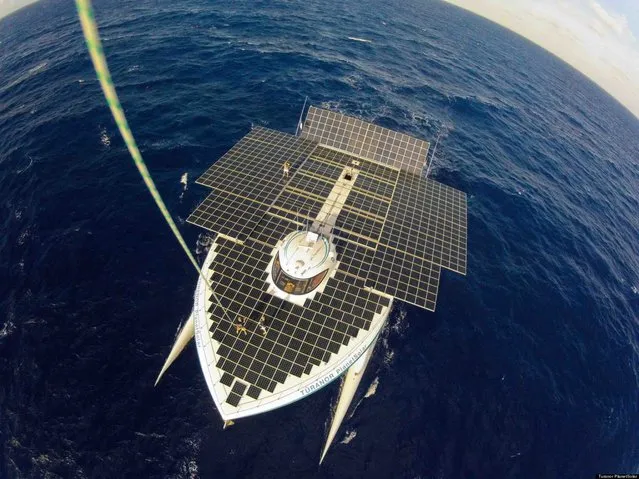
Turanor PlanetSolar

MS Tûranor PlanetSolar, known under the project name PlanetSolar, is the largest solar-powered boat in the world The vessel was designed by LOMOcean Design, built by Knierim Yachtbau in Kiel, Germany, and launched on 31 March 2010. In May 2012, it became the first ever solar electric vehicle to circumnavigate the globe. The 31-meter boat is covered in over 500 square meters of solar panels rated 93 kW, which in turn connect to one of the two electric motors in each hull. There are 8.5 tons of lithium-ion batteries in the ship's two hulls. The boat's shape allows it to reach speeds of up to 14 knots. The hull was model tested in wind tunnels and was tank tested to determine its hydrodynamics and aerodynamics. The boat has been designed to be used as a luxury yacht after the record attempt is finished.
Details
30 Oct 2013 09:06:00
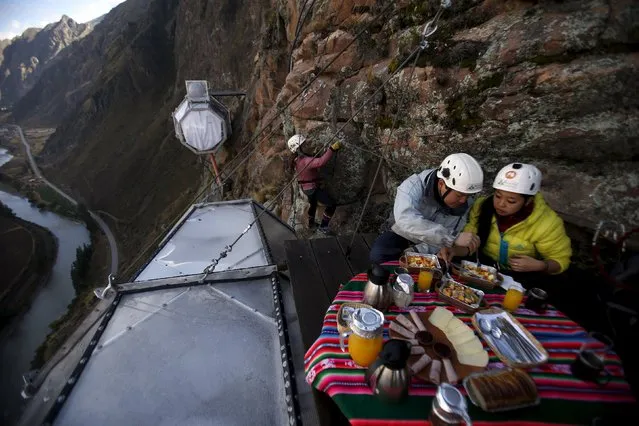
Guests have breakfast as another guest climbs to gather at the Skylodge Adventure Suites in the Sacred Valley in Cuzco, Peru, August 14, 2015. Tourists taking on an arduous climb up the steep cliff face of Peru's Sacred Valley are being rewarded for their efforts by being able to spend the night in transparent mountaintop sleeping pods at the “Skylodge Adventure Suites”. (Photo by Pilar Olivares/Reuters)

Guests have breakfast as another guest climbs to gather at the Skylodge Adventure Suites in the Sacred Valley in Cuzco, Peru, August 14, 2015. Tourists taking on an arduous climb up the steep cliff face of Peru's Sacred Valley are being rewarded for their efforts by being able to spend the night in transparent mountaintop sleeping pods at the “Skylodge Adventure Suites”. To reach the pods, visitors need to climb 400 metres of via ferrata (a steel cable and rungs) up the valley side or hike an intrepid trail through zip lines. (Photo by Pilar Olivares/Reuters)
Details
19 Aug 2015 12:53:00
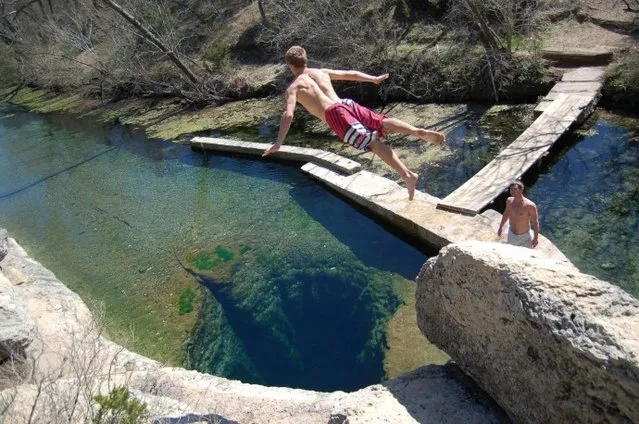
Dive The Deadly Jacob’s Well In Texas

Jacob's Well is a perennial karstic spring in the Texas Hill Country flowing from the bed of Cypress Creek, located northwest of Wimberley, Texas. The twelve foot (four meter) diameter mouth of the spring serves as a popular swimming spot for the local land owners whose properties adjoin Cypress Creek. From the opening in the creek bed, Jacob's Well cave descends vertically for about thirty feet (ten meters), then continues downward at an angle through a series of silted chambers separated by narrow restrictions, finally reaching a depth of one hundred and twenty feet (forty meters). Until the modern era, the Trinity Aquifer-fed natural artesian spring gushed water from the mouth of the cave, with a measured flow in 1924 of one hundred and seventy gallons per second (six hundred and forty liters per second) discharging six feet (two meters) into the air. The spring is the greatest source of water recharging the Edwards Aquifer.
Details
03 Jan 2014 08:20:00
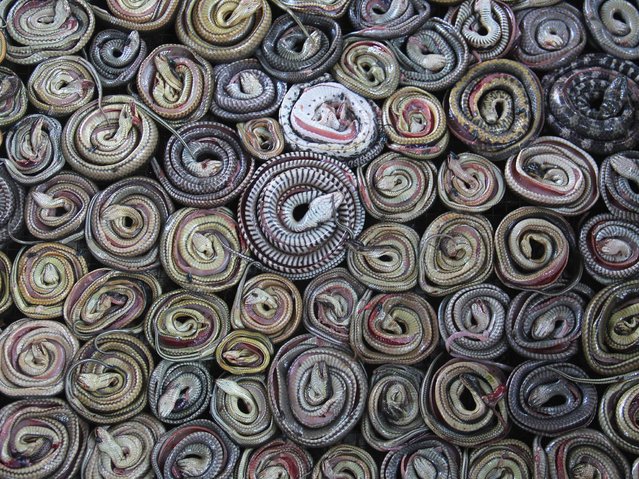
Snakes are collected and rolled before putting into the oven on March 2, 2014 in the village of Kertasura, Cirebon, Indonesia. (Photo by Nurcholis Anhari Lubis/Getty Images)

Snakes are collected and rolled before putting into the oven on March 2, 2014 in the village of Kertasura, Cirebon, Indonesia. At slaughter house snake skins measuring in the hundreds of metres, are sold to bag factories in the West and Central Java provinces on a monthly basis. From snake skin was manufactured into bags, shoes, wallets and belts. The price of a bag made from snake skin costs between 150,000 rupiah ($15 USD) and 300,000 rupiah ($30 USD), depending on its size. When snake skins reach Western fashion houses their price can increase dramatically and sell for up to $4,000 USD. (Photo by Nurcholis Anhari Lubis/Getty Images)
Details
05 Mar 2014 07:31:00