Loading...
Done
A daredevil photographer is determined to capture London in a whole new light – by scaling the city’s many rooftops. Jacob Riglin, from Richmond Upon Thames, photographs the nation's capital from above – hanging from scaffolding, dangling his legs over the edge of buildings and looking down from perilous heights. Such images have gained the photographer, 20, an incredible fan base on Instagram, which has seen his follower count rise to more than 150,000. (Photo by Jacob Riglin/Caters News)

A daredevil photographer is determined to capture London in a whole new light – by scaling the city’s many rooftops. Jacob Riglin, from Richmond Upon Thames, photographs the nation's capital from above – hanging from scaffolding, dangling his legs over the edge of buildings and looking down from perilous heights. Such images have gained the photographer, 20, an incredible fan base on Instagram, which has seen his follower count rise to more than 150,000. He said, “I had always been interested climbing and getting that adrenaline rush from feeling on top of the world”. Here: Jacob looking out to the London skyline. (Photo by Jacob Riglin/Caters News)
Details
17 Oct 2015 08:05:00
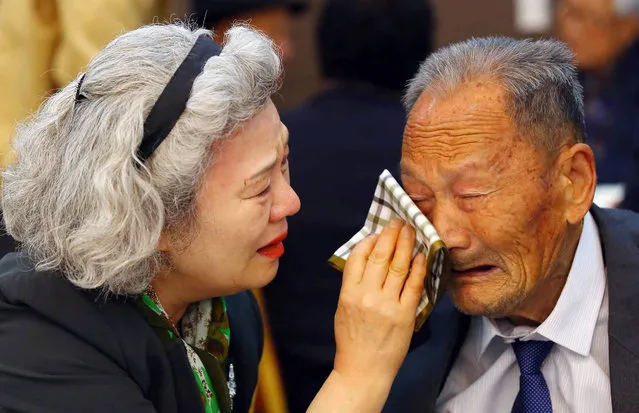
South Korean Lee Jung-sook (L), 68, wipes the tears from her North Korean father Lee Heung-jong, 88, as they bid each other a sad farewell at a resort on Mount Kumgang, North Korea, 22 October 2015. About 390 South Koreans arrived at the resort two days ago for the first face-to-face reunion of families separated by the 1950-53 Korean War in nearly 20 months. A second group of some 260 South Koreans will do the same for three days starting on 24 October. (Photo by Yonhap/EPA)

South Korean Lee Jung-sook (L), 68, wipes the tears from her North Korean father Lee Heung-jong, 88, as they bid each other a sad farewell at a resort on Mount Kumgang, North Korea, 22 October 2015. About 390 South Koreans arrived at the resort two days ago for the first face-to-face reunion of families separated by the 1950-53 Korean War in nearly 20 months. A second group of some 260 South Koreans will do the same for three days starting on 24 October. (Photo by Yonhap/EPA)
Details
24 Oct 2015 08:06:00
American science fiction writer L. Ron Hubbard, founder of the Church of Scientology, uses his Hubbard Electrometer

“Lafayette Ronald Hubbard (March 13, 1911 – January 24, 1986), better known as L. Ron Hubbard (and often referred to by his initials, LRH), was an American pulp fiction author and religious leader who founded the Church of Scientology. After establishing a career as a writer, becoming best known for his science fiction and fantasy stories, he developed a self-help system called Dianetics which was first published in May 1950. He subsequently developed his ideas into a wide-ranging set of doctrines and rituals as part of a new religious movement that he called Scientology. His writings became the guiding texts for the Church of Scientology and a number of affiliated organizations that address such diverse topics as business administration, literacy and drug rehabilitation”. – Wikipedia

Photo: American science fiction writer L. Ron Hubbard, founder of the Church of Scientology, uses his Hubbard Electrometer (patent pending) to determine whether tomatoes experience pain, 1959. His work led him to the conclusion that tomatoes “scream when sliced”. (Photo by Scott Lauder/Evening Standard/Hulton Archive/Getty Images)
Details
09 Sep 2011 09:34:00
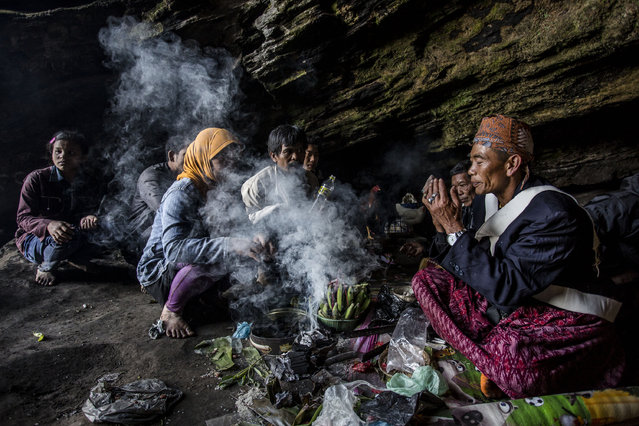
A Tenggerese shaman praying for worshippers at Widodaren cave during the Tenggerese Hindu Yadnya Kasada festival on July 31, 2015 in Probolinggo, East Java, Indonesia. The festival is the main festival of the Tenggerese people and lasts about a month. On the fourteenth day, the Tenggerese make the journey to Mount Bromo to make offerings of rice, fruits, vegetables, flowers and livestock to the mountain gods by throwing them into the volcano's caldera. (Photo by Ulet Ifansasti/Getty Images)

A Tenggerese shaman praying for worshippers at Widodaren cave during the Tenggerese Hindu Yadnya Kasada festival on July 31, 2015 in Probolinggo, East Java, Indonesia. The festival is the main festival of the Tenggerese people and lasts about a month. On the fourteenth day, the Tenggerese make the journey to Mount Bromo to make offerings of rice, fruits, vegetables, flowers and livestock to the mountain gods by throwing them into the volcano's caldera. The origin of the festival lies in the 15th century when a princess named Roro Anteng started the principality of Tengger with her husband Joko Seger, and the childless couple asked the mountain Gods for help in bearing children. The legend says the Gods granted them 24 children but on the provision that the 25th must be tossed into the volcano in sacrifice. The 25th child, Kesuma, was finally sacrificed in this way after initial refusal, and the tradition of throwing sacrifices into the caldera to appease the mountain Gods continues today. (Photo by Ulet Ifansasti/Getty Images)
Details
01 Aug 2015 12:07:00
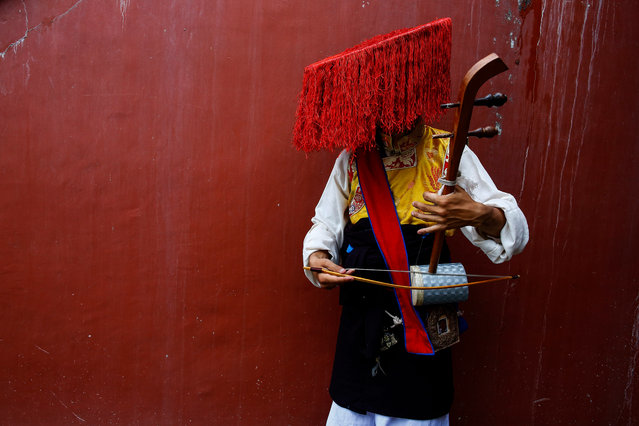
A Tibetan artists wearing a traditional costume waits before their performance during the 82nd pre-birthday celebration of Tibetan spiritual leader Dalai Lama at a Monastery in Kathmandu, Nepal, 05 July 2017. More than 1,000 monks and other Tibetans gathered at the Monastery compound to celebrate their spiritual leader's birthday. The Nepalese government has banned all kinds of Tibetan activities against the Chinese rule in Tibet so Tibetans have been changing the venue of the Dalai Lama's birthday celebration. The Dalai Lama will turn 82 on 06 July 2017. (Photo by Narendra Shrestha/EPA)

A Tibetan artists wearing a traditional costume waits before their performance during the 82nd pre-birthday celebration of Tibetan spiritual leader Dalai Lama at a Monastery in Kathmandu, Nepal, 05 July 2017. More than 1,000 monks and other Tibetans gathered at the Monastery compound to celebrate their spiritual leader's birthday. The Nepalese government has banned all kinds of Tibetan activities against the Chinese rule in Tibet so Tibetans have been changing the venue of the Dalai Lama's birthday celebration. The Dalai Lama will turn 82 on 06 July 2017. (Photo by Narendra Shrestha/EPA)
Details
10 Aug 2017 08:33:00
Under Exposed: Pekka Tuuri (Finland) – Great white shark, Isla Guadalupe, Mexico. Isla Guadalupe is the world capital when it comes to observing great white sharks, but cage diving seriously limits the possibilities to take ‘fresh’ pictures. When I took this, the water close to the surface was quite milky, making photography very challenging. From out of the ‘mist’, I saw this great white shark lurking behind a school of fusiliers. I quickly focused on the shark and set a wide aperture to get focus blur on the fish, along with a fast shutter to avoid excessive motion blur. (Photo by Pekka Tuuri/The Outdoor Photographer of the Year/The Guardian)

Under Exposed: Pekka Tuuri (Finland) – Great white shark, Isla Guadalupe, Mexico. “Isla Guadalupe is the world capital when it comes to observing great white sharks, but cage diving seriously limits the possibilities to take ‘fresh’ pictures. When I took this, the water close to the surface was quite milky, making photography very challenging. From out of the “mist”, I saw this great white shark lurking behind a school of fusiliers. I quickly focused on the shark and set a wide aperture to get focus blur on the fish, along with a fast shutter to avoid excessive motion blur”. (Photo by Pekka Tuuri/The Outdoor Photographer of the Year/The Guardian)
Details
25 Jan 2018 07:37:00
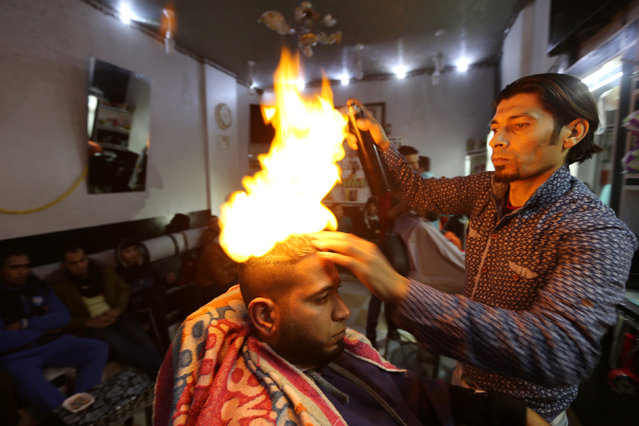
Palestinian barber Ramadan Odwan styles and straightens the hair of a customer with fire at his salon in Rafah, in the southern Gaza Strip February 2, 2017. In Ramadan Odwan's barbershop in Gaza, hair isn't just blow-dried, it's blowtorch-dried. “People have gone crazy about it, many people are curious to go through the experience and they are not afraid”, he told Reuters. “People here love adventures”. Odwan, 37, is not the first stylist in the world to use flame to straighten hair, but his craft is unique in the Gaza Strip. In his salon in the southern Gaza town of Rafah, Odwan applied what he described as a protective liquid coating to a customer's hair – he declined to disclose its contents – before aiming for the head and pressing the button on a small blowtorch. “I control how long I apply fire, I keep it on and off for 10 seconds or 15 seconds. It is completely safe and I have not encountered any accident since I started it two months ago”, Odwan added. Odwan charges 20 shekels ($5.20) for a haircut and fire-straightening. A barber for the past 18 years, he said part of the reason he uses the technique is to show that Palestinian barbers are as “professional as those out there around the world”. (Photo by Ibraheem Abu Mustafa/Reuters)

Palestinian barber Ramadan Odwan styles and straightens the hair of a customer with fire at his salon in Rafah, in the southern Gaza Strip February 2, 2017. In Ramadan Odwan's barbershop in Gaza, hair isn't just blow-dried, it's blowtorch-dried. “People have gone crazy about it, many people are curious to go through the experience and they are not afraid”, he told Reuters. “People here love adventures”. (Photo by Ibraheem Abu Mustafa/Reuters)
Details
11 Feb 2017 00:05:00
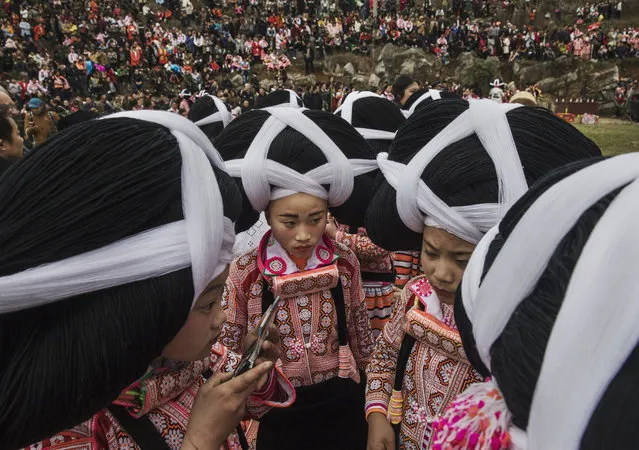
Girls of the Long Horn Miao ethnic minority group wear headdresses as they prepare gather for Tiaohua or Flower Festival as part of the Lunar New Year on February 6, 2017 in Longga village, Guizhou province, southern China. The Long Horn Miao are recognized for their declining practice of wrapping a blend of linen, wool, and the hair of their ancestors around animal horns or a wooden clip to make headdresses. Many young women say they now wear the headdresses only for special occasions and festivals, as the ornaments, which are attached by the horns to their real hair, have proved impractical for modern daily life in a fast changing world. China officially recognizes 56 different ethnic minorities, and statistics show over 7 million Chinese identifying themselves as Miao. But the small Long Horn Miao community counts only around 5000 people living in 12 villages, whose age-old traditions, language, and culture are fading. It is increasingly difficult in a modernizing China, as young people are drawn from remote rural villages to opportunities in bigger cities amongst wide-scale urbanization. Farming and labour remain the mainstays of life for the Long Horn Miao, leaving the area relatively poor in comparison with many parts of China. The government has invested significant amounts into local infrastructure and the tourism industry to try to bolster the local economy. (Photo by Kevin Frayer/Getty Images)

Girls of the Long Horn Miao ethnic minority group wear headdresses as they prepare gather for Tiaohua or Flower Festival as part of the Lunar New Year on February 6, 2017 in Longga village, Guizhou province, southern China. (Photo by Kevin Frayer/Getty Images)
Details
13 Feb 2017 00:01:00