Loading...
Done
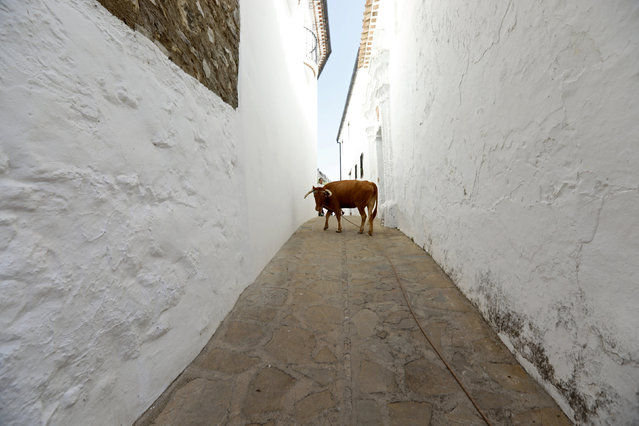
A heifer, tied with a rope, turns during “Toro de Cuerda” in the white village of Villaluenga del Rosario, southern Spain September 3, 2016. Dazzling clusters of cube-shaped houses perched on top of Andalusia's olive tree-studded mountains, the “Pueblos Blancos”, or white villages, of southern Spain are named for the lime wash the buildings are painted with to keep the interiors cool. The labyrinths of narrow alleyways are a throwback to when this region was known as Al-Andalus and was part of a medieval Muslim territory. While this region is stunningly beautiful and a big draw to tourists visiting the south of Spain, it is also one of the poorest areas in the country and has one of the highest unemployment rates in the European Union. (Photo by Marcelo del Pozo/Reuters)

A heifer, tied with a rope, turns during “Toro de Cuerda” in the white village of Villaluenga del Rosario, southern Spain September 3, 2016. Dazzling clusters of cube-shaped houses perched on top of Andalusia's olive tree-studded mountains, the “Pueblos Blancos”, or white villages, of southern Spain are named for the lime wash the buildings are painted with to keep the interiors cool. The labyrinths of narrow alleyways are a throwback to when this region was known as Al-Andalus and was part of a medieval Muslim territory. While this region is stunningly beautiful and a big draw to tourists visiting the south of Spain, it is also one of the poorest areas in the country and has one of the highest unemployment rates in the European Union. (Photo by Marcelo del Pozo/Reuters)
Details
20 Oct 2016 11:09:00
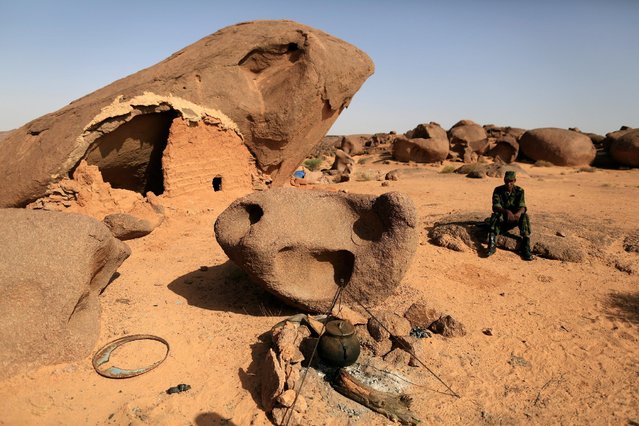
A Polisario fighter sits on a rock at a forward base on the outskirts of Tifariti, Western Sahara, September 9, 2016. At a rocky outpost in Western Sahara, a new generation of soldiers who have never known war are mobilising as tensions resurface in one of Africa's oldest disputes after a quarter century of uneasy peace. Young Sahrawi troops man new desert posts for the Polisario Front, which for more than 40 years has sought independence for the vast desert region - first in a guerrilla war against Morocco and then politically since a ceasefire deal in 1991. Now a standoff with Morocco, which controls the majority of Western Sahara, is renewing pressure for a diplomatic solution to ensure foot soldiers don't return to fighting as the last generation of commanders once did. The standoff since August has brought Moroccan and Polisario forces within 200 metres of each other in a narrow strip of land near the Mauritanian border. Rich in phosphate, Western Sahara has been contested since 1975 when Spanish colonial powers left. Morocco claimed the territory and fought the 16-year war with Polisario. (Photo by Zohra Bensemra/Reuters)

A Polisario fighter sits on a rock at a forward base on the outskirts of Tifariti, Western Sahara, September 9, 2016. At a rocky outpost in Western Sahara, a new generation of soldiers who have never known war are mobilising as tensions resurface in one of Africa's oldest disputes after a quarter century of uneasy peace. (Photo by Zohra Bensemra/Reuters)
Details
04 Nov 2016 12:09:00
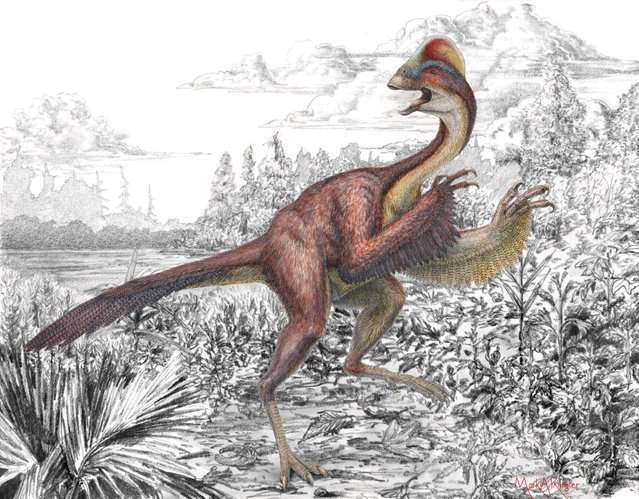
Life reconstruction of the new oviraptorosaurian dinosaur species Anzu wyliei in its 66 million-year-old environment in western North America as seen in an undated handout illustration by Mark A. Klinger, Carnegie Museum of Natural History. Some 18,000 species, great and small, were discovered in 2014, adding to the 2 million already known, scientists said on May 21, 2015 as they released a “Top 10” list that highlights the diversity of life. (Photo by Mark A. Klingler/Reuters/Carnegie Museum of Natural History)

Life reconstruction of the new oviraptorosaurian dinosaur species Anzu wyliei in its 66 million-year-old environment in western North America as seen in an undated handout illustration by Mark A. Klinger, Carnegie Museum of Natural History. Some 18,000 species, great and small, were discovered in 2014, adding to the 2 million already known, scientists said on May 21, 2015 as they released a “Top 10” list that highlights the diversity of life. Anzu wyliei, one of the top 10, dubbed “the chicken from hell”, is extinct. The feathered dinosaur whose partial skeletons were unearthed in the Dakotas was a contemporary of T. rex and Triceratops. (Photo by Mark A. Klingler/Reuters/Carnegie Museum of Natural History)
Details
22 May 2015 12:31:00
A member of the Fuerza Civil (Civil Force) police unit takes part in a simulated crime situation during a media presentation to show the police model that the federal government wants for the rest of the country, at the police academy in Monterrey December 17, 2014. Fuerza Civil, a tactical team of the police unit trained by the army, was created by the Nuevo Leon government in 2011 to curb down corruption and infiltration by drug gangs in the police corps, local media reported. (Photo by Daniel Becerril/Reuters)

A member of the Fuerza Civil (Civil Force) police unit takes part in a simulated crime situation during a media presentation to show the police model that the federal government wants for the rest of the country, at the police academy in Monterrey December 17, 2014. Fuerza Civil, a tactical team of the police unit trained by the army, was created by the Nuevo Leon government in 2011 to curb down corruption and infiltration by drug gangs in the police corps, local media reported. Promising a new law to stop the infiltration of local governments by organized crime, President Enrique Pena Nieto pledged to reform the penal system and send an proposal to Congress to unify multi-layered police forces in Mexico's 31 states. (Photo by Daniel Becerril/Reuters)
Details
19 Dec 2014 12:35:00
The unromantic gypsies. Children boxing in a gypsy camp in Kent, England on July 1, 1951. Like all boys these gypsy lads like to try their hand at boxing. Encouraged by their friends they fight it out on Corke's Meadow. Few Romanies now live a life of wandering romance. Most are like the three hundred squatters of Corke's Meadow, Kent, which is part of a “gypsy problem” that involves about 100,000 today. Of those about 25,000 can be rightly called gypsies, the rest are Mumpers and Posh-rats and Hobos. Corke's Meadow has both kinds. “Picture Post” cameraman Bert Hardy photographs the Corke's Meadow gypsies in their encampment. (Photo by Hulton-Deutsch Collection/Corbis via Getty Images)

The unromantic gypsies. Children boxing in a gypsy camp in Kent, England on July 1, 1951. Like all boys these gypsy lads like to try their hand at boxing. Encouraged by their friends they fight it out on Corke's Meadow. Few Romanies now live a life of wandering romance. Most are like the three hundred squatters of Corke's Meadow, Kent, which is part of a “gypsy problem” that involves about 100,000 today. Of those about 25,000 can be rightly called gypsies, the rest are Mumpers and Posh-rats and Hobos. Corke's Meadow has both kinds. “Picture Post” cameraman Bert Hardy photographs the Corke's Meadow gypsies in their encampment. (Photo by Hulton-Deutsch Collection/Corbis via Getty Images)
Details
12 Mar 2017 00:01:00
Festival goer with phallus logo t-shirt during the Kanamara Matsuri Steel Phallus Festival at Kawasaki, Japan on April 2, 2017. The Kanamara Matsuri or Festival of the Steel Phallus is held on the first Sunday of April at the Kanayama shrine. The shrine celebrates a legend of a steel pen*s and was frequented by prostitutes who wished to pray for protection from sexually transmitted diseases. Visitors now wish for easy delivery, marriage and matrimonial harmony. Because of the large steel phallus the unusual festival has become a tourist attraction attracting many overseas visitors and is used to raise money for HIV charities. Phallus shaped candy, carved vegetables, decorations, and a big parade are all part of the festival. (Photo by DELETREE/SIPA Press/Rex Features/Shutterstock)

Festival goer with phallus logo t-shirt during the Kanamara Matsuri Steel Phallus Festival at Kawasaki, Japan on April 2, 2017. The Kanamara Matsuri or Festival of the Steel Phallus is held on the first Sunday of April at the Kanayama shrine. The shrine celebrates a legend of a steel pen*s and was frequented by prostitutes who wished to pray for protection from sexually transmitted diseases. Visitors now wish for easy delivery, marriage and matrimonial harmony. Because of the large steel phallus the unusual festival has become a tourist attraction attracting many overseas visitors and is used to raise money for HIV charities. Phallus shaped candy, carved vegetables, decorations, and a big parade are all part of the festival. (Photo by DELETREE/SIPA Press/Rex Features/Shutterstock)
Details
04 Apr 2017 09:48:00
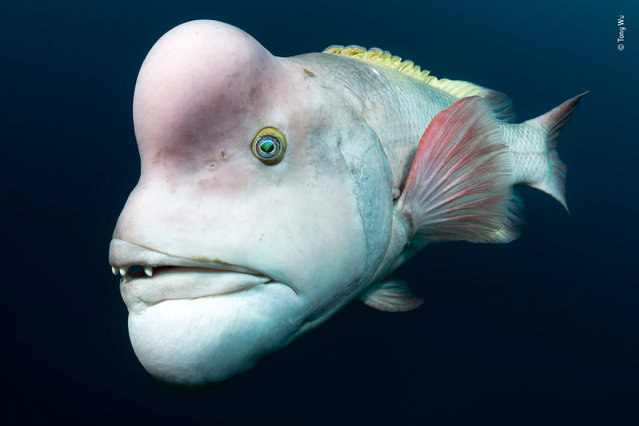
Looking for love by Tony Wu, USA. Highly commended, Animal Portraits. “Accentuating his mature appearance with pastel colours, protruding lips and an outstanding pink forehead, this Asian sheepshead wrasse sets out to impress females and see off rivals, which he will head-butt and bite, near Japan’s remote Sado Island. Individuals start out as females, and when they reach a certain age and size – up to a metre (more than 3 feet) long – can transform into males. Long-lived and slow-growing, the species is intrinsically vulnerable to overfishing”. (Photo by Tony Wu/2018 Wildlife Photographer of the Year)

Looking for love by Tony Wu, USA. Highly commended, Animal Portraits. “Accentuating his mature appearance with pastel colours, protruding lips and an outstanding pink forehead, this Asian sheepshead wrasse sets out to impress females and see off rivals, which he will head-butt and bite, near Japan’s remote Sado Island. Individuals start out as females, and when they reach a certain age and size – up to a metre (more than 3 feet) long – can transform into males. Long-lived and slow-growing, the species is intrinsically vulnerable to overfishing”. (Photo by Tony Wu/2018 Wildlife Photographer of the Year)
Details
03 Sep 2018 08:17:00
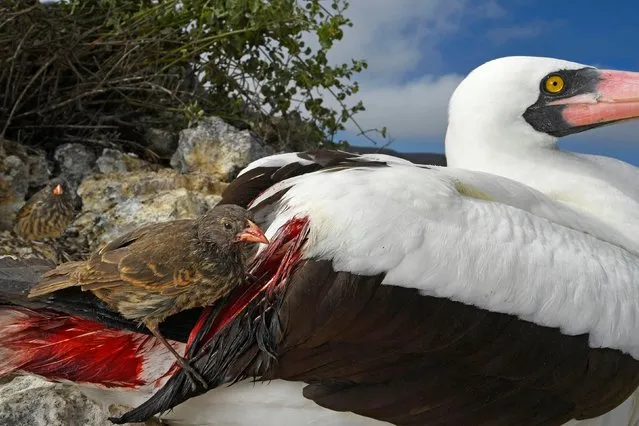
Bloodthirsty by Thomas P Peschak, Germany/South Africa — winner, Behaviour: birds. When rations run short on Wolf Island, in the remote northern Galápagos, the sharp-beaked ground finches become vampires. Their sitting targets are Nazca boobies and other large birds. The finches rely on a scant diet of seeds and insects, which regularly dries up, so they drink blood to survive. ‘I’ve seen more than half a dozen finches drinking from a single Nazca booby,’ says Tom. Rather than leave their nests the boobies tolerate the vampires, and the blood loss doesn’t seem to cause permanent harm. (Photo by Thomas P Peschak/2018 Wildlife Photographer of the Year)

Bloodthirsty by Thomas P. Peschak, Germany/South Africa — winner, Behaviour: birds. When rations run short on Wolf Island, in the remote northern Galápagos, the sharp-beaked ground finches become vampires. Their sitting targets are Nazca boobies and other large birds. The finches rely on a scant diet of seeds and insects, which regularly dries up, so they drink blood to survive. ‘I’ve seen more than half a dozen finches drinking from a single Nazca booby,’ says Tom. Rather than leave their nests the boobies tolerate the vampires, and the blood loss doesn’t seem to cause permanent harm. (Photo by Thomas P. Peschak/2018 Wildlife Photographer of the Year)
Details
19 Oct 2018 00:05:00