Loading...
Done
“Alice in Waterland” by Photographer Elena Kalis

“Alice in Waterland” is a beautiful series of photographs re-imagining the Lewis Carroll classic underwater. It’s a creation of photographer Elena Kalis, who lives on a small island in The Bahamas, surrounded, she says, “by pristine clear warm water. Underwater is where I spend a lot of time; snorkeling, diving, photographing. It is fascinating how the world changes down below: light, sound, gravity and proportions are different from what we are used to”. (Photo by Elena Kalis)
Details
02 Aug 2013 10:31:00
A Hawaiian photographer braved freezing temperatures for this cold SNAP – of what appears to be a firebird bursting from an aurora. (Photo by CJ Kale/Caters News)

“A Hawaiian photographer braved freezing temperatures for this cold SNAP – of what appears to be a firebird bursting from an aurora. Keen snapper CJ Kale, more used to sun, sea and sand while at work than snow, captured the incredible moment while on a trip to Alaska. It was his first time seeing the spectacular sight and lucked out – capturing some of the rarest colors of aurora on his first night”. – Caters News
Details
12 Aug 2014 12:15:00
Sikorsky H-5 helicopters

“Igor Sikorsky (May 25, 1889 – October 26, 1972), born Igor Ivanovich Sikorsky was a Russian American pioneer of aviation in both helicopters and fixed-wing aircraft. He designed and flew the world's first multi-engine fixed-wing aircraft, the Russky Vityaz in 1913, and the first airliner, Ilya Muromets, in 1914. After immigrating to the United States in 1919, Sikorsky founded the Sikorsky Aircraft Corporation in 1923, and developed the first of Pan American Airways' ocean-conquering flying boats in the 1930s. In 1939 Sikorsky designed and flew the Vought-Sikorsky VS-300, the first viable American helicopter, which pioneered the rotor configuration used by most helicopters today. Sikorsky would modify the design into the Sikorsky R-4, which became the world's first mass-produced helicopter in 1942”. – Wikipedia

Photo: Westland Sikorsky H-5's, used by British European Airways Helicopters, which fly between London and Birmingham. The Sikorsky H-5, (aka R-5, S-51, HO3S-1, or Horse) (R-5 until 1948; company designation VS-327) is a helicopter built by Sikorsky Aircraft Corporation, formerly used by the United States Air Force, and its predecessor, the United States Army Air Forces, as well as the United States Navy and United States Coast Guard (with the designations HO2S and HO3S). (Photo by Harrison /Topical Press Agency/Getty Images). 22nd May 1951

Details
06 Sep 2011 10:18:00
The unromantic gypsies. Children boxing in a gypsy camp in Kent, England on July 1, 1951. Like all boys these gypsy lads like to try their hand at boxing. Encouraged by their friends they fight it out on Corke's Meadow. Few Romanies now live a life of wandering romance. Most are like the three hundred squatters of Corke's Meadow, Kent, which is part of a “gypsy problem” that involves about 100,000 today. Of those about 25,000 can be rightly called gypsies, the rest are Mumpers and Posh-rats and Hobos. Corke's Meadow has both kinds. “Picture Post” cameraman Bert Hardy photographs the Corke's Meadow gypsies in their encampment. (Photo by Hulton-Deutsch Collection/Corbis via Getty Images)

The unromantic gypsies. Children boxing in a gypsy camp in Kent, England on July 1, 1951. Like all boys these gypsy lads like to try their hand at boxing. Encouraged by their friends they fight it out on Corke's Meadow. Few Romanies now live a life of wandering romance. Most are like the three hundred squatters of Corke's Meadow, Kent, which is part of a “gypsy problem” that involves about 100,000 today. Of those about 25,000 can be rightly called gypsies, the rest are Mumpers and Posh-rats and Hobos. Corke's Meadow has both kinds. “Picture Post” cameraman Bert Hardy photographs the Corke's Meadow gypsies in their encampment. (Photo by Hulton-Deutsch Collection/Corbis via Getty Images)
Details
12 Mar 2017 00:01:00
Festival goer with phallus logo t-shirt during the Kanamara Matsuri Steel Phallus Festival at Kawasaki, Japan on April 2, 2017. The Kanamara Matsuri or Festival of the Steel Phallus is held on the first Sunday of April at the Kanayama shrine. The shrine celebrates a legend of a steel pen*s and was frequented by prostitutes who wished to pray for protection from sexually transmitted diseases. Visitors now wish for easy delivery, marriage and matrimonial harmony. Because of the large steel phallus the unusual festival has become a tourist attraction attracting many overseas visitors and is used to raise money for HIV charities. Phallus shaped candy, carved vegetables, decorations, and a big parade are all part of the festival. (Photo by DELETREE/SIPA Press/Rex Features/Shutterstock)

Festival goer with phallus logo t-shirt during the Kanamara Matsuri Steel Phallus Festival at Kawasaki, Japan on April 2, 2017. The Kanamara Matsuri or Festival of the Steel Phallus is held on the first Sunday of April at the Kanayama shrine. The shrine celebrates a legend of a steel pen*s and was frequented by prostitutes who wished to pray for protection from sexually transmitted diseases. Visitors now wish for easy delivery, marriage and matrimonial harmony. Because of the large steel phallus the unusual festival has become a tourist attraction attracting many overseas visitors and is used to raise money for HIV charities. Phallus shaped candy, carved vegetables, decorations, and a big parade are all part of the festival. (Photo by DELETREE/SIPA Press/Rex Features/Shutterstock)
Details
04 Apr 2017 09:48:00
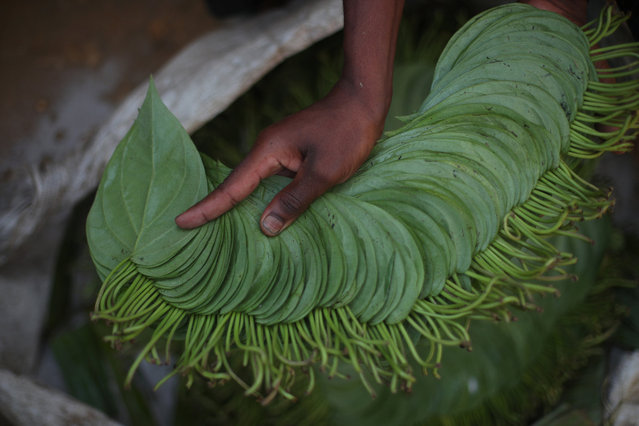
Faruk, 17, a Rohingya refugee trader holds betel leaves which are on sale at a stall in Palong Khali refugee camp near Cox's Bazar, Bangladesh, November 3, 2017. He left his village in Myanmar when the military opened fire towards the Rohingya. “I buy this betel leaf from Palong Khali market, in one bundle there are 160 pieces, I buy it for 80 taka and I sell it for 100 taka. Bangladeshi's and I sell for the same rate in the camp. Outside in the local market it is 80 taka per bundle. My problem is that I don't have money so I can't buy anything to eat, I can't buy fish to eat”, he said. (Photo by Hannah McKay/Reuters)

Faruk, 17, a Rohingya refugee trader holds betel leaves which are on sale at a stall in Palong Khali refugee camp near Cox's Bazar, Bangladesh, November 3, 2017. He left his village in Myanmar when the military opened fire towards the Rohingya. “I buy this betel leaf from Palong Khali market, in one bundle there are 160 pieces, I buy it for 80 taka and I sell it for 100 taka (1 Bangladeshi Taka = 0.012 US Dollar). Bangladeshi's and I sell for the same rate in the camp. Outside in the local market it is 80 taka per bundle. My problem is that I don't have money so I can't buy anything to eat, I can't buy fish to eat”, he said. (Photo by Hannah McKay/Reuters)
Details
27 Nov 2017 08:54:00
A young girl plays on the glass bottom platform of the Oriental Pear TV Tower as she travels with her family on the second day of the Chinese Lunar New Year holiday, also known as Spring Festival, in Shanghai, China on February 18, 2018. Some 287 million tourists travelled in China during the first four days of the week-long Chinese Lunar New Year holiday, up 11.1 percent from the same period last year, new data showed Sunday (18 February 2018). Tourism revenue rose 11.6 percent to 352.7 billion yuan (55.61 billion U.S. dollars) in the four days, the China National Tourism Administration (CNTA) said. On Sunday alone, some 73 million tourist trips were made across the country, up 15.3 percent, while tourism revenue rose 16.6 percent to 94.4 billion yuan. (Photo by Imaginechina/Rex Features/Shutterstock)

A young girl plays on the glass bottom platform of the Oriental Pear TV Tower as she travels with her family on the second day of the Chinese Lunar New Year holiday, also known as Spring Festival, in Shanghai, China on February 18, 2018. Some 287 million tourists travelled in China during the first four days of the week-long Chinese Lunar New Year holiday, up 11.1 percent from the same period last year, new data showed Sunday. (Photo by Imaginechina/Rex Features/Shutterstock)
Details
21 Feb 2018 00:03:00
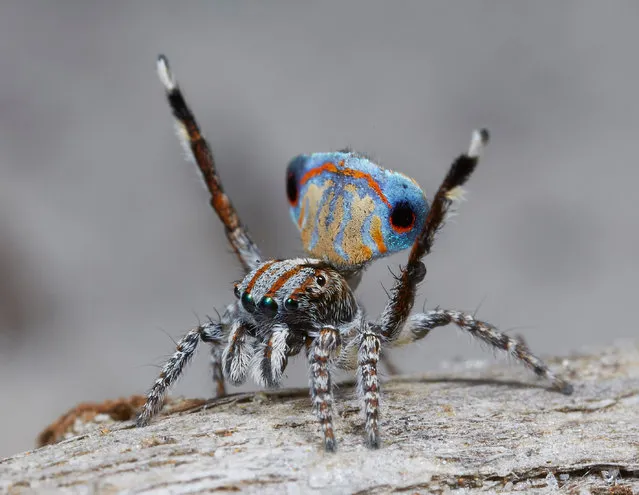
Several new species of peacock spider – just a few millimetres long and featuring extraordinary colours – have been discovered in Western Australia and South Australia. Jürgen Otto, a biologist from Sydney, has been researching the arachnids since 2005, and has gained a significant following online with his footage. He believes there are now 48 confirmed species of peacock spider within the Maratus genus, found across Australia but particularly in Western Australia – and many more awaiting confirmation. Here: Maratus Tasmanicus, one of seven new species of peacock spiders studied by the Sydney biologist Jürgen Otto. (Photo by Jürgen Otto)

Several new species of peacock spider – just a few millimetres long and featuring extraordinary colours – have been discovered in Western Australia and South Australia. Jürgen Otto, a biologist from Sydney, has been researching the arachnids since 2005, and has gained a significant following online with his footage. He believes there are now 48 confirmed species of peacock spider within the Maratus genus, found across Australia but particularly in Western Australia – and many more awaiting confirmation. Here: Maratus Tasmanicus, one of seven new species of peacock spiders studied by the Sydney biologist Jürgen Otto. (Photo by Jürgen Otto)
Details
30 May 2016 08:40:00