Loading...
Done
Carriers of the Great God Power brotherhood unload Virgen del Carmen statue after its journey on July 15, 2014 at Puerto de la Cruz dock on the Canary island of Tenerife, Spain. Since 1921, the statue of the Virgen del Carmen, patron saint of fishermen, has been carried with great fanfare annually as part of July Festivities to the Puerto de la Cruz dock where, at the end of its procession, it is hoisted aboard a decorated boat. (Photo by Gonzalo Arroyo Moreno/Getty Images)

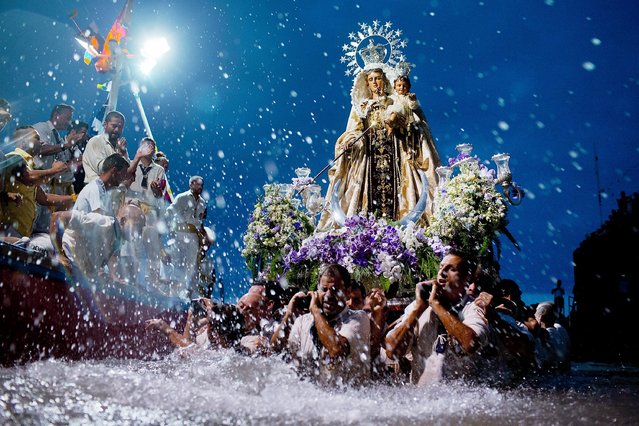
Carriers of the Great God Power brotherhood unload Virgen del Carmen statue after its journey on July 15, 2014 at Puerto de la Cruz dock on the Canary island of Tenerife, Spain. Since 1921, the statue of the Virgen del Carmen, patron saint of fishermen, has been carried with great fanfare annually as part of July Festivities to the Puerto de la Cruz dock where, at the end of its procession, it is hoisted aboard a decorated boat. Weather permitting, the boat carrying the statue, accompanied by a flotilla of other boats, makes a short journey along the island coast before returning to the harbour. In recent years, attendance at the event has numbered more than 35,000 people. (Photo by Gonzalo Arroyo Moreno/Getty Images)
Details
21 Jul 2014 11:18:00
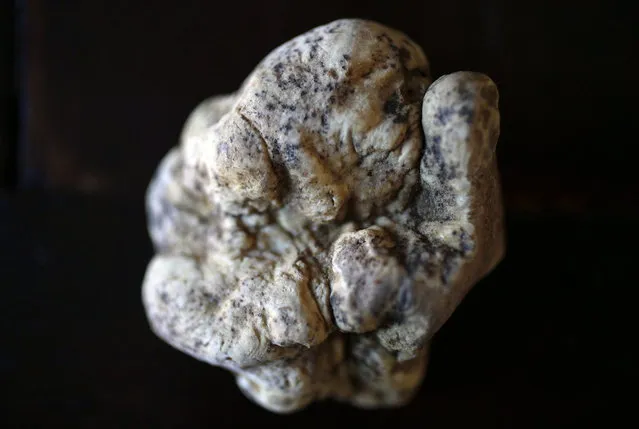
A truffle is seen on a table in Alba, north-western Italy November 11, 2013. Located in the heart of the Langhe – the hilly southern area of Italy's northwestern Piedmont region – Alba is the country's capital of white truffles, a variety of the prized fungus which grows underground. Truffles are found two to eight inches (5-20cm) below the ground near the roots of trees. (Photo by Stefano Rellandini/Reuters)

A truffle is seen on a table in Alba, north-western Italy November 11, 2013. Located in the heart of the Langhe – the hilly southern area of Italy's northwestern Piedmont region – Alba is the country's capital of white truffles, a variety of the prized fungus which grows underground. Truffles are found two to eight inches (5-20cm) below the ground near the roots of trees. They give off an odour which lasts for a limited period of time and can be detected with the assistance of well-trained dogs and experienced hunters. Output of white truffles, which are not cultivated and only grow naturally in forests, has fallen in Italy over the past few years, largely because climate change has brought a damaging mix of drought and torrential rains. (Photo by Stefano Rellandini/Reuters)
Details
31 Dec 2013 11:22:00
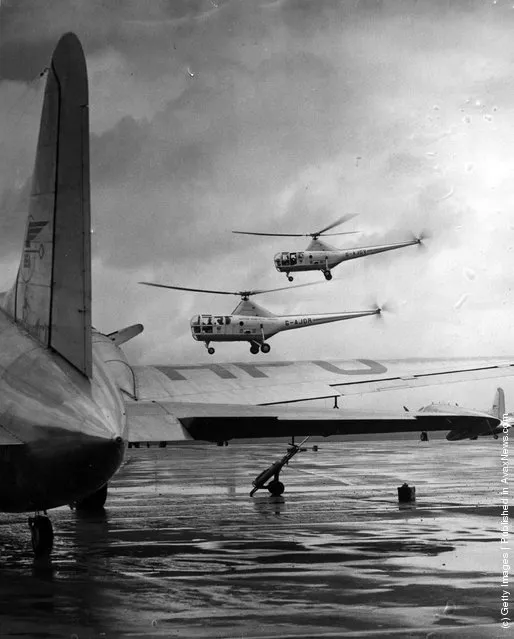
Sikorsky H-5 helicopters

“Igor Sikorsky (May 25, 1889 – October 26, 1972), born Igor Ivanovich Sikorsky was a Russian American pioneer of aviation in both helicopters and fixed-wing aircraft. He designed and flew the world's first multi-engine fixed-wing aircraft, the Russky Vityaz in 1913, and the first airliner, Ilya Muromets, in 1914. After immigrating to the United States in 1919, Sikorsky founded the Sikorsky Aircraft Corporation in 1923, and developed the first of Pan American Airways' ocean-conquering flying boats in the 1930s. In 1939 Sikorsky designed and flew the Vought-Sikorsky VS-300, the first viable American helicopter, which pioneered the rotor configuration used by most helicopters today. Sikorsky would modify the design into the Sikorsky R-4, which became the world's first mass-produced helicopter in 1942”. – Wikipedia

Photo: Westland Sikorsky H-5's, used by British European Airways Helicopters, which fly between London and Birmingham. The Sikorsky H-5, (aka R-5, S-51, HO3S-1, or Horse) (R-5 until 1948; company designation VS-327) is a helicopter built by Sikorsky Aircraft Corporation, formerly used by the United States Air Force, and its predecessor, the United States Army Air Forces, as well as the United States Navy and United States Coast Guard (with the designations HO2S and HO3S). (Photo by Harrison /Topical Press Agency/Getty Images). 22nd May 1951
Details
06 Sep 2011 10:18:00

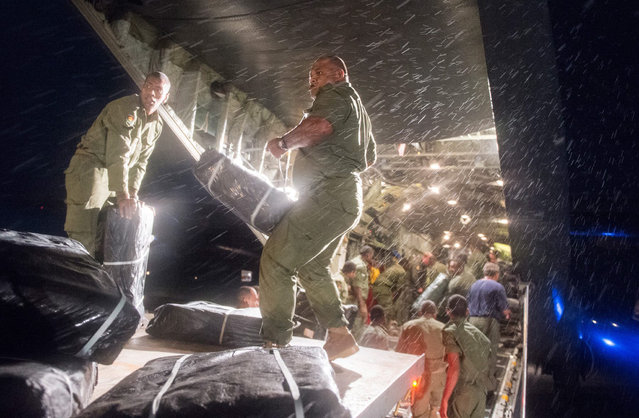
A handout image provided by the New Zealand Defence Force shows aid supplies being unloaded by Fijian soldiers from an Royal New Zealand Airforce C-130 Hercules plane in Suva, Fiji, 23 February 2016. Tool kits, generators, ration packs, water containers and chainsaws make up part of the New Zealand relief following Tropical Cyclone Winston. The death toll from the cyclone that hit Fiji over the weekend climbed to 29, local media reported ON 23 February. (Photo by Sam Shepherd/EPA/NZ Defence Force)

A handout image provided by the New Zealand Defence Force shows aid supplies being unloaded by Fijian soldiers from an Royal New Zealand Airforce C-130 Hercules plane in Suva, Fiji, 23 February 2016. Tool kits, generators, ration packs, water containers and chainsaws make up part of the New Zealand relief following Tropical Cyclone Winston. The death toll from the cyclone that hit Fiji over the weekend climbed to 29, local media reported ON 23 February. Cyclone Winston, the most powerful storm in Fiji's history, battered the country's main island of Viti Levu and other smaller surrounding islands on Saturday, the Fiji Broadcasting Corporation reported. (Photo by Sam Shepherd/EPA/NZ Defence Force)
Details
24 Feb 2016 12:56:00
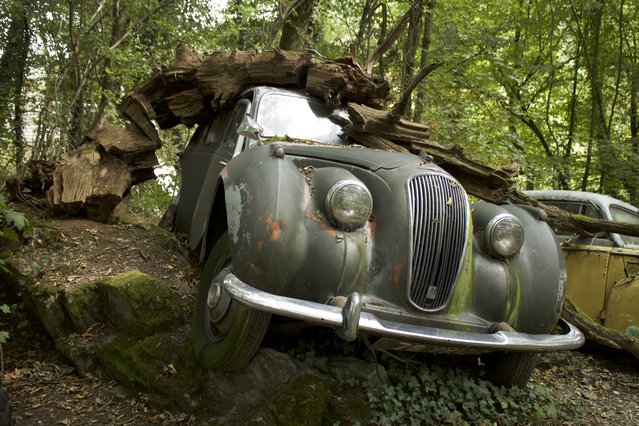
Michael Fröhlich's Jowett Javelin rotting car in his forest sculpture park in Neandertal Germany, September 11, 2016. An eccentric artist has collected fifty vintage cars and left them to rot in a forest – and now they're worth over $1 million. Former racing driver Michael Fröhlich, from Dusseldorf, Germany, has purposely crashed the cars into trees, buried them in mud and parked them on cliff faces in his estate's garden in the middle of the German Neanderthal. His collections includes a Jaguar XK120 worth $170,000, a Porsche 356 racer and a Buick worth $17,000. Perhaps his most interesting collectable is a Rolls Royce, with a purposefully misspelt “Buckingham Palace” – replacing the B with an F – emblazoned on the side with a replica of the Queen Elizabeth at the wheel. (Photo by Christoph Hagen/Barcroft Images)

Michael Fröhlich's Jowett Javelin rotting car in his forest sculpture park in Neandertal Germany, September 11, 2016. An eccentric artist has collected fifty vintage cars and left them to rot in a forest – and now they're worth over $1 million. Former racing driver Michael Fröhlich, from Dusseldorf, Germany, has purposely crashed the cars into trees, buried them in mud and parked them on cliff faces in his estate's garden in the middle of the German Neanderthal. His collections includes a Jaguar XK120 worth $170,000, a Porsche 356 racer and a Buick worth $17,000. (Photo by Christoph Hagen/Barcroft Images)
Details
24 Sep 2016 10:56:00
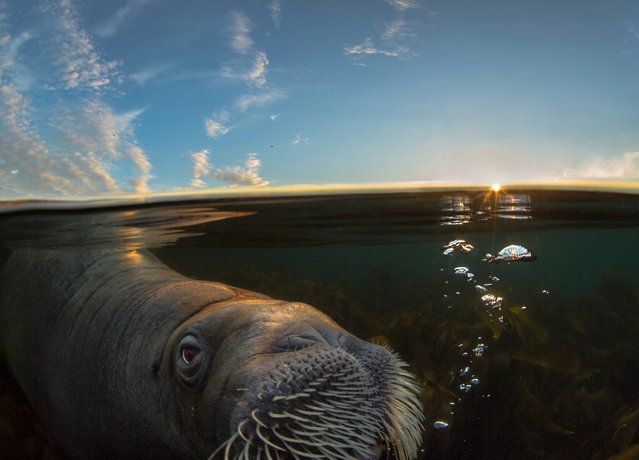
The Wildscreen festival is the world’s biggest celebration of screen-based natural history storytelling which takes place every two years in Bristol. Here: “Walrus in Midnight Sun”. Walrus feed mostly on bivalves in productive, shallow and often sandy habitats in the Arctic. This individual, though, arrived on a beach outside Tromsø, northern Norway, and found comfort on a stranded dead sperm whale. After two weeks he approached Audun, and only half a metre away he stretched his tusk forward and touched his hand gently. “This was one of the most memorable moments of my life”, Rikardsen says. He named the 500kg male Buddy. After two months, the dead whale was decomposed and Buddy suddenly disappeared. (Photo by Audun Rikardsen/Wildscreen 2016)

The Wildscreen festival is the world’s biggest celebration of screen-based natural history storytelling which takes place every two years in Bristol. Here: “Walrus in Midnight Sun”. Walrus feed mostly on bivalves in productive, shallow and often sandy habitats in the Arctic. This individual, though, arrived on a beach outside Tromsø, northern Norway, and found comfort on a stranded dead sperm whale. After two weeks he approached Audun, and only half a metre away he stretched his tusk forward and touched his hand gently. “This was one of the most memorable moments of my life”, Rikardsen says. He named the 500kg male Buddy. After two months, the dead whale was decomposed and Buddy suddenly disappeared. (Photo by Audun Rikardsen/Wildscreen 2016)
Details
07 Oct 2016 10:02:00
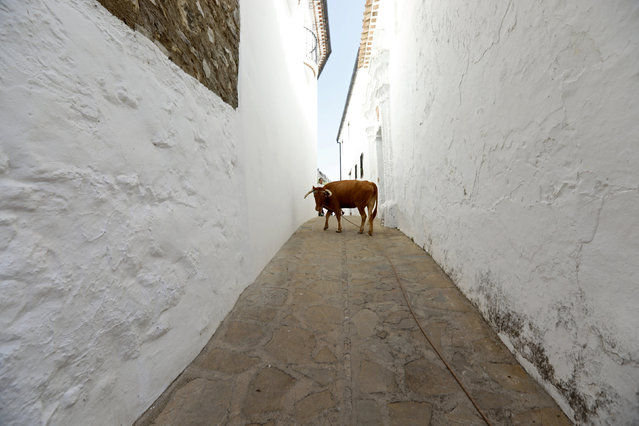
A heifer, tied with a rope, turns during “Toro de Cuerda” in the white village of Villaluenga del Rosario, southern Spain September 3, 2016. Dazzling clusters of cube-shaped houses perched on top of Andalusia's olive tree-studded mountains, the “Pueblos Blancos”, or white villages, of southern Spain are named for the lime wash the buildings are painted with to keep the interiors cool. The labyrinths of narrow alleyways are a throwback to when this region was known as Al-Andalus and was part of a medieval Muslim territory. While this region is stunningly beautiful and a big draw to tourists visiting the south of Spain, it is also one of the poorest areas in the country and has one of the highest unemployment rates in the European Union. (Photo by Marcelo del Pozo/Reuters)

A heifer, tied with a rope, turns during “Toro de Cuerda” in the white village of Villaluenga del Rosario, southern Spain September 3, 2016. Dazzling clusters of cube-shaped houses perched on top of Andalusia's olive tree-studded mountains, the “Pueblos Blancos”, or white villages, of southern Spain are named for the lime wash the buildings are painted with to keep the interiors cool. The labyrinths of narrow alleyways are a throwback to when this region was known as Al-Andalus and was part of a medieval Muslim territory. While this region is stunningly beautiful and a big draw to tourists visiting the south of Spain, it is also one of the poorest areas in the country and has one of the highest unemployment rates in the European Union. (Photo by Marcelo del Pozo/Reuters)
Details
20 Oct 2016 11:09:00
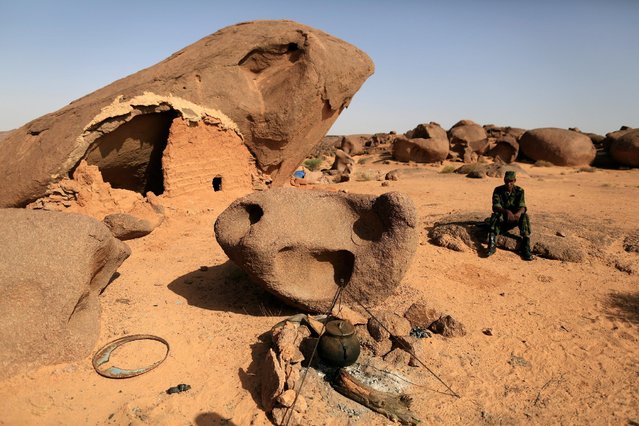
A Polisario fighter sits on a rock at a forward base on the outskirts of Tifariti, Western Sahara, September 9, 2016. At a rocky outpost in Western Sahara, a new generation of soldiers who have never known war are mobilising as tensions resurface in one of Africa's oldest disputes after a quarter century of uneasy peace. Young Sahrawi troops man new desert posts for the Polisario Front, which for more than 40 years has sought independence for the vast desert region - first in a guerrilla war against Morocco and then politically since a ceasefire deal in 1991. Now a standoff with Morocco, which controls the majority of Western Sahara, is renewing pressure for a diplomatic solution to ensure foot soldiers don't return to fighting as the last generation of commanders once did. The standoff since August has brought Moroccan and Polisario forces within 200 metres of each other in a narrow strip of land near the Mauritanian border. Rich in phosphate, Western Sahara has been contested since 1975 when Spanish colonial powers left. Morocco claimed the territory and fought the 16-year war with Polisario. (Photo by Zohra Bensemra/Reuters)

A Polisario fighter sits on a rock at a forward base on the outskirts of Tifariti, Western Sahara, September 9, 2016. At a rocky outpost in Western Sahara, a new generation of soldiers who have never known war are mobilising as tensions resurface in one of Africa's oldest disputes after a quarter century of uneasy peace. (Photo by Zohra Bensemra/Reuters)
Details
04 Nov 2016 12:09:00