Loading...
Done
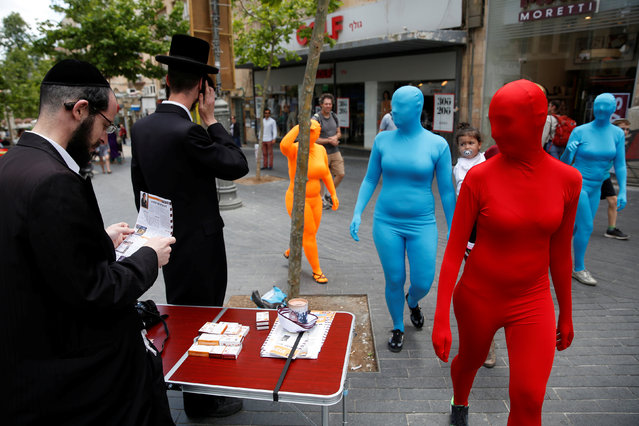
Members of the Prizma Ensemble wearing full solid-coloured bodysuits walk pest ultra orthodox jewish men as they take part in the 6th Jane's walk Jerusalem in Jerusalem Israel. May 6, 2016. (Photo by Baz Ratner/Reuters)

Members of the Prizma Ensemble wearing full solid-coloured bodysuits walk pest ultra orthodox jewish men as they take part in the 6th Jane's walk Jerusalem in Jerusalem, Israel May 6, 2016. Jane's Walk is a global walking tour movement, inspired by US-Canadian author and activist Jane Jacobs. (Photo by Baz Ratner/Reuters)
Details
07 May 2016 13:06:00
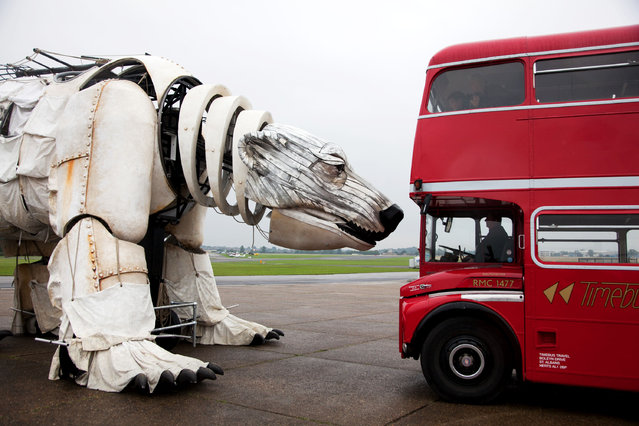
Giant Polar Bear Of London

Her name is Aurora, and she is the star of “Aurora's Parade”, the London chapter of ceride – Greenpeace’s global day of action to protest against Arctic destruction. According to DesignBoom, this giant people-powered super-puppet weighs about 3 tons and needs 15 puppeteers and 30 volunteers to operate. Aurora, described as “part protest, part performance”, has fur that includes the names of each supporter in the movement. Greenpeace hopes she will bring the voice and spirit of the Arctic to the public.
Details
13 Mar 2014 13:41:00


Two of the first six “neighborhood electric vehicles” (NEV) to be leased by the U.S. Army are on display during an introductory ceremony at Fort Myer January 12, 2009 in Arlington, Virginia. The Army has leased 800 of the non-tactical NEVs with a goal of 4,000 vehicles by 2011. These NEVs are manufactured by the Global Electric Motorcars division of Chrysler Corporation. With a full eight-hour charge, the NEVs can traverse 30 miles at a top speed of 25-miles-per-hour. (Photo by Chip Somodevilla/Getty Images)
Details
14 Apr 2011 09:37:00
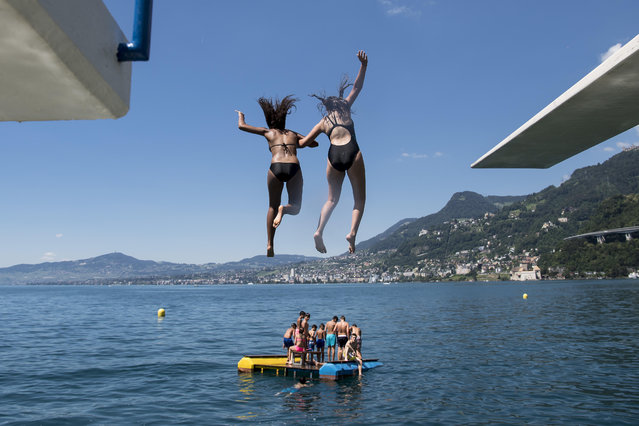
In this July 9, 2016 file photo, girls jump from a diving platform into the Geneva Lake and enjoy sunny and warm weather, in Villeneuve, Switzerland. After nearly 90 years, women can legally swim topless in Geneva’s lake and Rhone River without running the risk of a fine. Geneva’s regional council has voted to modify a 1929 ordinance that banned women from swimming topless in the city’s main natural waterways, though the change doesn’t apply to public swimming pools or swimming totally naked. Nicolas Bolle, an official with Geneva’s security department, on Thursday, April 6, 2017 confirmed the council’s action a day earlier. (Photo by Jean-Christophe Bott/Keystone via AP Photo)

In this July 9, 2016 file photo, girls jump from a diving platform into the Geneva Lake and enjoy sunny and warm weather, in Villeneuve, Switzerland. After nearly 90 years, women can legally swim topless in Geneva’s lake and Rhone River without running the risk of a fine. Geneva’s regional council has voted to modify a 1929 ordinance that banned women from swimming topless in the city’s main natural waterways, though the change doesn’t apply to public swimming pools or swimming totally naked. Nicolas Bolle, an official with Geneva’s security department, on Thursday, April 6, 2017 confirmed the council’s action a day earlier. (Photo by Jean-Christophe Bott/Keystone via AP Photo)
Details
08 Apr 2017 09:39:00
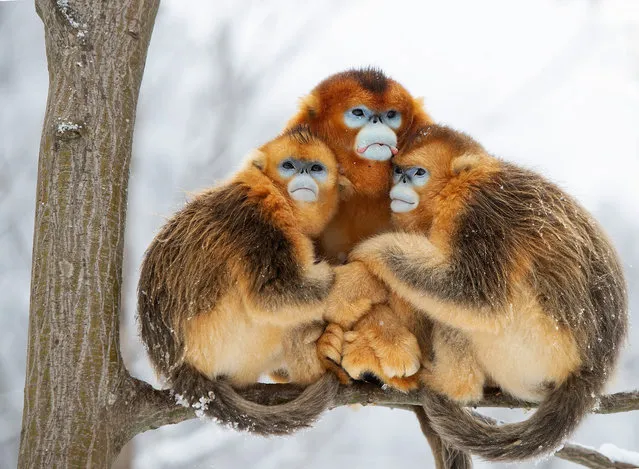
A golden huddle by Minqiang Lu, China. Two females and a male golden snub-nosed monkey huddle together to keep warm in the extreme cold. Threatened by forest loss and fragmentation, this endangered species is confined to central China. Restricted to living high up in the temperate forests, these monkeys – here in the Qinling mountains in Shaanxi province – feed mostly in the trees, on leaves, bark, buds and lichen. In heavy wind and snow, Minqiang walked up the mountain carrying his equipment. He stayed for half an hour in temperatures of –10C opposite the tree where the group was huddled before achieving this eye-level composition. (Photo by Minqiang Lu/Wildlife Photographer of the Year)

A golden huddle by Minqiang Lu, China. Two females and a male golden snub-nosed monkey huddle together to keep warm in the extreme cold. Threatened by forest loss and fragmentation, this endangered species is confined to central China. Restricted to living high up in the temperate forests, these monkeys – here in the Qinling mountains in Shaanxi province – feed mostly in the trees, on leaves, bark, buds and lichen. In heavy wind and snow, Minqiang walked up the mountain carrying his equipment. He stayed for half an hour in temperatures of –10C opposite the tree where the group was huddled before achieving this eye-level composition. (Photo by Minqiang Lu/Wildlife Photographer of the Year)
Details
12 Jan 2023 01:19:00
Moon jellyfish and cross jellies. (Photo by David Hall)

David Hall’s photographs of scenery and creatures off the coast of Canada in the Pacific Northwest portray serenity under the water, which belie the extreme challenges he faces to get his images. For each shoot, Hall wears a dry suit, a neoprene body suit that covers all of his body but his head and traps air inside to keep him warm. Water temperature in Canada’s British Columbia typically ranges between 45 and 50 degrees Fahrenheit. Photo: Moon jellyfish and cross jellies. (Photo by David Hall)
Details
16 Sep 2014 12:57:00
Assimilation By Dillon Marsh

Captured by South African photographer Dillon Marsh, these fantastic photographs depict the many designs employed by sociable weavers to build sturdy nests that are safe from intruders such as cobras and tree snakes. They are also nice cool during the day, and stay warm during cold desert nights. A University of Stellenbosch graduate, Marsh is currently interested in landscape photographer who seeks out anomalies that can be arranged in a photographic series. Assimilation depicts scores of intricate weaver’s nests atop utility poles in Southern Africa. Colonies of sociable weavers have been known to stay attached to one particular nest for up to 100 years, according to The San Diego Zoo.
Details
15 Feb 2014 14:47:00
New Zealand Penguins in Need of Sweaters

Penguin sweaters, also known as penguin jumpers, are sweaters which are knitted for penguins that have been caught in oil slicks. When an oil spill affects penguins, they are dressed in knitted sweaters to stop them preening their feathers and to keep them warm, since the spilled oil destroys their natural oils. This also prevents them from poisoning themselves by ingesting the oil. The sweaters are removed and discarded as soon as the penguins can be washed. The original project has been completed, but the knitting pattern is still available on-line, as subsequent oil spills make it necessary. The extra sweaters are kept on behalf of the Wildlife Rescue Team.
Details
31 Oct 2012 13:06:00