Loading...
Done
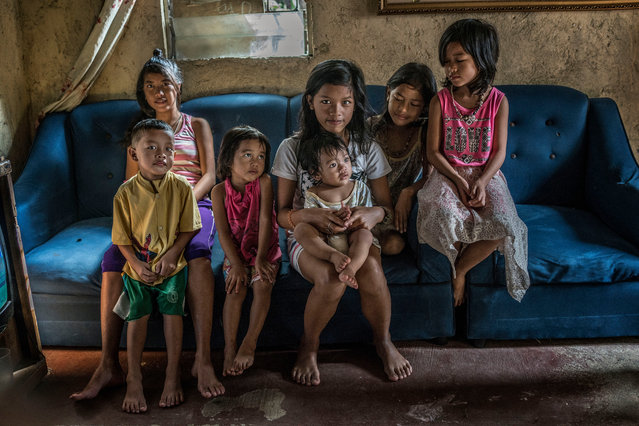
Constantino de Juan’s seven children sit on a sofa that still bears the bullet hole from their father’s shooting. Juan was preparing a spaghetti dinner on his daughter’s birthday when he was killed. (Photo by James Whitlow Delano/Funded by the Pulitzer Center on Crisis Reporting/The Guardian)

Since Rodrigo Duterte became president last year, his brutal campaign against drugs has claimed thousands of lives. Human rights groups say he is guilty of crimes against humanity, yet that is scant comfort to those mourning loved ones. Here: Constantino de Juan’s seven children sit on a sofa that still bears the bullet hole from their father’s shooting. Juan was preparing a spaghetti dinner on his daughter’s birthday when he was killed. (Photo by James Whitlow Delano/Funded by the Pulitzer Center on Crisis Reporting/The Guardian)
Details
20 Sep 2017 08:28:00
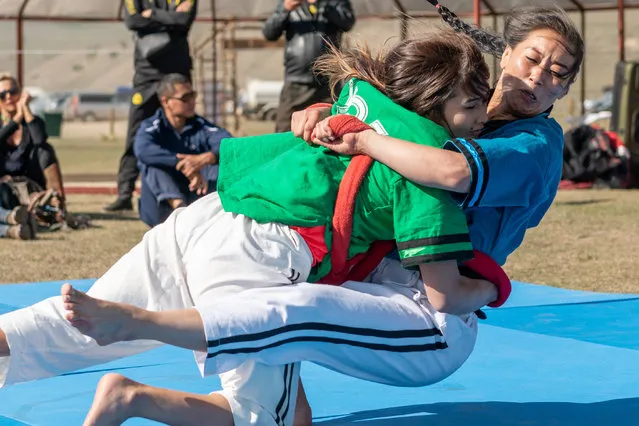
Meerim Momunova wrestles with her fellow Kyrgyz teammate Anara Ryskulova during a performance of a traditional style of wrestling called “Alysh”. Momunova is a champion in Asia and has been competing since 2015, after a background in judo. According to Momunova, one of the advantages of “Alysh” is the ease of the uniform for women – even Muslim women who cover their faces can compete. Momunova holds a degree in sports coaching and hopes to see more women come into this sport. (Photo by Eleanor Moseman/The Guardian)

This year’s World Nomad Games, a celebration of nomadic heritage, took place in the Issyk-Kul province of Kyrgyzstan. Eleanor Moseman photographed female competitors who had travelled from all over central Asia and eastern Europe, and explored the difficulties and challenges they face as competitors. (Photo by Eleanor Moseman/The Guardian)
Details
20 Sep 2018 00:05:00
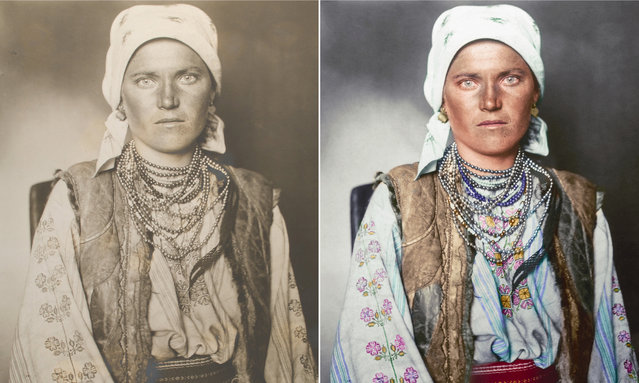
A Ruthenian woman circa 1906 from the region historically inhabiting the kingdom of the Rus, incorporating parts of modern-day Slavic speaking countries. Her outfit consists of a shirt and underskirt made from linen embroidered with traditional floral-based patterns. (Photo by Augustus Francis Sherman/New York Public Library/The Guardian)

Many of the 12 million people who entered the US through New York’s Ellis Island wore traditional dress from their homelands. Here: A Ruthenian woman circa 1906 from the region historically inhabiting the kingdom of the Rus, incorporating parts of modern-day Slavic speaking countries. Her outfit consists of a shirt and underskirt made from linen embroidered with traditional floral-based patterns. (Photo by Augustus Francis Sherman/New York Public Library/The Guardian)
Details
03 Oct 2016 09:15:00
For her series “Japanese Whispers”, Belgian photographer Zaza Bertrand headed inside the intimate world of rabuhos – Japanese love hotels. Love hotels became popular in Japan from the 1960s onwards, due to a lack of privacy in many family homes. There are now around 37,000 of these hotels in Japan, allowing short daytime “rests” or overnight stays. (Photo by Zaza Bertrand/The Guardian)

For her series “Japanese Whispers”, Belgian photographer Zaza Bertrand headed inside the intimate world of rabuhos – Japanese love hotels. Love hotels became popular in Japan from the 1960s onwards, due to a lack of privacy in many family homes. There are now around 37,000 of these hotels in Japan, allowing short daytime “rests” or overnight stays. (Photo by Zaza Bertrand/The Guardian)
Details
02 Dec 2016 11:30:00
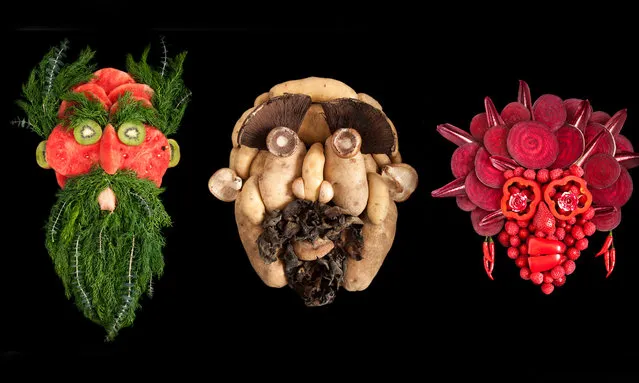
Photographer Emily Dryden and sculptor/actor Zahydé Pietri combine theatricality and organic produce to compose the photographs for their series Fresh Faces. The portraits are made from a wide range of fruit and vegetables and aim to highlight humanity’s diversity – Pietri is from Puerto Rico and Dryden is from New York. Each face has its own name and identity: “We have stories for them, which you can see in the expressions”, says Dryden, “but we decided to keep them to ourselves. We didn’t want to spoil that”. (Photo by Emily Dryden and Zahydé Pietri/The Guardian)

Photographer Emily Dryden and sculptor/actor Zahydé Pietri combine theatricality and organic produce to compose the photographs for their series Fresh Faces. The portraits are made from a wide range of fruit and vegetables and aim to highlight humanity’s diversity – Pietri is from Puerto Rico and Dryden is from New York. Each face has its own name and identity: “We have stories for them, which you can see in the expressions”, says Dryden, “but we decided to keep them to ourselves. We didn’t want to spoil that”. (Photo by Emily Dryden and Zahydé Pietri/The Guardian)
Details
25 Jul 2016 11:08:00
Black women in Brazil sit at the intersection of racism and misogyny, and have in recent years been at the forefront of a movement that challenges issues ranging from sexual and domestic violence to police brutality and stereotyping. Kolor Collective considers itself to be a part of this movement and questions expectations imposed on black women with satirical and subversive images, as seen here. (Photo by Kolor Art Collective/The Guardian)

Photographer Pol Kurucz’s vivid collection of photos explores issues faced by black Brazilian women, from political misrepresentation to unrealistic beauty standards. Kolor Collective is a Rio de Janeiro-based creative group that challenges the struggle faced by black women in Brazil through theatrical and provocative art. It was founded in 2015 by Franco-Hungarian photographer Pol Kurucz, who often touches on his own experiences of discrimination to call out sensitive social problems. (Photo by Kolor Art Collective/The Guardian)
Details
28 Dec 2016 07:24:00
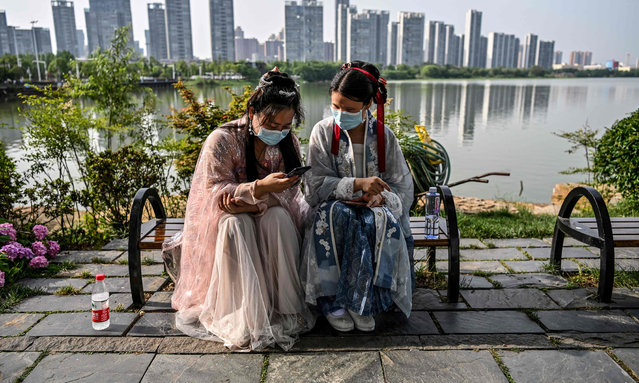
Young women wearing facemasks and traditional costumes of Song dynasty and Tang dynasty are seated on a bench in a park next to the East Lake in Wuhan, in China’s central Hubei province on May 17, 2020. The Guardian picture desk has chosen on December 17, 2020, the AFP photojournalist Hector Retamal as “Agency Photographer of the Year 2020” for his coverage of the novel coronavirus Covid-19 pandemic in Wuhan, China. (Photo by Hector Retamal/AFP Photo)

Young women wearing facemasks and traditional costumes of Song dynasty and Tang dynasty are seated on a bench in a park next to the East Lake in Wuhan, in China’s central Hubei province on May 17, 2020. The Guardian picture desk has chosen on December 17, 2020, the AFP photojournalist Hector Retamal as “Agency Photographer of the Year 2020” for his coverage of the novel coronavirus Covid-19 pandemic in Wuhan, China. (Photo by Hector Retamal/AFP Photo)
Details
12 Jan 2021 00:03:00
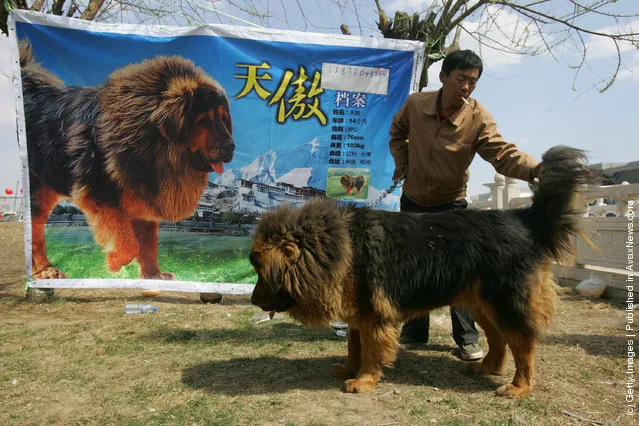
Tibetan Mastiff

“The Tibetan Mastiff also known as Do-khyi (variously translated as “home guard”, “door guard”, “dog which may be tied”, “dog which may be kept”), reflects its use as a guardian of herds, flocks, tents, villages, monasteries, and palaces, much as the old English ban-dog (also meaning tied dog) was a dog tied outside the home as a guardian. However, in nomad camps and in villages, the Do-khyi is traditionally allowed to run loose at night and woe be unto the stranger who walks abroad after dark”. – Wikipedia

Photo: A man displays a Tibetan Mastiff he raised during the Tibetan Mastiff exposition on April 7, 2007 in Langfang of Hebei Province, China. (Photo by China Photos/Getty Images)
Details
05 Oct 2011 14:27:00