Loading...
Done
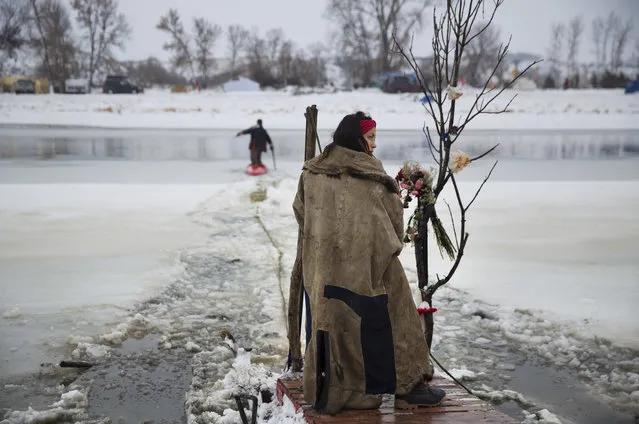
In this Thursday, December 1, 2016 photo, Cat Bigney, part of the Oglala Native American tribe, waits on the shore of the Cannonball river for travelers to arrive by canoe at the Oceti Sakowin camp where people have gathered to protest the Dakota Access oil pipeline in Cannon Ball, N.D. So far, those at the camp have shrugged off the heavy snow, icy winds and frigid temperatures. But if they defy next week's government deadline to abandon the camp, demonstrators know the real deep freeze lies ahead. Life-threatening wind chills and towering snow drifts could mean the greatest challenge is simple survival. (Photo by David Goldman/AP Photo)

In this Thursday, December 1, 2016 photo, Cat Bigney, part of the Oglala Native American tribe, waits on the shore of the Cannonball river for travelers to arrive by canoe at the Oceti Sakowin camp where people have gathered to protest the Dakota Access oil pipeline in Cannon Ball, N.D. So far, those at the camp have shrugged off the heavy snow, icy winds and frigid temperatures. But if they defy next week's government deadline to abandon the camp, demonstrators know the real deep freeze lies ahead. Life-threatening wind chills and towering snow drifts could mean the greatest challenge is simple survival. (Photo by David Goldman/AP Photo)
Details
06 Dec 2016 10:22:00
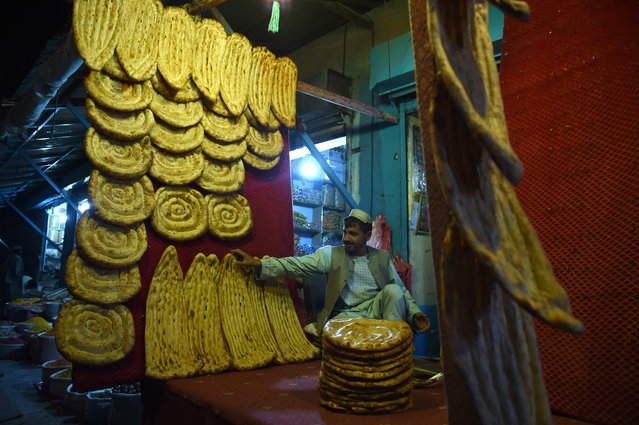
In this photograph taken on October 4, 2016, an Afghan baker prepares bread at his shop as he waits for customers in Lashkar Gah, the capital city of Helmand province For years Helmand was the centerpiece of the Western military intervention in Afghanistan only for it to slip deeper into a quagmire of instability, with almost the entire southern province teetering on the verge of collapse. Intensified fighting has killed hundreds and forced thousands to flee to besieged capital Lashkar Gah, sparking a humanitarian crisis as the city – one of the last government- held enclaves – risks falling to the Taliban' s repeated ferocious assaults. (Photo by Wakil Kohsar/AFP Photo)

In this photograph taken on October 4, 2016, an Afghan baker prepares bread at his shop as he waits for customers in Lashkar Gah, the capital city of Helmand province. For years Helmand was the centerpiece of the Western military intervention in Afghanistan only for it to slip deeper into a quagmire of instability, with almost the entire southern province teetering on the verge of collapse. Intensified fighting has killed hundreds and forced thousands to flee to besieged capital Lashkar Gah, sparking a humanitarian crisis as the city – one of the last government- held enclaves – risks falling to the Taliban' s repeated ferocious assaults. (Photo by Wakil Kohsar/AFP Photo)
Details
08 Dec 2016 12:41:00
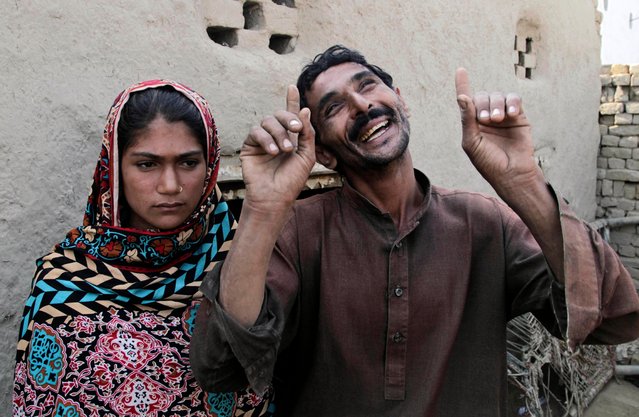
In this Tuesday, December 20, 2016 photo, Mohammad Ramzan, right, reacts while talking to The Associated Press with his young bride Saima in Jampur, Pakistan. Saima was given as a bride to the older man by her father so he could marry the groom’s sister, a practice of exchanging girls that is entrenched in conservative regions of Pakistan. It even has its own name in Urdu: Watta Satta, “give and take”. A mix of interests – family obligations, desire for sons, a wish to hand off a girl to a husband – can lead to a young teen in an a marriage she never sought. (Photo by K.M. Chaudhry/AP Photo)

In this Tuesday, December 20, 2016 photo, Mohammad Ramzan, right, reacts while talking to The Associated Press with his young bride Saima in Jampur, Pakistan. Saima was given as a bride to the older man by her father so he could marry the groom’s sister, a practice of exchanging girls that is entrenched in conservative regions of Pakistan. It even has its own name in Urdu: Watta Satta, “give and take”. A mix of interests – family obligations, desire for sons, a wish to hand off a girl to a husband – can lead to a young teen in an a marriage she never sought. (Photo by K.M. Chaudhry/AP Photo)
Details
31 Dec 2016 10:08:00
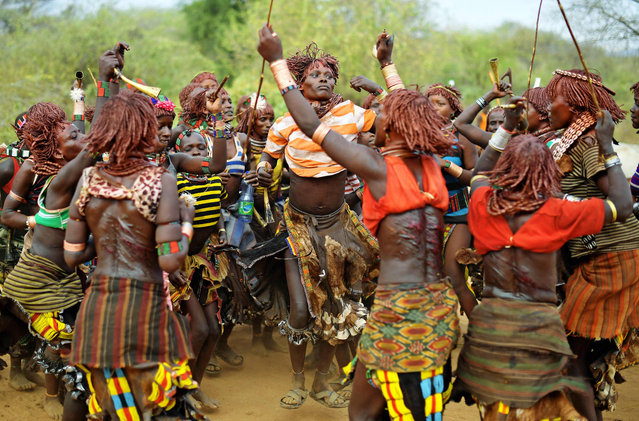
Hamar women dance before a bull jumping ceremony in Ethiopia's southern Omo Valley region near Turmi on September 19, 2016. The Hamar are a Nilotic ethnic group in Ethiopia. The construction of the Gibe III dam, the third largest hydroelectric plant in Africa, and large areas of very “thirsty” cotton and sugar plantations and factories along the Omo river are impacting heavily on the lives of tribes living in the Omo Valley who depend on the river for their survival and way of life. Human rights groups fear for the future of the tribes if they are forced to scatter, give up traditional ways through loss of land or ability to keep cattle as globalisation and development increases. (Photo by Carl De Souza/AFP Photo)

Hamar women dance before a bull jumping ceremony in Ethiopia's southern Omo Valley region near Turmi on September 19, 2016. The Hamar are a Nilotic ethnic group in Ethiopia. The construction of the Gibe III dam, the third largest hydroelectric plant in Africa, and large areas of very “thirsty” cotton and sugar plantations and factories along the Omo river are impacting heavily on the lives of tribes living in the Omo Valley who depend on the river for their survival and way of life. (Photo by Carl De Souza/AFP Photo)
Details
02 Oct 2016 08:45:00
The maid-themed cafe in Hangzhou, China on September 29, 2016. (Photo by AsiaWire)

The maid-themed cafe in Hangzhou, China on September 29, 2016. A cafe has been bringing in droves of new customers after hiring young women to dress up in Frech maid costumes while serving diners. Curious coffee- and coffee-lovers are coming from all corners of Hangzhou, capital of East China's Zhejiang Province, to get a taste of the “maid cafe” experience. The business is said to have been opened by a man surnamed Yu and his friends, all whom are natives or graduates of the city. The all-female staff who donned the black and white French maid outfits are also students currenting living or studying in Hangzhou, allowing them to marry their passion for serving with the part-time job. (Photo by AsiaWire)
Details
30 Sep 2016 09:14:00
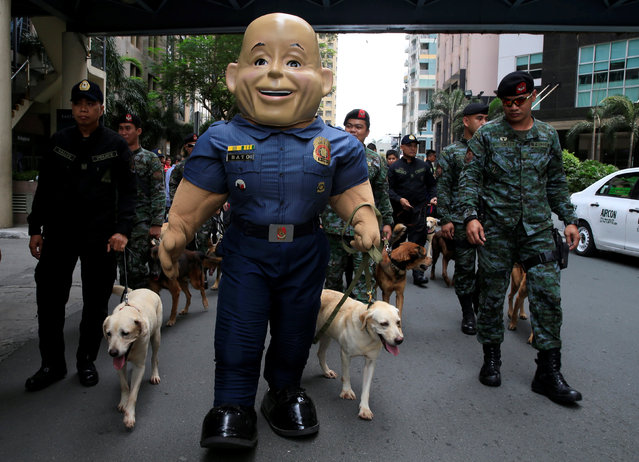
A mascot of the Philippine National Police (PNP), named after their Chief Director General Ronald Dela Rosa, marches with members of the K9 units and the Special Action Force before the mass blessing for rescue dogs during the celebration of the feast day of St. Francis of Assisi, patron Saint of Animals, at the St. John Paul II parish church in Eastwood, Quezon city, metro Manila, Philippines October 2, 2016. (Photo by Romeo Ranoco/Reuters)

A mascot of the Philippine National Police (PNP), named after their Chief Director General Ronald Dela Rosa, marches with members of the K9 units and the Special Action Force before the mass blessing for rescue dogs during the celebration of the feast day of St. Francis of Assisi, patron Saint of Animals, at the St. John Paul II parish church in Eastwood, Quezon city, metro Manila, Philippines October 2, 2016. (Photo by Romeo Ranoco/Reuters)
Details
03 Oct 2016 09:35:00
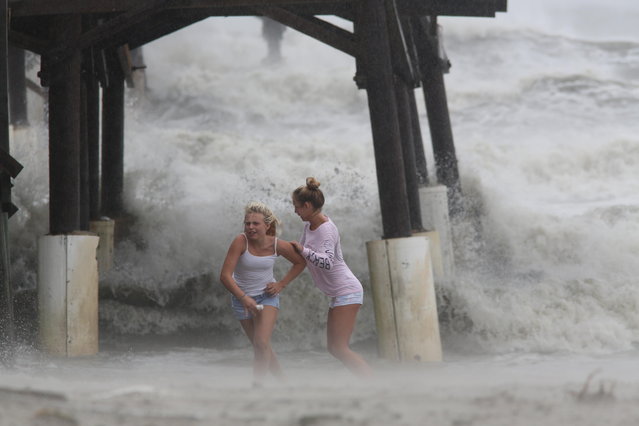
Cocoa Beach, Florida, USA. 7th October, 2016. Kaleigh Black, 14, left, and Amber Olsen, 12, run for cover as a squall with rain and wind pelt them while they explore the Cocoa Beach Pier on Friday (10/7/16) after hurricane Matthew passed to the east on Florida's east coast.(Photo by Douglas R. Clifford/Tampa Bay Times/ZUMA Wire/Alamy Live News)

Cocoa Beach, Florida, USA. 7th October, 2016. Kaleigh Black, 14, left, and Amber Olsen, 12, run for cover as a squall with rain and wind pelt them while they explore the Cocoa Beach Pier on Friday (10/7/16) after hurricane Matthew passed to the east on Florida's east coast.(Photo by Douglas R. Clifford/Tampa Bay Times/ZUMA Wire/Alamy Live News)
Details
09 Oct 2016 07:17:00
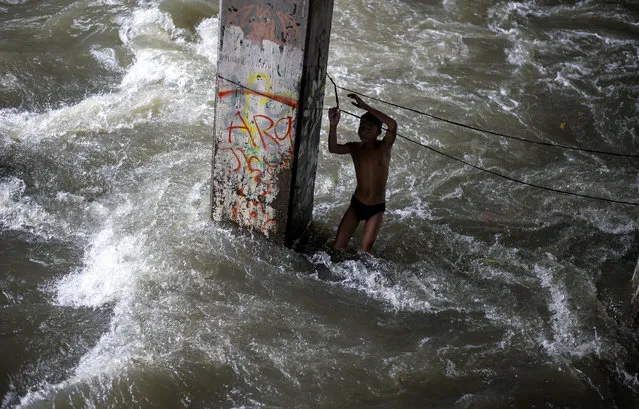
A boy plays in a swollen creek under a bridge in Manila on October 16, 2016. Typhoon Sarika lashed the main Philippine island of Luzon on October 16, flattening homes and toppling trees and power pylons as more than 12,000 people fled to safer ground, officials said. Shanties built beside a river, under a creek are the usual victims of floodings. (Photo by Noel Celis/AFP Photo)

A boy plays in a swollen creek under a bridge in Manila on October 16, 2016. Typhoon Sarika lashed the main Philippine island of Luzon on October 16, flattening homes and toppling trees and power pylons as more than 12,000 people fled to safer ground, officials said. Shanties built beside a river, under a creek are the usual victims of floodings. (Photo by Noel Celis/AFP Photo)
Details
17 Oct 2016 10:00:00