Loading...
Done
Students pose for a pictures taken by their friends during spring break on the beach in the resort city of Cancun, Mexico, February 27, 2009. (Photo by Israel Leal/AP Photo)

Students pose for a pictures taken by their friends during spring break on the beach in the resort city of Cancun, Mexico, February 27, 2009. (Photo by Israel Leal/AP Photo)
Details
09 Sep 2014 08:30:00
A motorcycle Majestic 350 CC 1931 is displayed on February 5, 2014 at the Grand Palais in Paris on the eve of an auction of luxury vintage cars. (Photo by Francois Guillot/AFP Photo)

A motorcycle Majestic 350 CC 1931 is displayed on February 5, 2014 at the Grand Palais in Paris on the eve of an auction of luxury vintage cars. (Photo by Francois Guillot/AFP Photo)
Details
07 Feb 2014 11:57:00
“Unexpected x2 (a.k.a. “how much is that doggie in the window”)”. Taiwan, 2011. (Asian (Street) Impressions)

“Unexpected x2 (a.k.a. “how much is that doggie in the window”)”. Taiwan, 2011. (Photo and caption by Asian (Street) Impressions)
Details
13 Oct 2013 10:34:00
26 Years of Growth: Shanghai Then and Now

Reuters photographer Carlos Barria recently spent time in Shanghai, China, the fastest-growing city in the world. A week ago, he took this amazing shot, recreating the same framing and perspective as a photograph taken in 1987, showing what a difference 26 years can make. (Photo by Carlos Barria/Reuters/Stringer via The Atlantic)
Details
11 Aug 2013 10:05:00
A baby black howler monkey (Alouatta caraya) clings onto its mother's back on Thursday January 29, 2009 in Singapore where it's national zoo is actively involved in the conservation and education of wildlife reserves. (Photo by Wong Maye-E/AP Photo)


“Wong Maye-E joined AP as a staff photographer in 2003. Based in Singapore, Maye-E's work is centered around Sports reportage, entertainment, politics, and regional news stories. Maye-E has covered headlining events such as the 2014 World Cup, Thailand political protests, and the devastation of the Philippines Typhoon”. – Associated Press. Photo: A baby black howler monkey (Alouatta caraya) clings onto its mother's back on Thursday January 29, 2009 in Singapore where it's national zoo is actively involved in the conservation and education of wildlife reserves. (Photo by Wong Maye-E/AP Photo)

Details
27 Aug 2014 09:14:00
The Topography Of Tears By Rose-Lynn Fisher

Do tears of joy look the same as ones of woe—or ones from chopping onions? In “The Topography of Tears,” the Los Angeles-based photographer Rose-Lynn Fisher explores the physical terrain of one hundred tears emitted during a range of emotional states and physical reactions. Using a Zeiss microscope with an attached digital camera, she captures the composition of tears enclosed in glass slides, magnified between 10x and 40x. “There are many factors that determine the look of each tear image, including the viscosity of the tear, the chemistry of the weeper, the settings of the microscope, and the way I process the images afterwards,” she says.
Details
21 May 2014 17:46:00
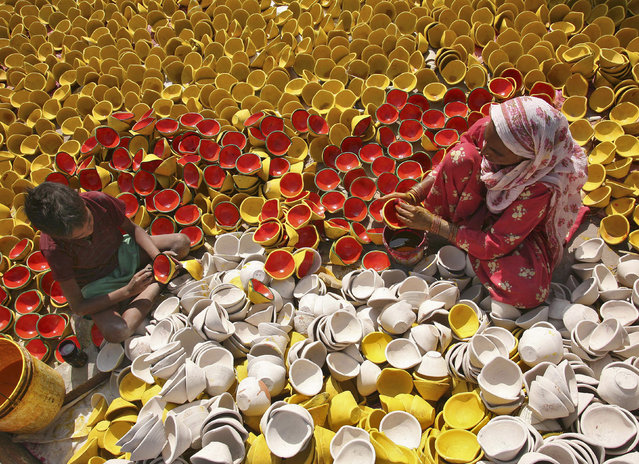
Potters colour earthen lamps at a workshop ahead of the Hindu festival of Diwali in Amritsar October 15, 2014. Earthen lamps are sold in large numbers during Diwali, the annual Hindu festival of lights, as people use them to decorate their homes. (Photo by Munish Sharma/Reuters)

Potters colour earthen lamps at a workshop ahead of the Hindu festival of Diwali in Amritsar October 15, 2014. Earthen lamps are sold in large numbers during Diwali, the annual Hindu festival of lights, as people use them to decorate their homes. (Photo by Munish Sharma/Reuters)
Details
21 Oct 2014 12:01:00
For her series “Japanese Whispers”, Belgian photographer Zaza Bertrand headed inside the intimate world of rabuhos – Japanese love hotels. Love hotels became popular in Japan from the 1960s onwards, due to a lack of privacy in many family homes. There are now around 37,000 of these hotels in Japan, allowing short daytime “rests” or overnight stays. (Photo by Zaza Bertrand/The Guardian)

For her series “Japanese Whispers”, Belgian photographer Zaza Bertrand headed inside the intimate world of rabuhos – Japanese love hotels. Love hotels became popular in Japan from the 1960s onwards, due to a lack of privacy in many family homes. There are now around 37,000 of these hotels in Japan, allowing short daytime “rests” or overnight stays. (Photo by Zaza Bertrand/The Guardian)
Details
02 Dec 2016 11:30:00