Loading...
Done
A protestor gestures toward the White House on the Ellipse near the South Lawn of the White House during the Women's March on Washington January 21, 2017 in Washington, DC. Large crowds are attending the anti-Trump rally a day after U.S. President Donald Trump was sworn in as the 45th U.S. president. (Photo by Drew Angerer/Getty Images)

A protestor gestures toward the White House on the Ellipse near the South Lawn of the White House during the Women's March on Washington January 21, 2017 in Washington, DC. Large crowds are attending the anti-Trump rally a day after U.S. President Donald Trump was sworn in as the 45th U.S. president. (Photo by Drew Angerer/Getty Images)
Details
17 Mar 2017 00:05:00
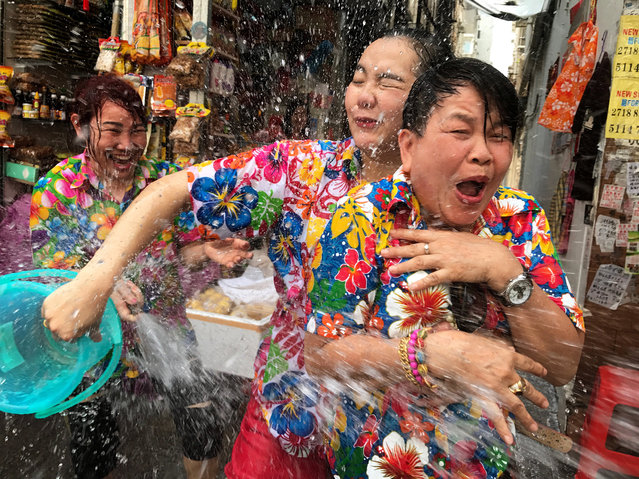
People spray water in the street ahead of “Songkran”, the annual Thai New Year water-throwing festival, in Kowloon City, Hong Kong, China, 09 April 2017. The pouring of water is a key element in the festival as it represents purification and the washing away of one's sins and bad luck for the year. The event also includes a “Miss Songkran” pageant where contestants are clothed in traditional Thai dress, and a winner is crowned. This year's “Songkran” will begin in Thailand on 13 April 2017. (Photo by Alex Hofford/EPA)

People spray water in the street ahead of “Songkran”, the annual Thai New Year water-throwing festival, in Kowloon City, Hong Kong, China, 09 April 2017. The pouring of water is a key element in the festival as it represents purification and the washing away of one's sins and bad luck for the year. The event also includes a “Miss Songkran” pageant where contestants are clothed in traditional Thai dress, and a winner is crowned. This year's “Songkran” will begin in Thailand on 13 April 2017. (Photo by Alex Hofford/EPA)
Details
10 Apr 2017 09:05:00
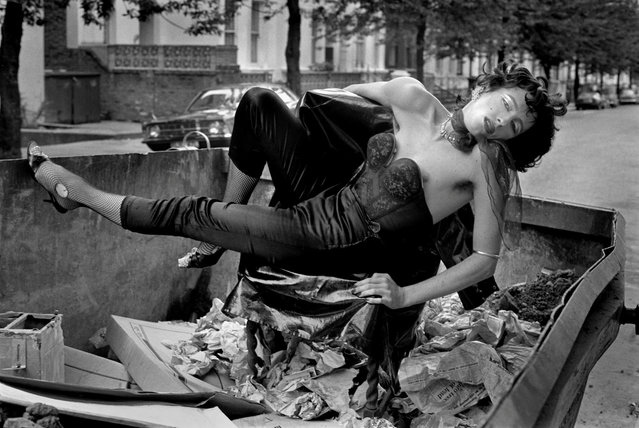
“A very delicate person, beneath the flamboyance”. Jasper, Ladbroke Grove, 1977. “In the 1970s, Australia was rather cut off. I’d always wanted to live abroad, so I moved to Rome and then London. I was an art historian, but started studying photography part-time. I was interested in the demi-monde culture and began mixing in all sorts of circles. Jasper was a rather wonderful character. He was from Sydney, but he was living downstairs from me in Ladbroke Grove, in a flat rented to some gay friends. It was fairly eclectic. Jasper was always playing around with clothes and makeup. If he was looking particularly wonderful, I might get out my lights and take a shot. Or he might put makeup on me. He wasn’t always in drag, but he was permanently in diva mode, dependably louche, funny and naughty. I think all that comes across in the image. He was actually a very delicate person, though, beneath the wit and flamboyance. Jasper floated through London all too briefly. His real name was Peter MacMahon, but to us he was only ever Jasper Havoc, an alter ego he’d created while part of a transvestite troupe called Sylvia and the Synthetics. They were legendary in Sydney gay culture. On this day, we’d been taking some pictures inside and had gone out into the streets to fool around some more. Jasper was wearing a corset and fishnets ensemble, with other bits and pieces, and we joked about him being trashy as he lay in the skip. We just took the shot for ourselves. It wasn’t done with any publication in mind, or anything else. This was way before the internet and people didn’t share images. If you dressed up, it was just for that moment”. (Photo by Jane England)

“A very delicate person, beneath the flamboyance”. Jasper, Ladbroke Grove, 1977. “In the 1970s, Australia was rather cut off. I’d always wanted to live abroad, so I moved to Rome and then London. I was an art historian, but started studying photography part-time. I was interested in the demi-monde culture and began mixing in all sorts of circles. Jasper was a rather wonderful character...”. (Photo by Jane England)
Details
26 Jun 2017 09:04:00
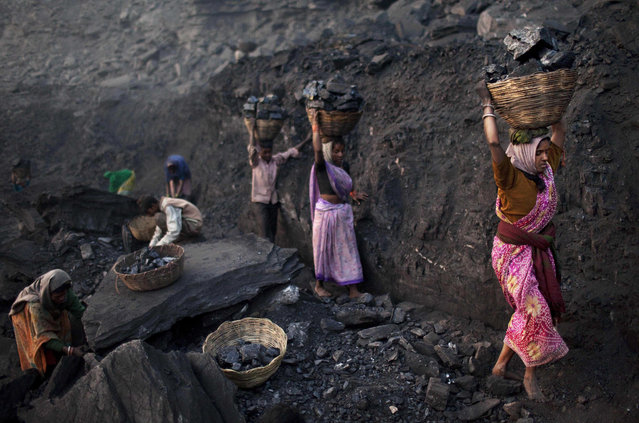
In this Friday, January 7, 2011 photo, people carry baskets of coal scavenged illegally at an open-cast mine in the village of Bokapahari in the eastern Indian state of Jharkhand where a community of coal scavengers live and work. The world's biggest coal users – China, the United States and India – have boosted coal mining in 2017, in an abrupt departure from last year's record global decline for the heavily polluting fuel and a setback to efforts to rein in climate change emissions. (Photo by Kevin Frayer/AP Photo)

In this Friday, January 7, 2011 photo, people carry baskets of coal scavenged illegally at an open-cast mine in the village of Bokapahari in the eastern Indian state of Jharkhand where a community of coal scavengers live and work. The world's biggest coal users – China, the United States and India – have boosted coal mining in 2017, in an abrupt departure from last year's record global decline for the heavily polluting fuel and a setback to efforts to rein in climate change emissions. (Photo by Kevin Frayer/AP Photo)
Details
28 Jun 2017 08:08:00
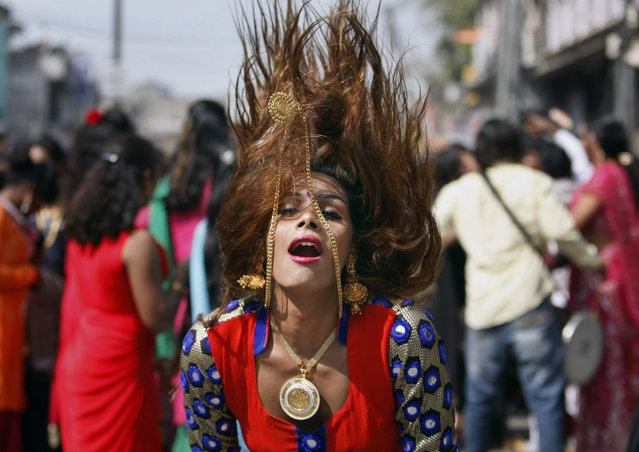
A eunuch dances during a rally to mark the congregation of thousands of eunuchs from different parts of India, in Jammu, India, Friday, March 13, 2015. The term eunuchs is used in India to describe transvestites, transsexuals and others who identify themselves as neither male nor female but as a member of a third gender. They traditionally survive by begging, dancing at weddings or blessing newborn babies and are frequently subjected to discrimination. (Photo by Channi Anand/AP Photo)

A eunuch dances during a rally to mark the congregation of thousands of eunuchs from different parts of India, in Jammu, India, Friday, March 13, 2015. The term eunuchs is used in India to describe transvestites, transsexuals and others who identify themselves as neither male nor female but as a member of a third gender. They traditionally survive by begging, dancing at weddings or blessing newborn babies and are frequently subjected to discrimination. (Photo by Channi Anand/AP Photo)
Details
21 Mar 2015 12:33:00
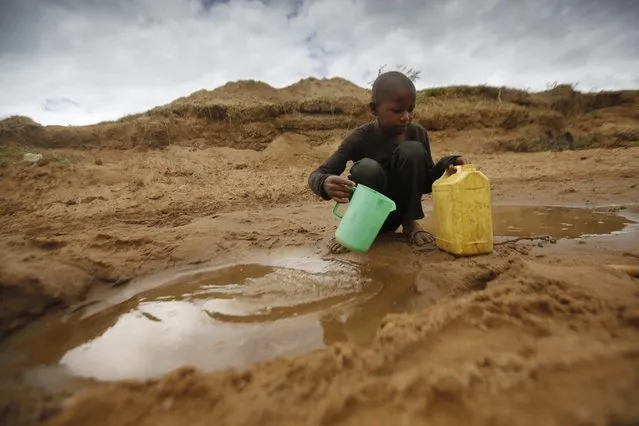
A young boy scoops water from a hand-dug well in the dry riverbed near Matinyani, in the semi-arid Kitui County in southeastern Kenya, 22 March 2015, the World Water Day. Residents of Kitui County and other arid and semi-arid areas of the country have been hard-hit by extremely poor rainfall this year while the government said in previous month that some 1.6 million people countrywide are facing acute starvation due to the drought and will need relief food over the next six months. (Photo by Dai Kurokawa/EPA)

A young boy scoops water from a hand-dug well in the dry riverbed near Matinyani, in the semi-arid Kitui County in southeastern Kenya, 22 March 2015, the World Water Day. Residents of Kitui County and other arid and semi-arid areas of the country have been hard-hit by extremely poor rainfall this year while the government said in previous month that some 1.6 million people countrywide are facing acute starvation due to the drought and will need relief food over the next six months. Residents of Matinyani say they haven't seen a drop of rain in nearly four months. Thousands of Kenyans in rural areas walk tens of kilometers just to fetch water to drink and to be used in their homes. According to an estimate by UNESCO (United Nations Educational, Scientific and Cultural Organization), 17 million people lack access to safe water in Kenya, where the drought is a perennial problem. (Photo by Dai Kurokawa/EPA)
Details
23 Mar 2015 11:01:00
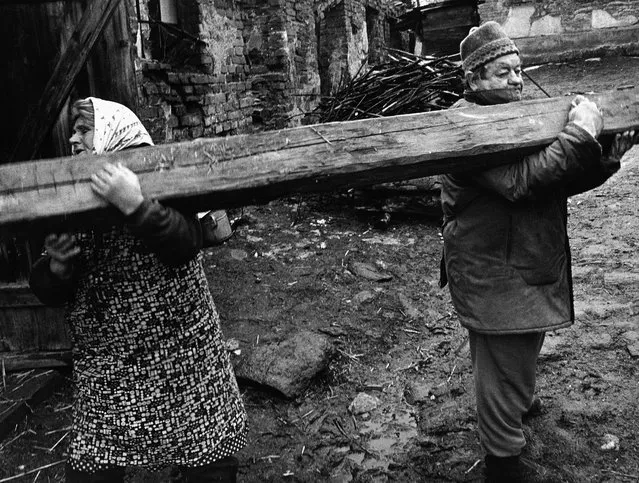
A love story with two log choppers. “In 1993, I was working on a project about life in the Olomouc region of Czechoslovakia. One day, I came to the village of Dlouhá Loučka-Křivá and went into a courtyard where I saw two old people, a husband and wife, sawing firewood for winter. They were working quietly, concentrating. I watched them fetch a beam from a wrecked barn, but they didn’t discuss how they planned to carry it to the saw. The woman faced one way, the man the other. When they realised, the woman eventually turned and followed her husband. The picture I took is the picture of many relationships – when each partner wants something different, but they have to come to an agreement, pull together eventually”. (Photo by Jindrich Streit)

A love story with two log choppers. “In 1993, I was working on a project about life in the Olomouc region of Czechoslovakia. One day, I came to the village of Dlouhá Loučka-Křivá and went into a courtyard where I saw two old people, a husband and wife, sawing firewood for winter. They were working quietly, concentrating. I watched them fetch a beam from a wrecked barn, but they didn’t discuss how they planned to carry it to the saw. The woman faced one way, the man the other. When they realised, the woman eventually turned and followed her husband. The picture I took is the picture of many relationships – when each partner wants something different, but they have to come to an agreement, pull together eventually”. (Photo by Jindrich Streit)
Details
04 Aug 2016 12:34:00
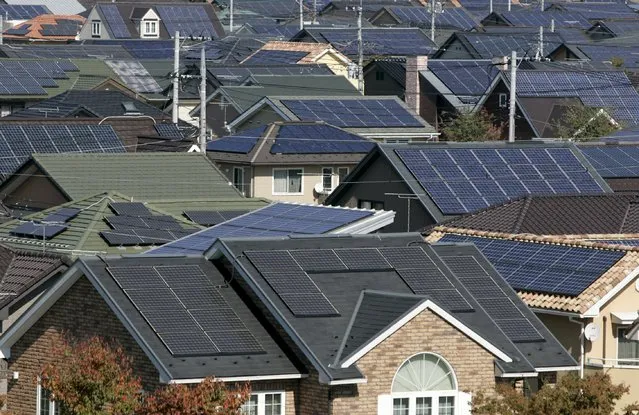
Rooftops of solar powered houses are pictured in Ota, 80 km northwest of Tokyo in this October 28, 2008 file photo. One by one, Japan is turning off the lights at the giant oil-fired power plants that propelled it to the ranks of the world's top industrialised nations. With nuclear power in the doldrums after the Fukushima disaster, it's solar energy that is becoming the alternative. (Photo by Yuriko Nakao/Reuters)

Rooftops of solar powered houses are pictured in Ota, 80 km northwest of Tokyo in this October 28, 2008 file photo. One by one, Japan is turning off the lights at the giant oil-fired power plants that propelled it to the ranks of the world's top industrialised nations. With nuclear power in the doldrums after the Fukushima disaster, it's solar energy that is becoming the alternative. Solar power is set to become profitable in Japan as early as this quarter, according to the Japan Renewable Energy Foundation (JREF), freeing it from the need for government subsidies and making it the last of the G7 economies where the technology has become economically viable. (Photo by Yuriko Nakao/Reuters)
Details
24 Nov 2015 08:04:00