Loading...
Done
In this Thursday, December 1, 2016 photo, Cat Bigney, part of the Oglala Native American tribe, waits on the shore of the Cannonball river for travelers to arrive by canoe at the Oceti Sakowin camp where people have gathered to protest the Dakota Access oil pipeline in Cannon Ball, N.D. So far, those at the camp have shrugged off the heavy snow, icy winds and frigid temperatures. But if they defy next week's government deadline to abandon the camp, demonstrators know the real deep freeze lies ahead. Life-threatening wind chills and towering snow drifts could mean the greatest challenge is simple survival. (Photo by David Goldman/AP Photo)

In this Thursday, December 1, 2016 photo, Cat Bigney, part of the Oglala Native American tribe, waits on the shore of the Cannonball river for travelers to arrive by canoe at the Oceti Sakowin camp where people have gathered to protest the Dakota Access oil pipeline in Cannon Ball, N.D. So far, those at the camp have shrugged off the heavy snow, icy winds and frigid temperatures. But if they defy next week's government deadline to abandon the camp, demonstrators know the real deep freeze lies ahead. Life-threatening wind chills and towering snow drifts could mean the greatest challenge is simple survival. (Photo by David Goldman/AP Photo)
Details
06 Dec 2016 10:22:00
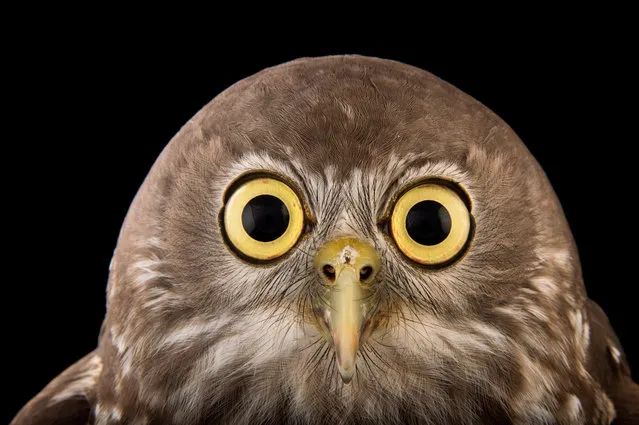
The National Geographic Photo Ark is a travelling exhibition of photographer Joel Sartore’s quest to create a photo archive of biodiversity around the world. So far, Sartore has captured studio portraits of more than 6,000 species – a number that he hopes to double. On 1 July, the ark will open at Melbourne zoo – the first time it has been exhibited in the southern hemisphere. More than 50 portraits will be on display, including many of Australian endangered animals being protected by programs at the zoo itself. These captions have been edited from text supplied by Melbourne zoo. Here: Barking owl. So-named because its call sounds like a barking dog, these birds are native to Australia, Indonesia and Papua New Guinea. In Victoria they are listed as an endangered species, and in 2003 there were estimated to be fewer than 50 breeding pairs. The main threat to the species in Victoria is loss of habitat, especially large trees with hollows in which they can nest and on which many of their prey depend. Apart from a bark, they may utter a chilling scream when they feel threatened. (Photo by Joel Sartore/National Geographic Photo Ark/The Guardian)

The National Geographic Photo Ark is a travelling exhibition of photographer Joel Sartore’s quest to create a photo archive of biodiversity around the world. So far, Sartore has captured studio portraits of more than 6,000 species – a number that he hopes to double. On 1 July, the ark will open at Melbourne zoo – the first time it has been exhibited in the southern hemisphere. More than 50 portraits will be on display, including many of Australian endangered animals being protected by programs at the zoo itself. These captions have been edited from text supplied by Melbourne zoo. Here: Barking owl. (Photo by Joel Sartore/National Geographic Photo Ark/The Guardian)
Details
01 Jul 2017 07:45:00
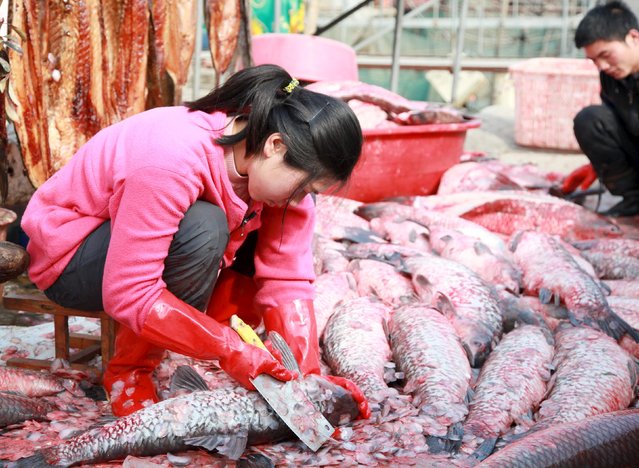
A woman scales fish by the side of a lake as she prepares for the upcoming Chinese Lunar New Year in Suqian, Jiangsu province, China, January 27, 2016. (Photo by Reuters/China Daily)

A woman scales fish by the side of a lake as she prepares for the upcoming Chinese Lunar New Year in Suqian, Jiangsu province, China, January 27, 2016. (Photo by Reuters/China Daily)
Details
04 Feb 2016 11:03:00
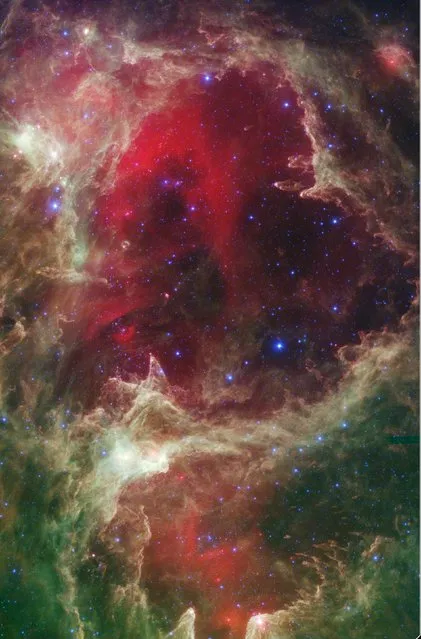
An infrared portrait from NASA's Spitzer Space Telescope which shows generations of stars is seen in this undated NASA handout image released February 14, 2013. In this wispy star-forming region, called W5, the oldest stars can be seen as blue dots in the centers of the two hollow cavities (other blue dots are background and foreground stars not associated with the region). Red shows heated dust that pervades the region's cavities, while green highlights dense clouds. (Photo by NASA/Reuters/JPL-Caltech/Harvard-Smithsonian/Handout)

An infrared portrait from NASA's Spitzer Space Telescope which shows generations of stars is seen in this undated NASA handout image released February 14, 2013. In this wispy star-forming region, called W5, the oldest stars can be seen as blue dots in the centers of the two hollow cavities (other blue dots are background and foreground stars not associated with the region). Red shows heated dust that pervades the region's cavities, while green highlights dense clouds. (Photo by NASA/Reuters/JPL-Caltech/Harvard-Smithsonian/Handout)
Details
03 Mar 2013 08:44:00
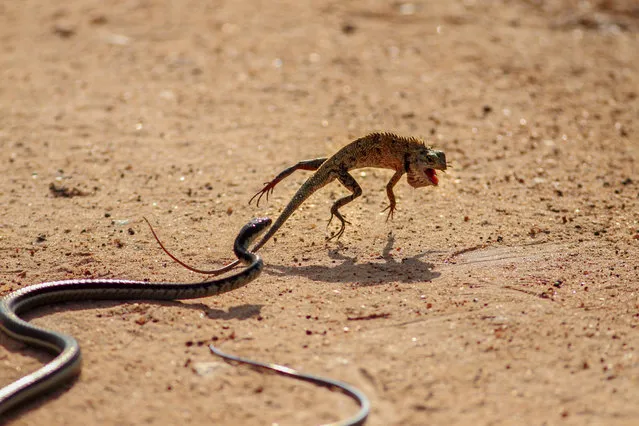
Yala national park, Sri Lanka. Category: Action. “The daylight was fading and I was scanning the bush for a leopard. Then, I saw this garden lizard and a common bronzeback snake in the road. When the snake struck, the lizard performed amazing acrobatics to avoid it. The snake didn’t enjoy the extra attention from the crowd of jeeps. The distraction gave the lizard the chance to live another day”. (Photo by Sajith Buddikha Withanage/National Geographic Traveller UK)

Yala national park, Sri Lanka. Category: Action. “The daylight was fading and I was scanning the bush for a leopard. Then, I saw this garden lizard and a common bronzeback snake in the road. When the snake struck, the lizard performed amazing acrobatics to avoid it. The snake didn’t enjoy the extra attention from the crowd of jeeps. The distraction gave the lizard the chance to live another day”. (Photo by Sajith Buddikha Withanage/National Geographic Traveller UK)
Details
25 Jan 2017 11:26:00
Typhoon Haiyan survivor Mariena Delacueva stands amongst the ruins of her families home on November 6, 2014 in San Antonio, Samar, Philippines. Mariena's looks after the property after her parents moved to Manila to find work so they can save enough money to rebuild the house. (Photo by Chris McGrath/Getty Images)

Typhoon Haiyan survivor Mariena Delacueva stands amongst the ruins of her families home on November 6, 2014 in San Antonio, Samar, Philippines. Mariena's looks after the property after her parents moved to Manila to find work so they can save enough money to rebuild the house. Residents of Leyte and surrounds are preparing for the 1-year anniversary since Super Typhoon Yolanda struck the coast on November 8, 2013, leaving more than 6000 dead and many more homeless. (Photo by Chris McGrath/Getty Images)
Details
11 Nov 2014 11:59:00
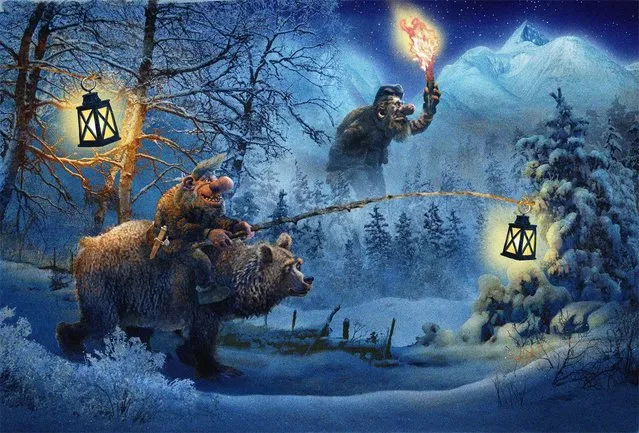
Norwegian Trolls By Ivar Rodningen Part 2

Some people think of trolls as nothing but savage beast, yet others realize that beneath their rock-hard skin hides a gentle kind heart. Ivar Rodningem is one of the people who knows the true nature of trolls. Though these creatures look unruly, it is just the way they were born. Trolls come in all shapes and sizes. Some are small, some are large, and some are simply enormous. They help each other out, though elders tend to be loners, preferring the company of their own thoughts to anybody else. You shouldn’t run for your life if you ever meet a troll, though we wouldn’t recommend pestering them, as they are mighty strong, even the little ones.


See also:Part 1
Details
07 Mar 2015 12:05:00
A replica model of a Lamborghini Aventador LP 700-4 in Dubai, UAE. This is the world's most expensive model car, made from carbon fibre and covered in a thin layer of pure gold. (Photo by Robert Gulpen/Barcroft Media)

A replica model of a Lamborghini Aventador LP 700-4 in Dubai, UAE. This is the world's most expensive model car, made from carbon fibre and covered in a thin layer of pure gold. The 1:8 scale replica Lamborghini Aventador LP 700-4, designed by German engineer Robert Gülpen, is available to buy for £200,000. But amazingly this model – currently on display at the Lamborghini showroom in Dubai – is just a prototype for a solid gold model, which will go up for auction in 2014 with a price tag of £4.6 million. (Photo by Robert Gulpen/Barcroft Media)
Details
19 May 2014 11:23:00