Loading...
Done
Kelley McMann, Gator Rebel, 2002. (Photo by Malcolm Lightner)

The Mile O' Mud is a 7/8-mile oval track with a 1/8-mile diagonal lane slashed through the center. The racing lanes are approximately 60 feet wide. On average, the muddy water is four to six feet deep, with three strategically placed holes. The largest hole, located in front of the grandstand, is the treacherous “Sippy Hole”, named for the legendary driver “Mississippi” Milton Morris, Swamp Buggy King 1955, who repeatedly got stuck in it. (Photo by Malcolm Lightner)
Details
19 May 2016 11:20:00
Tony North; First place, Breathing Spaces; Overall Winner; Blue Tajinaste, La Palma, Canary Islands, Spain. “Echium thyrsiflorum is endemic to the mountains of La Palma island – from high up, there was a magnificent view of both the caldera below, and the stars above. The Unesco La Palma biosphere reserve encompasses the entire island, with the Caldera de Taburiente containing mountains with a highest peak of 2,426 metres – the Roque de los Muchachos”. (Photo by Tony North/IGPOTY)

Tony North; First place, Breathing Spaces; Overall Winner; Blue Tajinaste, La Palma, Canary Islands, Spain. “Echium thyrsiflorum is endemic to the mountains of La Palma island – from high up, there was a magnificent view of both the caldera below, and the stars above. The Unesco La Palma biosphere reserve encompasses the entire island, with the Caldera de Taburiente containing mountains with a highest peak of 2,426 metres – the Roque de los Muchachos”. (Photo by Tony North/IGPOTY)
Details
10 Feb 2023 04:41:00
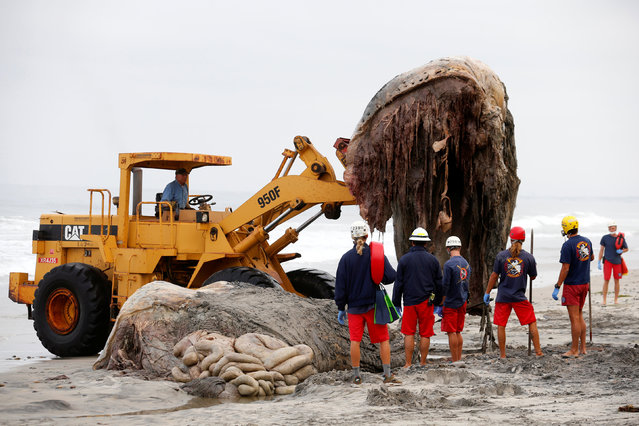
Heavy machinery is used as Encinitas lifeguards work to remove the carcass of a large humpback whale that washed ashore in Leucadia, California, United States, July 18, 2016. (Photo by Mike Blake/Reuters)

Heavy machinery is used as Encinitas lifeguards work to remove the carcass of a large humpback whale that washed ashore in Leucadia, California, United States, July 18, 2016. (Photo by Mike Blake/Reuters)
Details
19 Jul 2016 12:50:00
People prepare for the burning of the 'Ninot' caricatures during the last day of the 'Fallas' festival on March 19, 2012 in Valencia, Spain

“The Falles is a traditional celebration held in commemoration of Saint Joseph in Valencia, Spain. The term Falles refers to both the celebration and the monuments created during the celebration. A number of towns in the Valencian Community have similar celebrations inspired by the original in Valencia”. – Wikipedia

Photo: A person prepares for the burning of the “Ninot” caricatures during the last day of the “Fallas” festival on March 19, 2012 in Valencia, Spain. The festival, which runs March 15 – 19, celebrates the arrival of spring with fireworks, fiestas and bonfires. (Photo by Xaume Olleros/Getty Images)
Details
20 Mar 2012 11:36:00
Tardigrades (commonly known as waterbears or moss piglets). (Photo by SPL/East News)

“Tardigrades (commonly known as waterbears or moss piglets) are small, water-dwelling, segmented animals with eight legs. Tardigrades were first discovered in 1773 by Johann August Ephraim Goeze, who called them kleiner Wasserbär, meaning “little water bear” in German. The name Tardigrada means “slow walker” and was given by Lazzaro Spallanzani in 1777. The name water bear comes from the way they walk, reminiscent of a bear's gait. The biggest adults may reach a body length of 1.5 millimetres (0.059 in), the smallest below 0.1 mm. Freshly hatched tardigrades may be smaller than 0.05 mm”. – Wikipedia. Photo: Tardigrades. (Photo by SPL/East News)
Details
26 Sep 2012 09:55:00
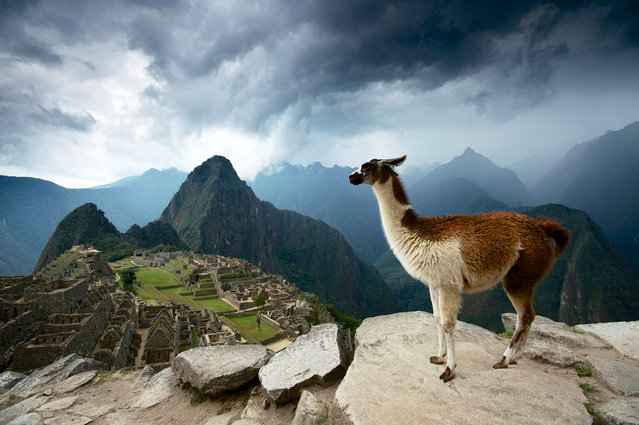
Machu Picchu, Peru. A llama’s-eye view of the legendary Inca settlement at Machu Picchu, isolated high in the Peruvian Andes. (Photo by Jim Turner/National Geographic)

Machu Picchu, Peru. A llama’s-eye view of the legendary Inca settlement at Machu Picchu, isolated high in the Peruvian Andes. (Photo by Jim Turner/National Geographic)
Details
16 Nov 2015 08:13:00
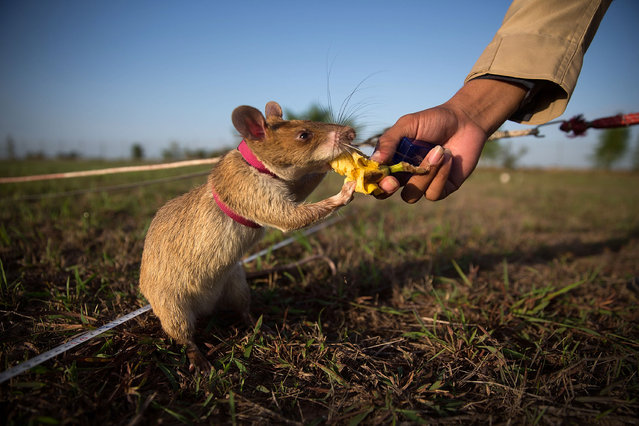
A mine detection rat is given banana as a reward after successfully identifying an inactive mine on July 2, 2015 in Siem Reap, Cambodia. (Photo by Taylor Weidman/Getty Images)

A mine detection rat is given banana as a reward after successfully identifying an inactive mine on July 2, 2015 in Siem Reap, Cambodia. The Cambodian Mine Action Center (CMAC) working with the Belgian NGO APOPO has recently begun testing the feasability of using large mine detection rats from Tanzania to help clear fields of mines and unexploded ordnance in one of the most bombed and mined countries in the world. (Photo by Taylor Weidman/Getty Images)
Details
03 Jul 2015 13:31:00
Young girls attend a training session in MGFSO Olympic reserve school in Moscow on May 30, 2016. (Photo by Kirill Kudryavtsev/AFP Photo)

Young girls attend a training session in MGFSO Olympic reserve school in Moscow on May 30, 2016. (Photo by Kirill Kudryavtsev/AFP Photo)
Details
05 Jun 2016 13:29:00