Loading...
Done


“The frilled shark (Chlamydoselachus anguineus) is one of two extant species of shark in the family Chlamydoselachidae, with a wide but patchy distribution in the Atlantic and Pacific Oceans. This uncommon species is found over the outer continental shelf and upper continental slope, generally near the bottom though there is evidence of substantial upward movements. It has been caught as deep as 1,570 m (5,150 ft), whereas in Suruga Bay, Japan it is most common at depths of 50–200 m (160–660 ft). Exhibiting several “primitive” features, the frilled shark has often been termed a «living fossil»”. – Wikipedia

Photo: A 1.6 meter long Frill shark swims in a tank after being found by a fisherman at a bay in Numazu, on January 21, 2007 in Numazu, Japan. The frill shark, also known as a Frilled shark usually lives in waters of a depth of 600 meters and so it is very rare that this shark is found alive at sea-level. It's body shape and the number of gill are similar to fossils of sharks which lived 350,000,000 years ago. (Photo by Awashima Marine Park/Getty Images)
Details
05 May 2011 10:01:00
A policer officer hits a man with a baton as he tries to maintain order while migrants wait for trains at a temporary camp near Gevgelija, Macedonia, September 7, 2015.  Several thousand migrants in Macedonia boarded trains on Sunday to travel north after spending a night in a provisional camp. (Photo by Stoyan Nenov/Reuters)

A policer officer hits a man with a baton as he tries to maintain order while migrants wait for trains at a temporary camp near Gevgelija, Macedonia, September 7, 2015. Several thousand migrants in Macedonia boarded trains on Sunday to travel north after spending a night in a provisional camp. Macedonia has organised trains twice a day to the north border where migrants cross into Serbia to make their way to Hungary. Since June, Macedonian authorities have said that more than 60,000 migrants have entered the country, and around 1,500 entered just in one day, mainly refugees from Syria. (Photo by Stoyan Nenov/Reuters)
Details
09 Sep 2015 12:55:00
Cookie the cockapoo dog is enjoying herself on the beach by jumping over a sea defence as the sun shines at Heacham, West Norfolk, England on July 14, 2020. (Photo by Paul Marriott/Rex Features/Shutterstock)

Cookie the cockapoo dog is enjoying herself on the beach by jumping over a sea defence as the sun shines at Heacham, West Norfolk, England on July 14, 2020. (Photo by Paul Marriott/Rex Features/Shutterstock)
Details
19 Jul 2020 00:03:00
Waxwings in Balham south London on December 31, 2023. There has been a huge influx of this erruptive species this year. This probably due to severe storms and a shortage of food in their native Scandinavia in the Autumn. (Photo by Jack Hill/The Times)

Waxwings in Balham south London on December 31, 2023. There has been a huge influx of this erruptive species this year. This probably due to severe storms and a shortage of food in their native Scandinavia in the Autumn. (Photo by Jack Hill/The Times)
Details
25 Jan 2024 10:02:00
A girl holds a blossom in her mouth while posing for photos under cherry blossom trees at Wuhan University on March 11, 2021 in Wuhan, China. Tourists come to view cherry blossoms at the university during the spring. Wuhan University, first founded in 1893, is widely known as one of the most beautiful universities in China. Last year Wuhan University did not receive guests due to the pandemic lockdown. Currently the limit is 10,000 tourists a day. With no recorded cases of community transmission since May 2020, life for residents is gradually returning to normal. (Photo by Getty Images/China Stringer Network)

A girl holds a blossom in her mouth while posing for photos under cherry blossom trees at Wuhan University on March 11, 2021 in Wuhan, China. Tourists come to view cherry blossoms at the university during the spring. Wuhan University, first founded in 1893, is widely known as one of the most beautiful universities in China. (Photo by Getty Images/China Stringer Network)
Details
16 Mar 2021 09:45:00
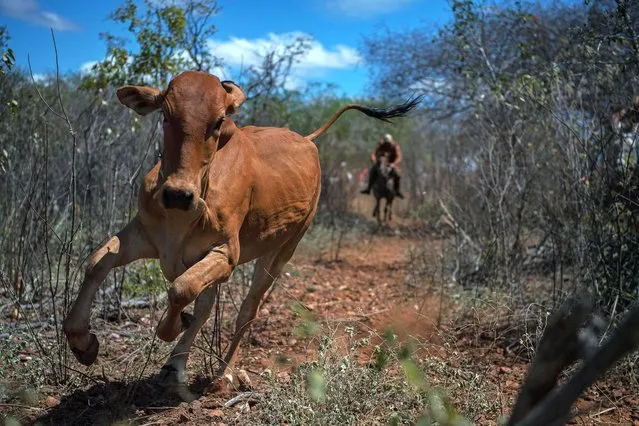
A young bull flees from a Brazilian vaqueiro, or cowboy, competing in the “Pega de Boi” (Ox Catch) tournament in Cabrobo, Pernambuco State, Brazil, on September 4, 2022. The riders compete in pairs to retrieve a cord from a bull which has been released and runs away from them and they are timed on how quickly they can return with the cord. The leather clothing provides them with protection from the dense savannah vegetation which contains a lot of large thorns. Riders have been known to die competing in the tournament (Photo by Carl de Souza/AFP Photo)

A young bull flees from a Brazilian vaqueiro, or cowboy, competing in the “Pega de Boi” (Ox Catch) tournament in Cabrobo, Pernambuco State, Brazil, on September 4, 2022. The riders compete in pairs to retrieve a cord from a bull which has been released and runs away from them and they are timed on how quickly they can return with the cord. The leather clothing provides them with protection from the dense savannah vegetation which contains a lot of large thorns. Riders have been known to die competing in the tournament (Photo by Carl de Souza/AFP Photo)
Details
25 Sep 2022 04:38:00
A woman poses for pictures with skulls made of cardboard placed on an altar next to the San Francisco church in Mexico City during the celebration of All Souls Day on November 2, 2015. (Photo by Yuri Cortez/AFP Photo)

A woman poses for pictures with skulls made of cardboard placed on an altar next to the San Francisco church in Mexico City during the celebration of All Souls Day on November 2, 2015. (Photo by Yuri Cortez/AFP Photo)
Details
05 Nov 2015 08:08:00
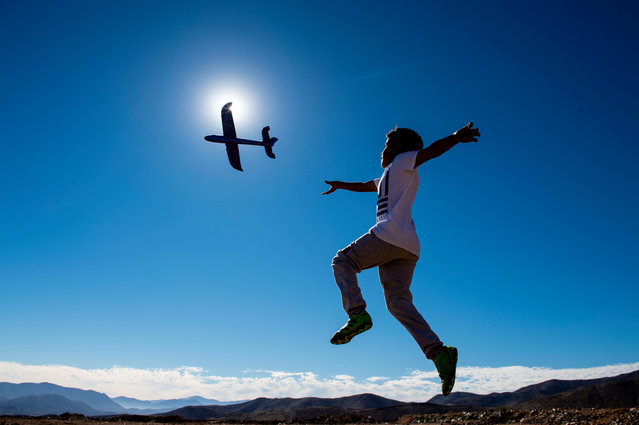
A boy plays with a toy plane on the eve of a solar eclipse, in La Higuera, Coquimbo Region, in the Atacama desert about 580 km north of Santiago, on July 1, 2019. A total solar eclipse will be visible from small parts of Chile and Argentina on July 2. (Photo by Martin Bernetti/AFP Photo)

A boy plays with a toy plane on the eve of a solar eclipse, in La Higuera, Coquimbo Region, in the Atacama desert about 580 km north of Santiago, on July 1, 2019. A total solar eclipse will be visible from small parts of Chile and Argentina on July 2. (Photo by Martin Bernetti/AFP Photo)
Details
14 May 2020 00:03:00