Loading...
Done
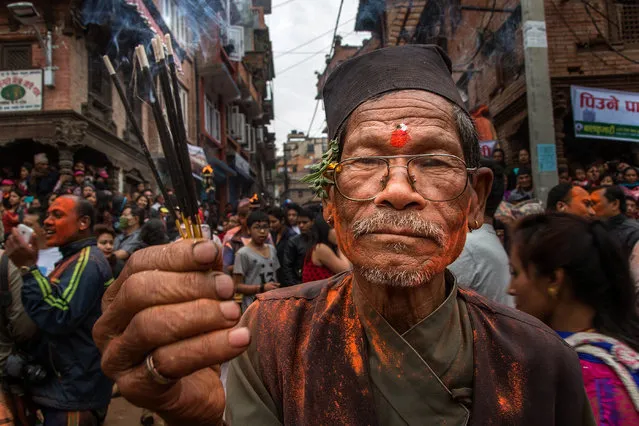
A devotee holds incense sticks while celebrating the Sindoor Jatra Festival on April 15, 2015 in Thimi, Nepal. Sindoor Jatra Festival is celebrated each year in Thimi, on the outskirts of Kathmandu, to welcome the Nepali New Year and celebrate the coming of spring. During the Festival, devotees are smeared with vermillion powder and 30 chariots containing the images of several gods and goddesses are carrying by the devotees around the town, while others sing, dance and play musical instruments. (Photo by Omar Havana/Getty Images)

A devotee holds incense sticks while celebrating the Sindoor Jatra Festival on April 15, 2015 in Thimi, Nepal. Sindoor Jatra Festival is celebrated each year in Thimi, on the outskirts of Kathmandu, to welcome the Nepali New Year and celebrate the coming of spring. During the Festival, devotees are smeared with vermillion powder and 30 chariots containing the images of several gods and goddesses are carrying by the devotees around the town, while others sing, dance and play musical instruments. (Photo by Omar Havana/Getty Images)
Details
18 Apr 2015 09:17:00
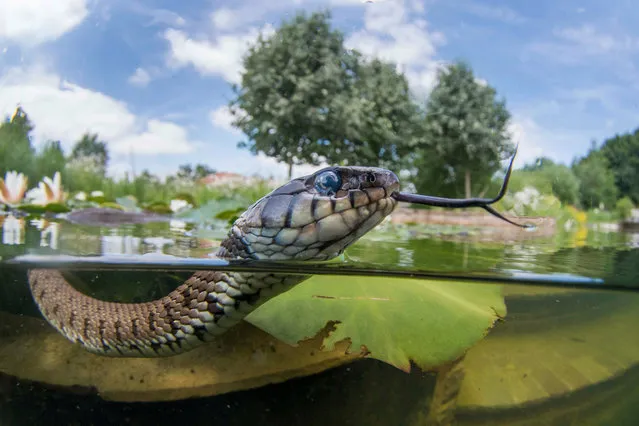
British Waters Wide Angle category runner-up. Grass snake swimming along a garden pond by Jack Perks (UK)in Nottinghamshire, UK. “I’m always on the lookout for unusual freshwater subjects and grass snakes are a species I’ve been after for years. I was told about a pond where the odd grass snake hangs around the lilly pads for frogs. I put my drysuit on and got into the water and could see one slithering along the surface. Slowly making my way towards it with my head only just poking above I got the spilt shot”. (Photo by Jack Perks/Underwater Photographer of the Year 2019)

British Waters Wide Angle category runner-up. Grass snake swimming along a garden pond by Jack Perks (UK)in Nottinghamshire, UK. “I’m always on the lookout for unusual freshwater subjects and grass snakes are a species I’ve been after for years. I was told about a pond where the odd grass snake hangs around the lilly pads for frogs. I put my drysuit on and got into the water and could see one slithering along the surface. Slowly making my way towards it with my head only just poking above I got the spilt shot”. (Photo by Jack Perks/Underwater Photographer of the Year 2019)
Details
28 Feb 2019 00:03:00
Diesel is poured into a container at theArea 10 shopping centre in Abuja, Nigeria May 25, 2015. (Photo by Afolabi Sotunde/Reuters)

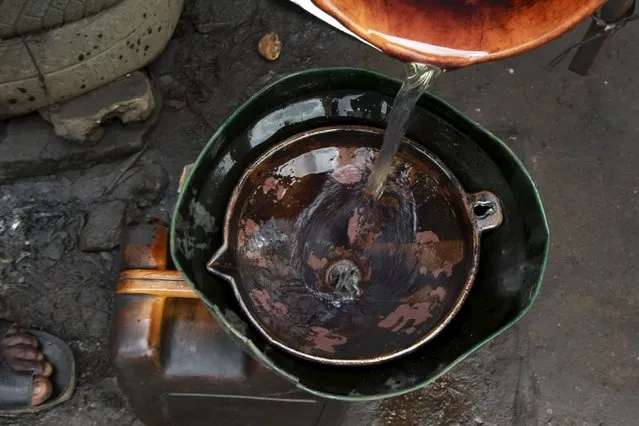
Diesel is poured into a container at theArea 10 shopping centre in Abuja, Nigeria May 25, 2015. Nigerian fuel marketers agreed to resume distribution on Monday after weeks of disruption led to chronic fuel shortages, bringing phone companies, banks and airlines to a standstill days before the inauguration of the country's new president. (Photo by Afolabi Sotunde/Reuters)
Details
26 May 2015 10:59:00
Cheerleaders let their hair fly as they perform prior to a German first division Bundesliga soccer match between 1. FC Cologne and Bayern Munich in Cologne, Germany, March 4, 2017. (Photo by Michael Probst/AP Photo)

Cheerleaders let their hair fly as they perform prior to a German first division Bundesliga soccer match between 1. FC Cologne and Bayern Munich in Cologne, Germany, March 4, 2017. (Photo by Michael Probst/AP Photo)
Details
05 Mar 2017 07:45:00
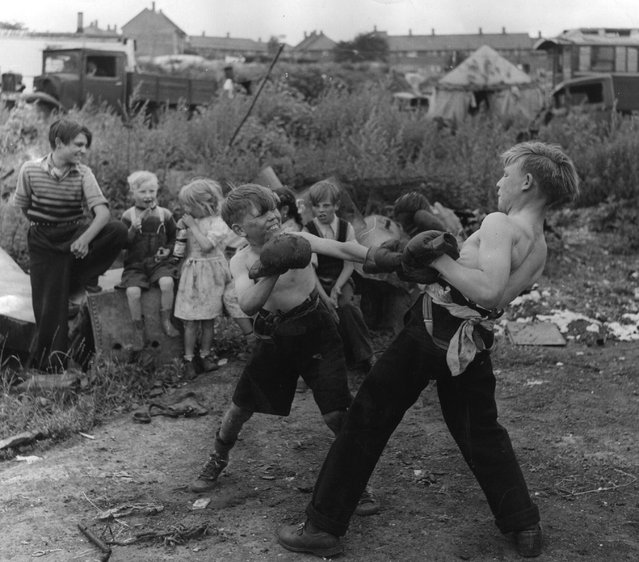
The unromantic gypsies. Children boxing in a gypsy camp in Kent, England on July 1, 1951. Like all boys these gypsy lads like to try their hand at boxing. Encouraged by their friends they fight it out on Corke's Meadow. Few Romanies now live a life of wandering romance. Most are like the three hundred squatters of Corke's Meadow, Kent, which is part of a “gypsy problem” that involves about 100,000 today. Of those about 25,000 can be rightly called gypsies, the rest are Mumpers and Posh-rats and Hobos. Corke's Meadow has both kinds. “Picture Post” cameraman Bert Hardy photographs the Corke's Meadow gypsies in their encampment. (Photo by Hulton-Deutsch Collection/Corbis via Getty Images)

The unromantic gypsies. Children boxing in a gypsy camp in Kent, England on July 1, 1951. Like all boys these gypsy lads like to try their hand at boxing. Encouraged by their friends they fight it out on Corke's Meadow. Few Romanies now live a life of wandering romance. Most are like the three hundred squatters of Corke's Meadow, Kent, which is part of a “gypsy problem” that involves about 100,000 today. Of those about 25,000 can be rightly called gypsies, the rest are Mumpers and Posh-rats and Hobos. Corke's Meadow has both kinds. “Picture Post” cameraman Bert Hardy photographs the Corke's Meadow gypsies in their encampment. (Photo by Hulton-Deutsch Collection/Corbis via Getty Images)
Details
12 Mar 2017 00:01:00
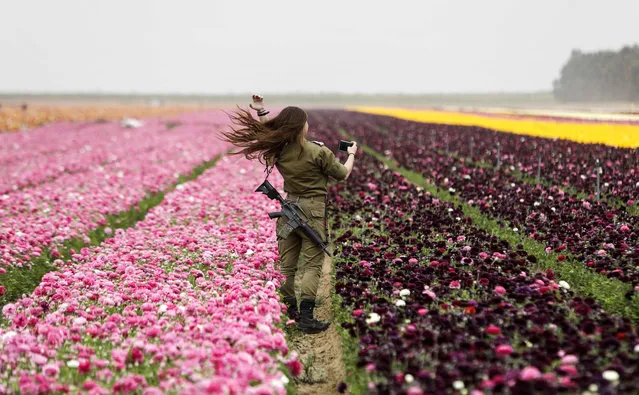
An Israeli soldier looks through her cell phone as she enjoys the Ranunculus flowers in a field in the southern Israeli Kibbutz of Nir Yitzhak, located along the Israeli- Gaza Strip border, during the Jewish holiday of Pesach (Passover) on April 12, 2017. (Photo by Menahem Kahana/AFP Photo)

An Israeli soldier looks through her cell phone as she enjoys the Ranunculus flowers in a field in the southern Israeli Kibbutz of Nir Yitzhak, located along the Israeli- Gaza Strip border, during the Jewish holiday of Pesach (Passover) on April 12, 2017. (Photo by Menahem Kahana/AFP Photo)
Details
21 Apr 2017 07:54:00
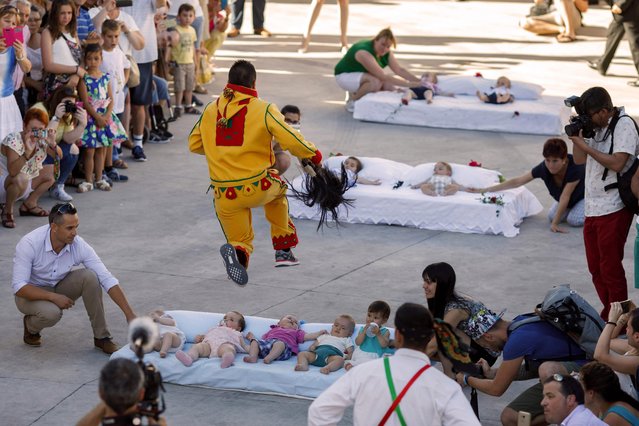
A man dressed up as the devil jumps over babies lying on a mattress in the street during “El Colacho”, the “baby jumping festival” in the village of Castrillo de Murcia, near Burgos on June 18, 2017. Baby jumping (El Colacho) is a traditional Spanish practice dating back to 1620 that takes place annually to celebrate the Catholic feast of Corpus Christi. During the act – known as El Salto del Colacho (the devil's jump) or simply El Colacho – men dressed as the Devil jump over babies born in the last twelve months of the year who lie on mattresses in the street. (Photo by Cesar Manso/AFP Photo)

A man dressed up as the devil jumps over babies lying on a mattress in the street during “El Colacho”, the “baby jumping festival” in the village of Castrillo de Murcia, near Burgos on June 18, 2017. Baby jumping (El Colacho) is a traditional Spanish practice dating back to 1620 that takes place annually to celebrate the Catholic feast of Corpus Christi. During the act – known as El Salto del Colacho (the devil's jump) or simply El Colacho – men dressed as the Devil jump over babies born in the last twelve months of the year who lie on mattresses in the street. (Photo by Cesar Manso/AFP Photo)
Details
20 Jun 2017 07:29:00
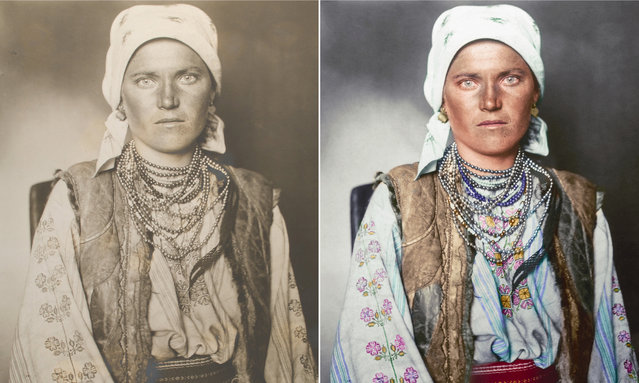
A Ruthenian woman circa 1906 from the region historically inhabiting the kingdom of the Rus, incorporating parts of modern-day Slavic speaking countries. Her outfit consists of a shirt and underskirt made from linen embroidered with traditional floral-based patterns. (Photo by Augustus Francis Sherman/New York Public Library/The Guardian)

Many of the 12 million people who entered the US through New York’s Ellis Island wore traditional dress from their homelands. Here: A Ruthenian woman circa 1906 from the region historically inhabiting the kingdom of the Rus, incorporating parts of modern-day Slavic speaking countries. Her outfit consists of a shirt and underskirt made from linen embroidered with traditional floral-based patterns. (Photo by Augustus Francis Sherman/New York Public Library/The Guardian)
Details
03 Oct 2016 09:15:00