Loading...
Done
Taylor's sister, who works in an animal rescue center, found this baby jackdaw who was in need of a little extra love and attention before being released into the wild

Mark Taylor may not have any training as a photographer, but that doesn’t stop him from taking amazing animal photos. From his studio in Southeast England, Taylor has made a big business out of photographing man’s best friends, following in the footsteps of his late mother, Jane Burton. Most of the animals he works with are babies, who are more comfortable in front of the camera than older animals.

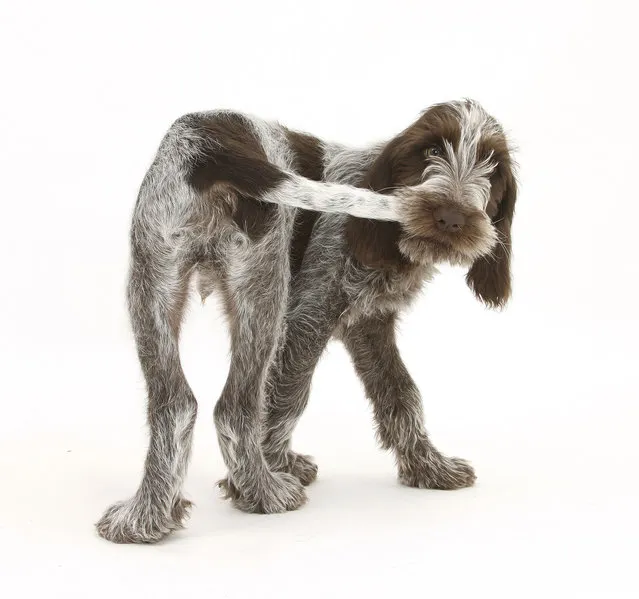
Photo: Taylor often uses animals that belonged to friends of his late mother, including this Italian Spinone puppy chewing his tail. Baby animals make ideal subjects, as the older dogs and cats get, the warier they are of spending time in a studio. And his trick for getting this small subject to pose? Dog treats, of course. (Photo by Mark Taylor/Rex Features)
Details
27 Apr 2012 13:45:00
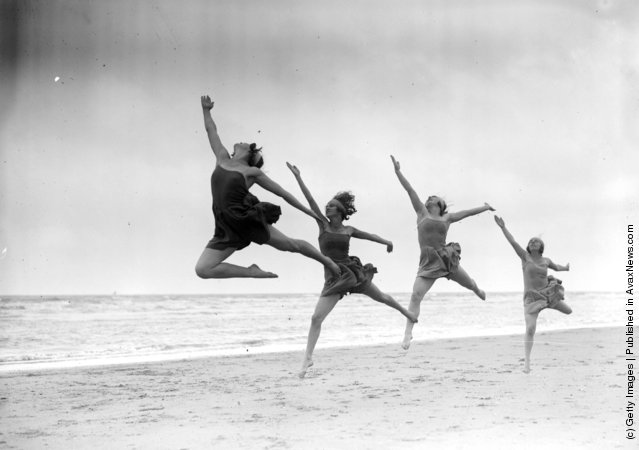
1929: Margaret Morris dancers exercising on the sands at Saint-Idesbald

Margaret Morris dancers exercising on the sands at Saint-Idesbald. (Photo by Fox Photos/Getty Images). August 1929
Details
23 Oct 2011 15:43:00
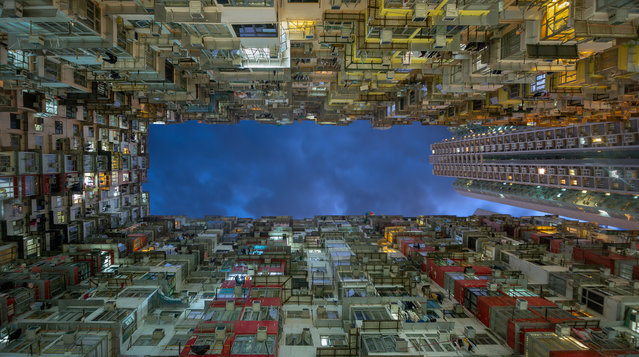
Winner. “I took this vertical image in the Quarry Bay district of Hong Kong during the dusk ‘blue hour’, when there was a perfect balance between the ambient light in the sky and the artificial lights of the high-rise residential buildings”. MICK RYAN, JUDGE: “Quarry Bay is a rich area for great shots and this is a particularly striking image of these old apartments, a unique perspective that was wisely taken as the light fades and the apartment lights come on”. (Photo by Jatinder Heer/The Guardian)

Winner. “I took this vertical image in the Quarry Bay district of Hong Kong during the dusk ‘blue hour’, when there was a perfect balance between the ambient light in the sky and the artificial lights of the high-rise residential buildings”. (Photo by Jatinder Heer/The Guardian)
Details
02 Nov 2018 00:05:00
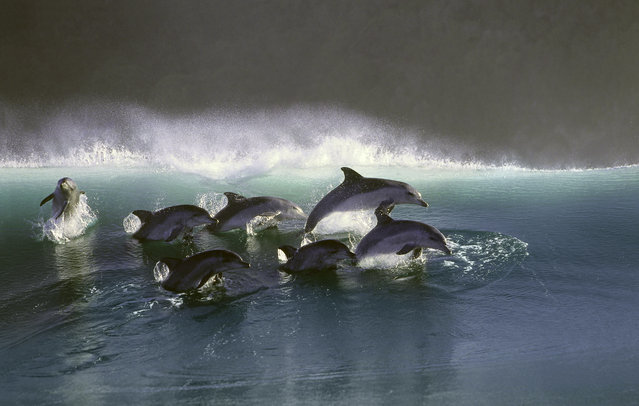
Pod of dolphins surf effortlessly through the waves in the wild traveling at speeds up to 20 mph

Pod of dolphins surf effortlessly through the waves in the wild traveling at speeds up to 20 mph. (Photo by Greg Huglin)
Details
01 May 2012 11:43:00
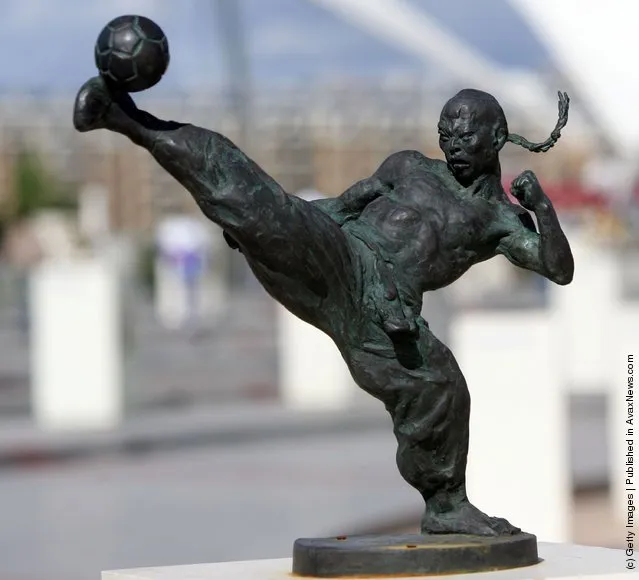
Chinese Olympic Sculpture

A sculpture is displayed at the Olympic Sculptures Exhibition at the Sculpture Park September 4, 2006 in Changchun of Jilin Province, China. (Photo by China Photos/Getty Images)
Details
12 Aug 2011 12:01:00
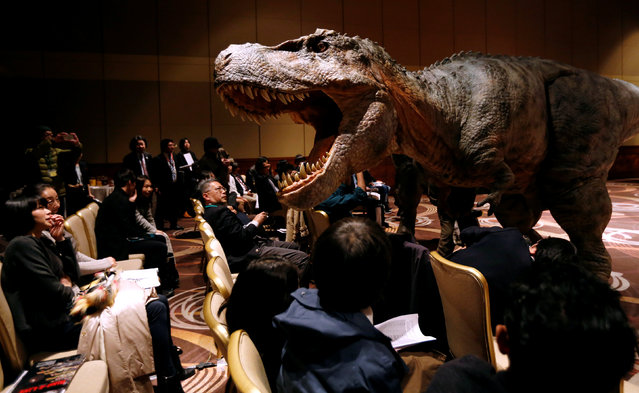
Japan's On-Art Corp's eight metre tall dinosaur-shaped mechanical suit robot “TRX03” performs during its unveiling in Tokyo, Japan November 10, 2016. (Photo by Toru Hanai/Reuters)

Japan's On-Art Corp's eight metre tall dinosaur-shaped mechanical suit robot “TRX03” performs during its unveiling in Tokyo, Japan November 10, 2016. Stomping and roaring dinosaurs took to the stage in Tokyo on Thursday as part of a presentation for a proposed entertainment park where visitors will be able to see the realistic replicas first-hand. Japanese firm ON-ART Corp. unveiled man-operated robotic models of raptors, an allosaurus and a tyrannosaurus rex, in a performance at a hotel hall. (Photo by Toru Hanai/Reuters)
Details
11 Nov 2016 08:32:00
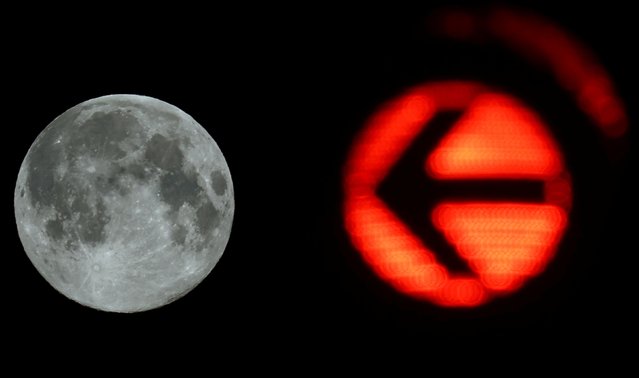
A traffic light is seen next to the Pink Supermoon in Frankfurt, Germany, April 8, 2020. (Photo by Kai Pfaffenbach/Reuters)

A traffic light is seen next to the Pink Supermoon in Frankfurt, Germany, April 8, 2020. (Photo by Kai Pfaffenbach/Reuters)
Details
10 Apr 2020 00:03:00
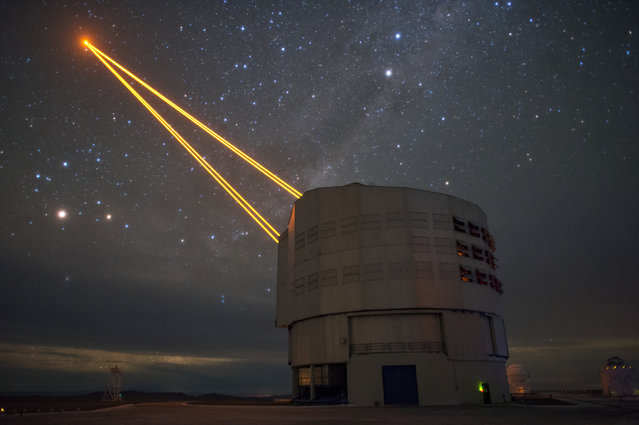
Four pillars of light from the 4 Laser Guide Star Facility on ESO's Very Large Telescope (VLT) are shown reaching into the Chilean night sky in this image from ESO Photo Ambassador Fred Kamphues, on September 2, 2016. The lasers are a key part of the adaptive optics system on the VLT. Adaptive optics allows astronomers to drastically reduce the atmospheric distortion present at even the best sites in the world for astronomy, including Paranal in Chile, the home of the VLT. (Photo by F. Kamphues/ESO)

Four pillars of light from the 4 Laser Guide Star Facility on ESO's Very Large Telescope (VLT) are shown reaching into the Chilean night sky in this image from ESO Photo Ambassador Fred Kamphues, on September 2, 2016. The lasers are a key part of the adaptive optics system on the VLT. Adaptive optics allows astronomers to drastically reduce the atmospheric distortion present at even the best sites in the world for astronomy, including Paranal in Chile, the home of the VLT. (Photo by F. Kamphues/ESO)
Details
23 Feb 2017 00:06:00