Loading...
Done
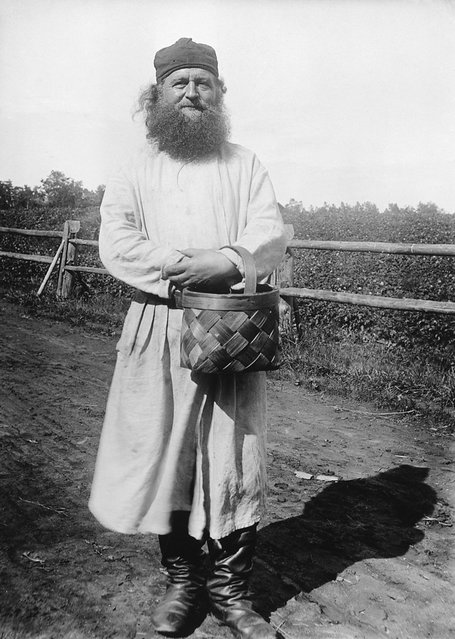
Priest, Valamo Monastery, Karelia, Russia (then Finland), 1930s. Father Venerius with a birchbark basket. (Photo by Einar Erici)

“Einar Erici (1885–1965) was a physician by profession, working at a tuberculosis hospital in Stockholm, even running a private medical practice. He was by then the most renowned Swedish expert of church organs and organ builders, and his archival collection is today held by the Swedish National Heritage Board. This archive includes mostly writings, such as letters and manuscripts for published articles and essays, but also more than 2 000 black and white photos – original prints, glass plates and film negatives”. – Swedish National Heritage Board

Photo: Priest, Valamo Monastery, Karelia, Russia (then Finland), 1930s. Father Venerius with a birchbark basket. (Photo by Einar Erici)
Details
09 Dec 2012 11:41:00
Roma Community In Romania

“Inspired by the French authorities' solution to move Romas from point A to point B, Romanian authorities planned and started forced evictions of Roma informal settlements in cities like Cluj-Napoca and Baia Mare. Some of these settlements date back to the early 1990’s. These communities were tolerated by the authorities who verbally encouraged Romas to build in the area, meanwhile, reassuring them nothing bad would ever happen to them. However, the the reality today is that during political campaigns, authorities are planning forced evictions without reasons other than ethnic cleansing of the cities. My home documents the every day life of Roma communities in Romania, 2011”. – Mugur Varzariu. (Photo by Mugur Varzariu, 2011 FotoVisura Grant Finalist)
Details
20 Apr 2012 13:22:00
Is it a leaf? Is it tree bark? No, it’s the Satanic leaf-tailed gecko. Cleverly disguised as a rotting leaf, Madagascar’s camouflage king has red eyes, pointy horns and a taste for night hunting: it’s nature’s most devilish deceiver. (Photo by Thomas Marent/ARDEA)

Is it a leaf? Is it tree bark? No, it’s the Satanic leaf-tailed gecko. Cleverly disguised as a rotting leaf, Madagascar’s camouflage king has red eyes, pointy horns and a taste for night hunting: it’s nature’s most devilish deceiver. The twisted body and veiny skin echo the detail of a dry leaf, which ensures the gecko blends in with its forest home. The mottled tail appears to have sections missing, as though it has withered over time. This mini-monster epitomises survival of the fittest, having adapted gradually to become today’s extraordinary leaf impersonator. (Photo by Thomas Marent/ARDEA)
Details
20 Nov 2015 08:03:00
State Plates Project By Jonathan Lawrence

You have to agree, that most of the designs of the license plates in the United States are pretty boring and bland. In most cases, a three-year-old could have done a better job. This is the reason why Jonathan Lawrence has decided to create a project of redesigning the license plates of all 50 states. His designs feature fresh vibrant colors, as well as clean and readable design. These are the license plates you’d want to use if you have anything that is better than a rundown, old pickup truck (no offence to owners of rundown, old pickup trucks). Some of his designs are humorous, some are strict and official; however, all of them look better than the license plates that are in circulation today. (Photo by Jonathan Lawrence)
Details
24 Nov 2014 13:45:00
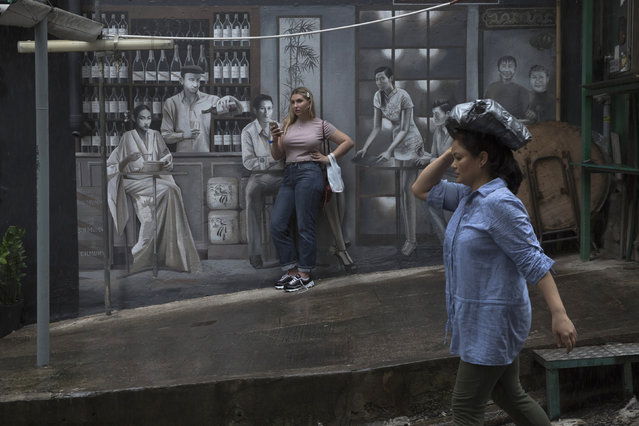
In this June 12, 2017 photo, a woman stands in front of a mural on the slope in Central district, Hong Kong. (Photo by Kin Cheung/AP Photo)

In this June 12, 2017 photo, a woman stands in front of a mural on the slope in Central district, Hong Kong. Once known as Victoria after the British queen, Hong Kong island's waterfront formed the core of the British settlement after Hong Kong island was handed over as a colony in 1842. Today as Hong Kong approaches the 20th anniversary of its return to China, it remains a bustling commercial and financial center as well as the location of the main government offices. However, along the streets that angle sharply upward toward the mountains above, a more relaxed pace of life endures. (AP Photo/Kin Cheung)
Details
28 Jun 2017 08:18:00


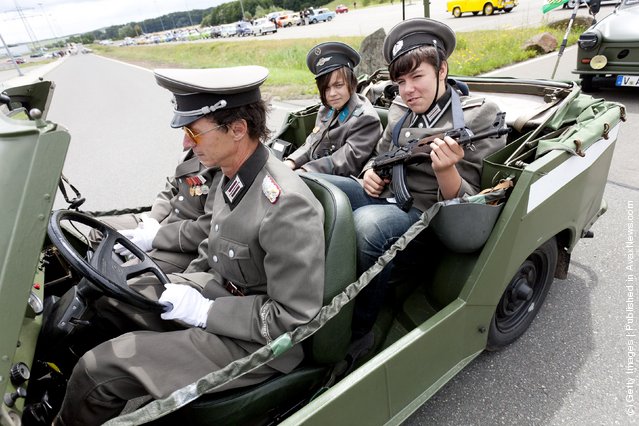
“The Trabant is a car that was produced by former East German auto maker VEB Sachsenring Automobilwerke Zwickau in Zwickau, Sachsen. It was the most common vehicle in East Germany, and was also exported to countries both inside and outside the communist bloc. The main selling points was that it had room for four adults and luggage in a compact, light and durable shell and that it was fast (when introduced) and durable. With its mediocre performance, smoky two-stroke engine, and production shortages, the Trabant is often cited as an example of the disadvantages of centralized planning; on the other hand, it is regarded with derisive affection as a symbol of the failed former East Germany and of the fall of communism (in former West Germany, as many East Germans streamed into West Berlin and West Germany in their Trabants after the opening of the Berlin Wall in 1989). It was in production without any significant changes for nearly 30 years with 3,096,099 Trabants produced in total”. – Wikipedia

Photo: Enthusiasts weared in uniforms of the former eastern german army trive in a military Trabant car as fans and owners of East German-era Trabant cars gather at the 2011 International Trabantfahrer Treffen (International Trabant Drivers Meeting) on June 26, 2011 in Zwickau, Germany. The Trabant, also known as the Trabi, was among the main cars produced in communist East Germany and built by VEB Sachsenring Automobilwerke in Zwickau for 30 years until 1989. Today the car has cult status for many followers and one company, IndiKar, is even seeking to revive the brand in a modern, electric version. (Photo by Carsten Koall/Getty Images)
Details
27 Jun 2011 12:21:00
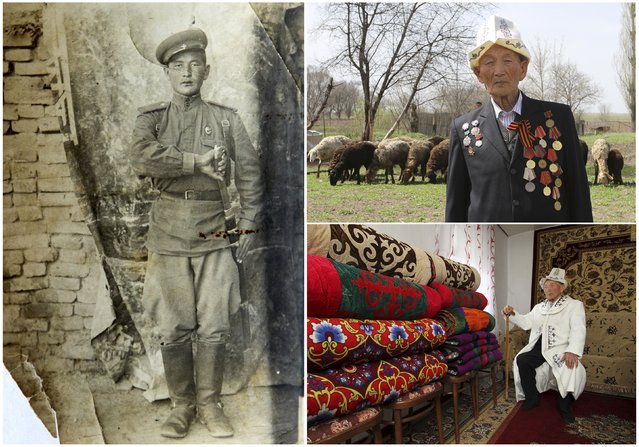
World War Two veteran Abla Begaliyev, 91, is seen in an undated handout picture (L), poses for a picture in Arashan (Top R) and at home in Kyrgyzstan April 14, 2015. Begaliyev served in the border guard cavalry from February 1942 until April 1947. Originally from Kyrgyzstan, he fought on the Ukrainian front and relocated to the border with Afghanistan at the end of World War Two. (Photo by Vladimir Pirogov/Reuters/Family handout (L))

World War Two veteran Abla Begaliyev, 91, is seen in an undated handout picture (L), poses for a picture in Arashan (Top R) and at home in Kyrgyzstan April 14, 2015. Begaliyev served in the border guard cavalry from February 1942 until April 1947. Originally from Kyrgyzstan, he fought on the Ukrainian front and relocated to the border with Afghanistan at the end of World War Two. As the world marks the 70th anniversary of the end of World War Two, Reuters photographers the length and breadth of the former Soviet republics (CCCP) captured portraits of Red Army veterans, mostly now in their 80s and 90s, today and through archive pictures at the time. More than 20 million Soviet citizens were killed in the war. (Photo by Vladimir Pirogov/Reuters/Family handout (L))
Details
08 May 2015 14:22:00
Jenna carefully watches two giant boa constrictors that their owner, a street performer she barely knows, entrusted to her. She is careful to keep the one snake wrapped around exercise bars to prevent a wound in the animal’s mouth from touching the sand and getting infected. Jenna is a single mom on disability. She suffers from failed back surgery syndrome, acquired from a violent car accident she had as a teenager. She and her young son Jackson can be found most afternoons on the beach. Originally from South Carolina, Jenna came to Venice in 2010 and describes herself as “an open-minded Christian who loves everyone for who they are”. Nowadays Jenna sometimes has trouble reconciling her inclusive progressive values with her family’s conservative political stance, especially in today’s toxic political climate. (Photo by Dotan Saguy)

Over the past three years, Los Angeles-based photographer Dotan Saguy has spent hundreds of hours documenting the diverse culture, people and pageantry of the iconic Venice Beach boardwalk. He was irresistibly drawn to the free-spirited, anti-materialistic and inclusive nature of the world-famous location, which he found to be a breath of fresh air in contrast to Los Angeles’s sometimes homogenized, celebrity-obsessed culture. (Photo by Dotan Saguy)
Details
01 Aug 2018 00:03:00