Loading...
Done


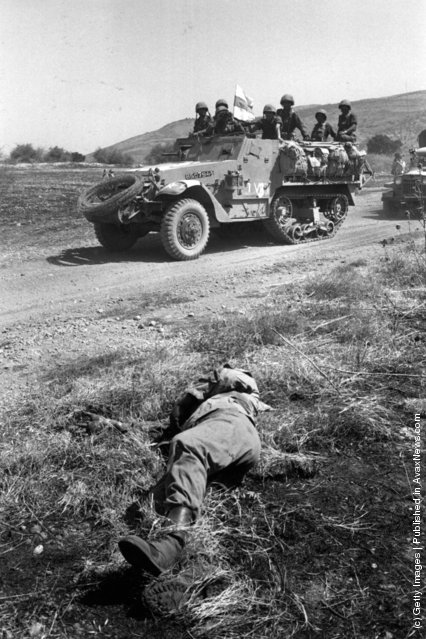
“The Six-Day War or June War, also known as the 1967 Arab-Israeli War or the Third Arab-Israeli War, was fought between June 5 and June 10, 1967, by Israel and the neighboring states of Egypt (known then as the United Arab Republic [UAR]), Jordan, and Syria. The war began with a large-scale surprise air strike by Israel on Egypt. The outcome was a swift and decisive Israeli victory. Israel took effective control of the Gaza Strip and the Sinai Peninsula from Egypt, the West Bank and East Jerusalem from Jordan, and the Golan Heights from Syria. Opinions are divided on whether Israel's attack was an act of aggression or a preemptive strike of a defensive nature”. – Wikipedia

Photo: The corpse of a soldier lying on the line of the Israeli advance into Syria during the Six-Day War. (Photo by Terry Fincher/Getty Images). 1967
Details
21 May 2011 08:29:00
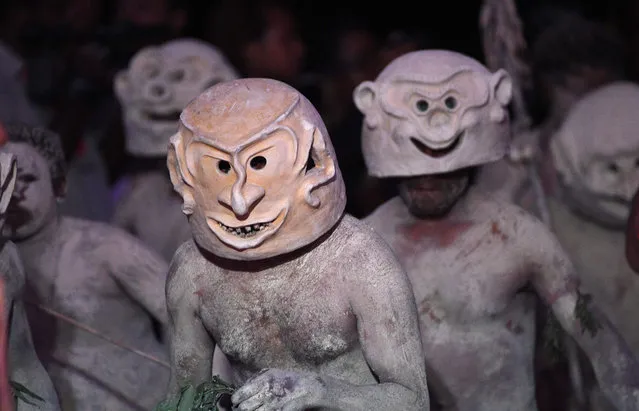
A picture made available on 09 September 2015 shows traditional mud men dancers from the Asaro District of Goroka in the Eastern Highlands Province of Papua New Guinea perform for the official opening of the Pacific Islands Forum in Port Moresby, Papua New Guinea, 08 September 2015. The Pacific Islands Forum goes from 07 to 11 September and discusses the regions vulnerability to Climate Change. (Photo by Mick Tsikas/EPA)

A picture made available on 09 September 2015 shows traditional mud men dancers from the Asaro District of Goroka in the Eastern Highlands Province of Papua New Guinea perform for the official opening of the Pacific Islands Forum in Port Moresby, Papua New Guinea, 08 September 2015. The Pacific Islands Forum goes from 07 to 11 September and discusses the regions vulnerability to Climate Change. (Photo by Mick Tsikas/EPA)
Details
10 Sep 2015 13:38:00
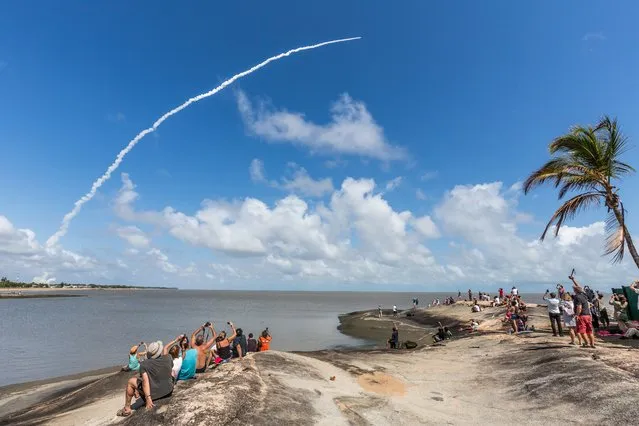
People take photos as an Ariane 5 space rocket with a payload of four Galileo satellites lifts off from ESA's European Spaceport in Kourou, French Guiana, on November 17, 2016. Ariane 5 successfully launched on November 17 four satellites which will be part of the Galileo global satellite navigation system. (Photo by Jody Amiet/AFP Photo)

People take photos as an Ariane 5 space rocket with a payload of four Galileo satellites lifts off from ESA's European Spaceport in Kourou, French Guiana, on November 17, 2016. Ariane 5 successfully launched on November 17 four satellites which will be part of the Galileo global satellite navigation system. (Photo by Jody Amiet/AFP Photo)
Details
18 Nov 2016 15:38:00
Two Chinese farmers got more than they bargained for when they pulled up the root of a fleece flower – and came face-to-face with the doppelganger of Homer Simpson, on May 17, 2013. The large root appears to have two bulging eyes and a prominent nose – giving it an uncanny resemblance to the famous cartoon character. With two offshoot roots shaped like arms, it even looks like it is pondering or confused – just what you would expect from the real Homer. (Photo by ImagineChina)

Two Chinese farmers got more than they bargained for when they pulled up the root of a fleece flower – and came face-to-face with the doppelganger of Homer Simpson, on May 17, 2013. The large root appears to have two bulging eyes and a prominent nose – giving it an uncanny resemblance to the famous cartoon character. With two offshoot roots shaped like arms, it even looks like it is pondering or confused – just what you would expect from the real Homer. (Photo by ImagineChina)
Details
18 May 2013 11:52:00
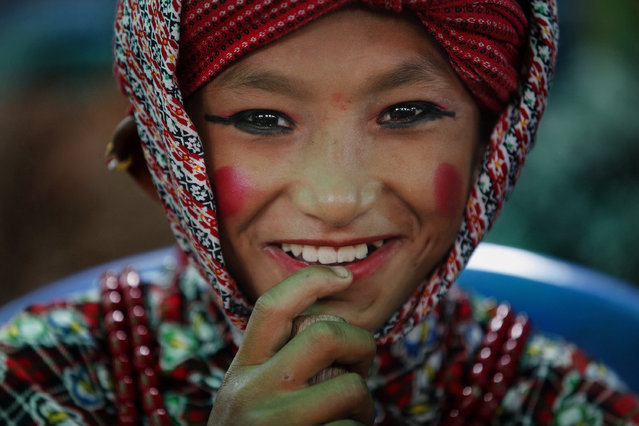
A Nepalese boy gets ready to perform a stick dance during a rally held to pay tribute to the victims of an earthquake, in Bhaktapur, Nepal, Wednesday, September 2, 2015. Two powerful earthquakes in April and May devastated the Himalayan nation killing more than 8,800 people. (Photo by Niranjan Shrestha/AP Photo)

A Nepalese boy gets ready to perform a stick dance during a rally held to pay tribute to the victims of an earthquake, in Bhaktapur, Nepal, Wednesday, September 2, 2015. Two powerful earthquakes in April and May devastated the Himalayan nation killing more than 8,800 people. (Photo by Niranjan Shrestha/AP Photo)
Details
03 Sep 2015 13:07:00
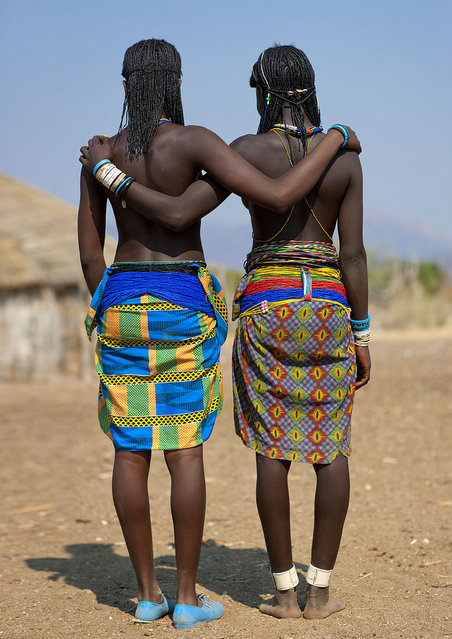
“Show us our butts! Mucawana tribe – Angola. In Soba village, the Muhacaona (Mucawana) tribe, perhaps the best place i have visited. They use cow dung and fat to make this so nice haircut, and love the beads. They asked me to make pictures of their backs... and butts to see on the camera screen if everything was perfect!”. (Eric Lafforgue)

“Show us our butts! Mucawana tribe – Angola. In Soba village, the Muhacaona (Mucawana) tribe, perhaps the best place i have visited. They use cow dung and fat to make this so nice haircut, and love the beads. They asked me to make pictures of their backs... and butts to see on the camera screen if everything was perfect!”. (Photo and comments by Eric Lafforgue)
Details
09 Nov 2012 15:04:00
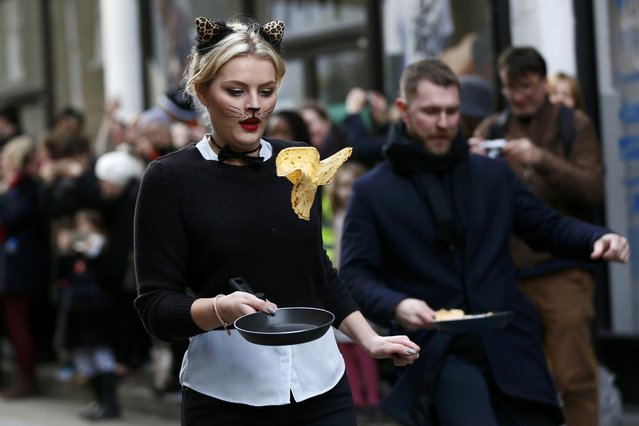
Participants take part in the annual Great Spitalfields Pancake Race in aid of London's Air Ambulance in London, Britain February 9, 2016. (Photo by Stefan Wermuth/Reuters)

Participants take part in the annual Great Spitalfields Pancake Race in aid of London's Air Ambulance in London, Britain February 9, 2016. (Photo by Stefan Wermuth/Reuters)
Details
10 Feb 2016 12:13:00


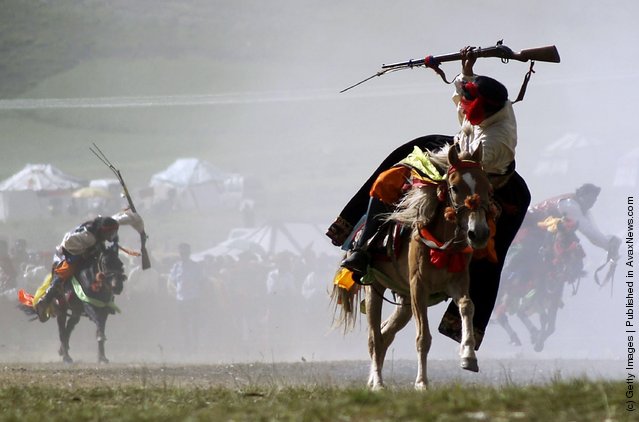
A Tibetan rider fires his weapon as he perfoms his riding skills at the Qinghai Yushu Horse Racing Festival on July 27, 2007 in Yushu County of Yushu Tibetan Autonomous Prefecture, Qinghai Province, northwest China. The Horse Racing Festival of Tibetan nomads in Yushu Prefecture falls in late July and early August on the Tibetan calendar. During the festival, various equestrian skills will be performed along with singing, dancing and costume shows. (Photo by China Photos/Getty Images)
Details
03 Apr 2011 12:33:00