Loading...
Done
A visitor takes a photo of a boulder plastic made of synthetic material called “To be in Limbo” hangs from the ceiling of the 20 meter high Jesuit Church in Vienna, Austria, Tuesday, November 25, 2014. (Photo by Ronald Zak/AP Photo)

A visitor takes a photo of a boulder plastic made of synthetic material called “To be in Limbo” hangs from the ceiling of the 20 meter high Jesuit Church in Vienna, Austria, Tuesday, November 25, 2014. The eight meter high, hollow and 700 kilogram heavy sculpture from the artists group Steinbrener/Dempf and Huber is supposed to symbolize faith and its threatening moments. The installation will remain until April 19, 2015 and then move to a church in Hamburg, Germany. (Photo by Ronald Zak/AP Photo)
Details
29 Nov 2014 12:08:00
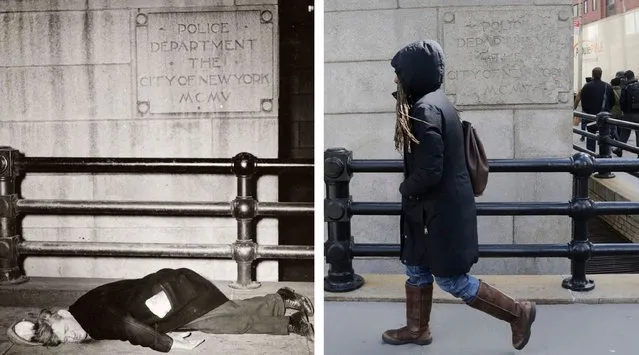
A new book of photos by legendary photographer Weegee shows what industrialized, pre-gentrified New York looked like in the mid-20th century, before the city was crammed with towers and billboards. (Photo by AP Photo/Copyright Weegee/The International Center of Photography, Mark Lennihan)

A new book of photos by legendary photographer Weegee shows what industrialized, pre-gentrified New York looked like in the mid-20th century, before the city was crammed with towers and billboards. Here: this combination shows the 1945 photo “Derelict sleeping on the sidewalk outside police headquarters” by Weegee, provided by the International Center of Photography in New York, and a woman walking on the same spot on Wednesday, March 18, 2015. (Photo by AP Photo/Copyright Weegee/The International Center of Photography, Mark Lennihan)


Details
27 Mar 2015 13:16:00
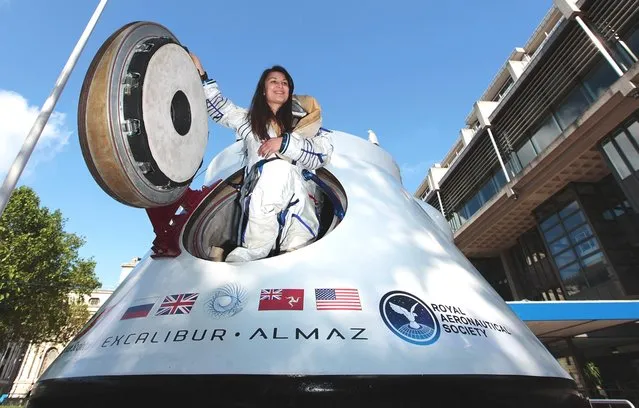
Jenn Sander from Red Robin PR, wearing a spacesuit once worn by US Astronaut Peggy Whitson, sits inside a re-entry capsule owned by Excalibur Almaz

A British space-exploration company has revealed its aim to fly the public to the moon from 2015 – providing they have £100m for a ticket.

Photo: Jenn Sander from Red Robin PR, wearing a spacesuit once worn by US Astronaut Peggy Whitson, sits inside a re-entry capsule owned by Excalibur Almaz outside the Queen Elizabeth II Centre on June 19, 2012 in London, England. The company today announced their plan to fly people to the moon on what is the 40th anniversary year of the Apollo 17 moon landing. (Photo by Rosie Hallam)
Details
20 Jun 2012 10:07:00
People run away as a building is toppled during a controlled demolition as part of an urban transformation in Ankara, Turkey, February 3, 2014. (Photo by Serap Doganyigit/Reuters)

People run away as a building is toppled during a controlled demolition as part of an urban transformation in Ankara, Turkey, February 3, 2014. (Photo by Serap Doganyigit/Reuters)
Details
29 Mar 2017 09:32:00
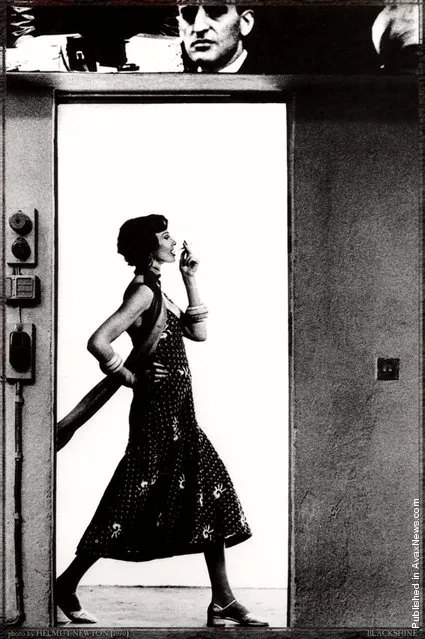
Photographers: Helmut Newton

“Newton was born in Berlin, the son of Klara “Claire” (Marquis) and Max Neustädter, a button factory owner. His family was Jewish. Newton attended the Heinrich-von-Treitschke-Realgymnasium and the American School in Berlin. Interested in photography from the age of 12 when he purchased his first camera, he worked for the German photographer Yva (Elsie Neulander Simon) from 1936. The increasingly oppressive restrictions placed on Jews by the Nuremberg laws meant that his father lost control of the factory in which he manufactured buttons and buckles; he was briefly interned in a concentration camp on “Kristallnacht”, November 9, 1938, which finally compelled the family to leave Germany. Newton's parents fled to South America. He was issued with a passport just after turning 18, and left Germany on December 5, 1938. At Trieste he boarded the “Conte Rosso” (along with about 200 others escaping the Nazis) intending to journey to China. After arriving in Singapore he found he was able to remain there, first and briefly as a photographer for the Straits Times and then as a portrait photographer”. – Wikipedia

Photo: Sigourney Weaver by Helmut Newton, 1995.

Details
08 Apr 2012 13:49:00
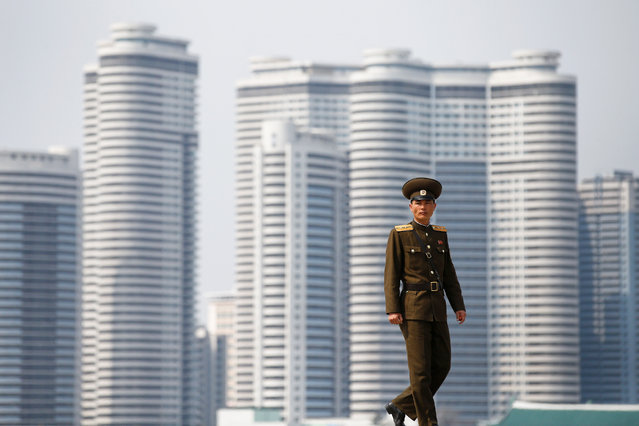
A soldier walks on the bank of the river in central Pyongyang, North Korea on April 16, 2017. (Photo by Damir Sagolj/Reuters)

A soldier walks on the bank of the river in central Pyongyang, North Korea on April 16, 2017. (Photo by Damir Sagolj/Reuters)
Details
20 Jan 2018 07:01:00
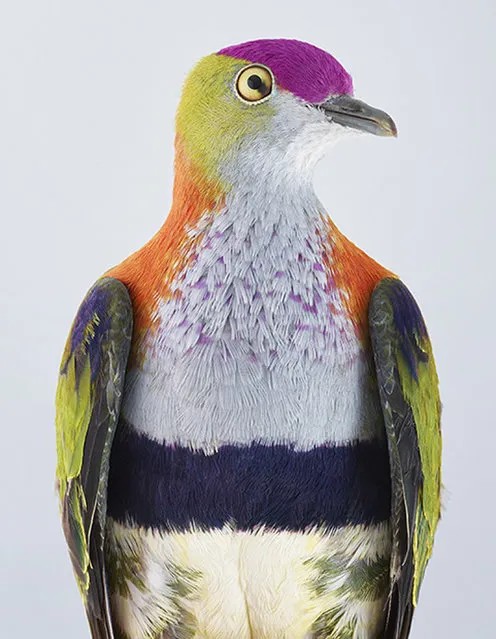
The series, which was photographed between 2015 and 2017, is currently on display at the Purdy Hicks Gallery in London, running through August 24, 2018. (Photo by Leila Jefferies/Caters News Agency)

This photographer has made it her mission to change people’s perception of pigeons – focusing on some of the most beautiful of the more than 300 species found globally. Rather than focus on the gray, nondescript birds people usually associate with the term “pigeon”, Leila Jeffreys has instead decided to snap the more vibrant varieties. Whether it be the wompoo pigeon, with its deep purple breast and green wings, or the rose-crowned fruit dove, with its pink head, Jeffreys, 46, gives the birds the same attention she would give a human model. (Photo by Leila Jefferies/Caters News Agency)
Details
14 Aug 2018 00:01:00
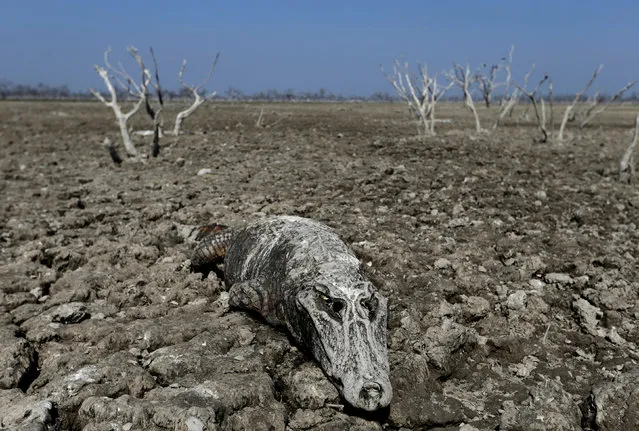
The carcass of a yacare caiman lies in the dried-up river bed of the Pilcomayo river in Boqueron, Paraguay, August 14, 2016. In Paraguay, alongside the Pilcomayo River, black vultures flew over a shrinking pond where a group of crocodilian reptiles known as yacare caimans sought refuge. Water from the river, which divides Paraguay and Argentina in the area of the Gran Chaco, was scarce. This is not an uncommon sight in the region of General Diaz, about 700 kilometres (435 miles) northwest of the country's capital Asuncion, where the Pilcomayo's waters form lakes and streams that give life to capybaras, birds and caimans. “The river's situation is critical. No water is forecast to enter the basin until December, as happens every year”, said Alcides Gonzalez, a resident of the area. (Photo by Jorge Adorno/Reuters)

The carcass of a yacare caiman lies in the dried-up river bed of the Pilcomayo river in Boqueron, Paraguay, August 14, 2016. In Paraguay, alongside the Pilcomayo River, black vultures flew over a shrinking pond where a group of crocodilian reptiles known as yacare caimans sought refuge. Water from the river, which divides Paraguay and Argentina in the area of the Gran Chaco, was scarce. This is not an uncommon sight in the region of General Diaz, about 700 kilometres (435 miles) northwest of the country's capital Asuncion, where the Pilcomayo's waters form lakes and streams that give life to capybaras, birds and caimans. (Photo by Jorge Adorno/Reuters)
Details
03 Nov 2016 12:40:00