Loading...
Done
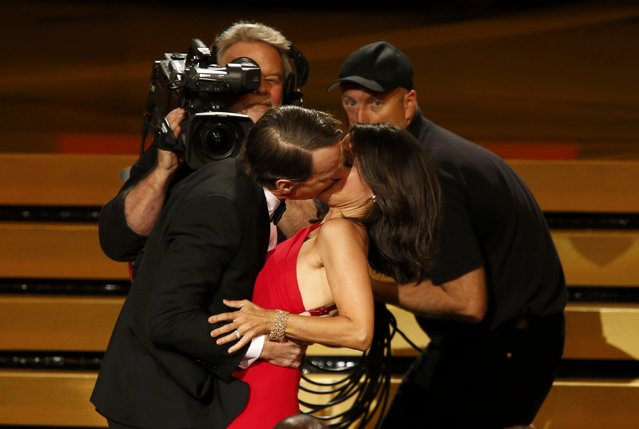
Actor Bryan Cranston engages Julia-Louis Dreyfus in a prolonged kiss as she takes the stage to accept the award for Outstanding Lead Actress In A Comedy Series for her role in HBO's “Veep” during the 66th Primetime Emmy Awards in Los Angeles, California August 25, 2014. (Photo by Mario Anzuoni/Reuters)

Actor Bryan Cranston engages Julia-Louis Dreyfus in a prolonged kiss as she takes the stage to accept the award for Outstanding Lead Actress In A Comedy Series for her role in HBO's “Veep” during the 66th Primetime Emmy Awards in Los Angeles, California August 25, 2014. (Photo by Mario Anzuoni/Reuters)
Details
30 Aug 2014 10:28:00
Crown line handler Bobby Marie controls 'Chain Gang' as the balloon is inflated during the 43nd Annual Helen to the Atlantic Balloon Race and Festival, in Helen, Georgia, USA, 04 June 2016. The race is the oldest balloon event in the southern USA and United States' only long-distance hot air balloon race, according to the organizers. (Photo by Erik S. Lesser/EPA)

Crown line handler Bobby Marie controls “Chain Gang” as the balloon is inflated during the 43nd Annual Helen to the Atlantic Balloon Race and Festival, in Helen, Georgia, USA, 04 June 2016. The race is the oldest balloon event in the southern USA and United States' only long-distance hot air balloon race, according to the organizers. (Photo by Erik S. Lesser/EPA)
Details
05 Jun 2016 13:37:00
Actresses Pamela Anderson (L) and Elizabeth Hurley pose together as they arrive at the Vanity Fair post-Academy Awards party at Mortons in Los Angeles, March 25, 2001. (Photo by Frederick M. Brown/AFP Photo via Getty Images)

Actresses Pamela Anderson (L) and Elizabeth Hurley pose together as they arrive at the Vanity Fair post-Academy Awards party at Mortons in Los Angeles, March 25, 2001. (Photo by Frederick M. Brown/AFP Photo via Getty Images)
Details
31 Dec 2023 21:29:00
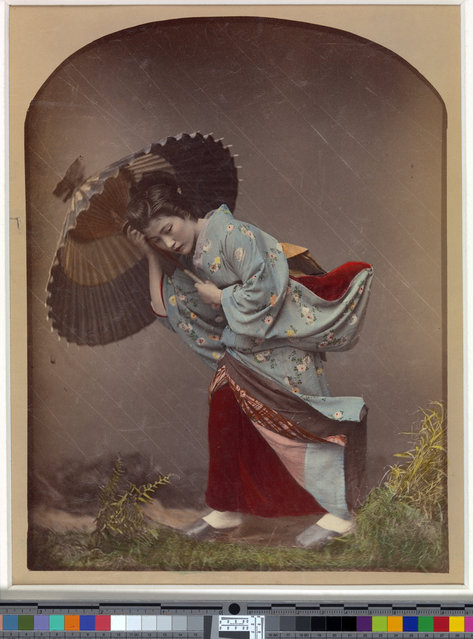
“Woman with Umbrella in Rain” by Raimund von Stillfried. Artist: Kusakabe Kimbei (Japanese, 1841–1934), 1870s. (Photo courtesy of The Metropolitan Museum of Art)

“Woman with Umbrella in Rain” by Raimund von Stillfried. Artist: Kusakabe Kimbei (Japanese, 1841–1934), 1870s. Commercial photography studios in Meiji-era Japan were renowned for the subtlety and refinement of their coloring techniques. This hand-tinted image of a young woman caught in a heavy rainstorm achieved its naturalistic effect by knitting together multiple strands of artifice: the greenery in the foreground was a studio prop; the flaps of the kimono were suspended by thin wires to create the impression of a strong wind; and long, diagonal marks were made on the negative to suggest streaks of rain. (Photo courtesy of The Metropolitan Museum of Art)
Details
12 May 2013 10:13:00
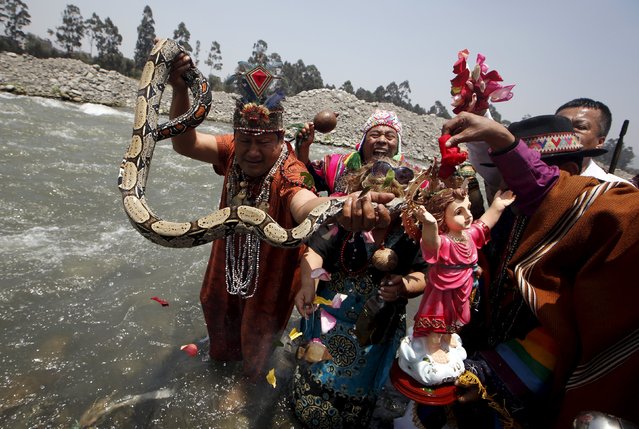
Peruvian shamans holding a figure of a Nino Jesus (Child Jesus) and a snake perform a ritual at the Rimac river to fight the negative effects of the Nino weather phenomena over Nature, in Lima, October 1, 2015. (Photo by Mariana Bazo/Reuters)

Peruvian shamans holding a figure of a Nino Jesus (Child Jesus) and a snake perform a ritual at the Rimac river to fight the negative effects of the Nino weather phenomena over Nature, in Lima, October 1, 2015. (Photo by Mariana Bazo/Reuters)
Details
03 Oct 2015 08:07:00
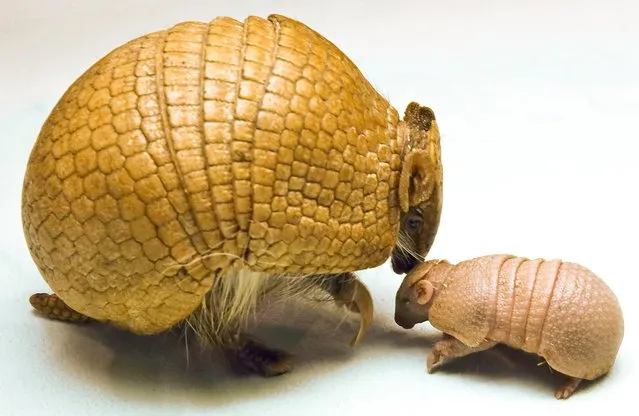
In this Sunday, April 27, 2014 handout photo provided by Busch Gardens Tampa, mother armadillo Zowie, left, welcomes her newborn Southern three-banded armadillo baby at the Animal Ambassador Team, in Tampa, Fla. The baby was able to walk and roll into a ball within moments of its birth. Southern three-banded armadillos are the only species of armadillo that can fully roll up into a ball. The baby armadillo currently weighs 118 grams, which is about the weight equivalent to an average cell phone. (Photo by AP Photo/Busch Gardens Tampa)

In this Sunday, April 27, 2014 handout photo provided by Busch Gardens Tampa, mother armadillo Zowie, left, welcomes her newborn Southern three-banded armadillo baby at the Animal Ambassador Team, in Tampa, Fla. The baby was able to walk and roll into a ball within moments of its birth. Southern three-banded armadillos are the only species of armadillo that can fully roll up into a ball. (Photo by AP Photo/Busch Gardens Tampa)
Details
03 May 2014 16:16:00
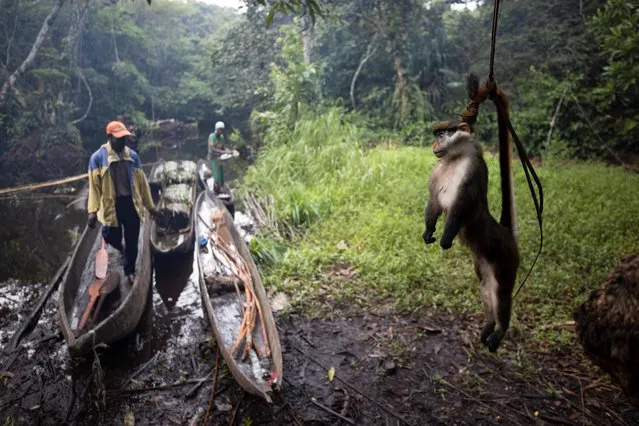
A dead red-tailed monkey hangs by its tail above the ground, in order to keep it away from ants, in the forest near the city of Mbandaka, Democratic Republic of the Congo, April 5, 2019. Bushmeat hunters are emptying Central Africa's forests at a high rate, researchers say. A growing appetite for wild meat in cities has ramped up the scale of hunting. Research shows around 6 million tonnes of bushmeat are sourced annually from the Congo Basin, whose forest spans across six countries and is second in size only to the Amazon. (Photo by Thomas Nicolon/Reuters)

A dead red-tailed monkey hangs by its tail above the ground, in order to keep it away from ants, in the forest near the city of Mbandaka, Democratic Republic of the Congo, April 5, 2019. Bushmeat hunters are emptying Central Africa's forests at a high rate, researchers say. A growing appetite for wild meat in cities has ramped up the scale of hunting. Research shows around 6 million tonnes of bushmeat are sourced annually from the Congo Basin, whose forest spans across six countries and is second in size only to the Amazon. (Photo by Thomas Nicolon/Reuters)
Details
14 Oct 2019 00:03:00
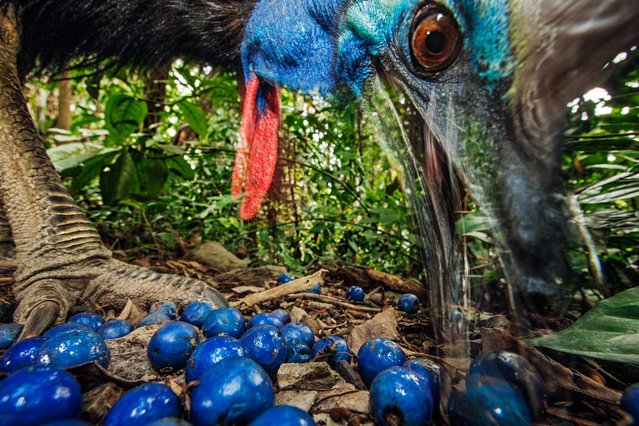
“Cassowaries are large, flightless birds related to emus and (more distantly) to ostriches, rheas, and kiwis”, writes Olivia Judson in the September issue of National Geographic magazine. (Photo by Christian Ziegler/National Geographic)

“Cassowaries are large, flightless birds related to emus and (more distantly) to ostriches, rheas, and kiwis”, writes Olivia Judson in the September issue of National Geographic magazine. How large? People-size: Adult males stand well over five foot five and top 110 pounds. Females are even taller, and can weigh more than 160 pounds. Dangerous when roused, they’re shy and peaceable when left alone. But even birds this big and tough are prey to habitat loss. The dense New Guinea and Australia rain forests where they live have dwindled. Today cassowaries might number 1,500 to 2,000. And because they help shape those same forests – by moving seeds from one place to another – “if they vanish”, Judson writes, “the structure of the forest would gradually change” too. (Photo by Christian Ziegler/National Geographic)

Details
06 Jan 2014 12:21:00