Loading...
Done
Smoke rises from a house days after part of the ground it was resting on collapsed into Lake Whitney, Texas in this June 13, 2014 file photo. I was covering the controlled burn of a house slowly falling into Lake Whitney due to the decaying cliff underneath.  Asked to take photos from an aerial perspective, an instructor and I took off from Grand Prairie Municipal Airport around 9am. (Photo and caption by Brandon Wade/Reuters)

Smoke rises from a house days after part of the ground it was resting on collapsed into Lake Whitney, Texas in this June 13, 2014 file photo. I was covering the controlled burn of a house slowly falling into Lake Whitney due to the decaying cliff underneath. Asked to take photos from an aerial perspective, an instructor and I took off from Grand Prairie Municipal Airport around 9am. The burn, scheduled to start an hour later, was delayed. I love flying, but patience proved challenging as circling for nearly three hours gets boring fast. Once the fire started we only had 15 minutes to take photos because the plane was booked at 1pm. The owners invested their retirement savings in the house and were even advised by geologists that the ground was stable. To watch your investment literally go up in flames must take its toll emotionally. The owners said they don't expect their insurance to cover the loss. (Photo and caption by Brandon Wade/Reuters)
Details
27 Nov 2014 15:01:00
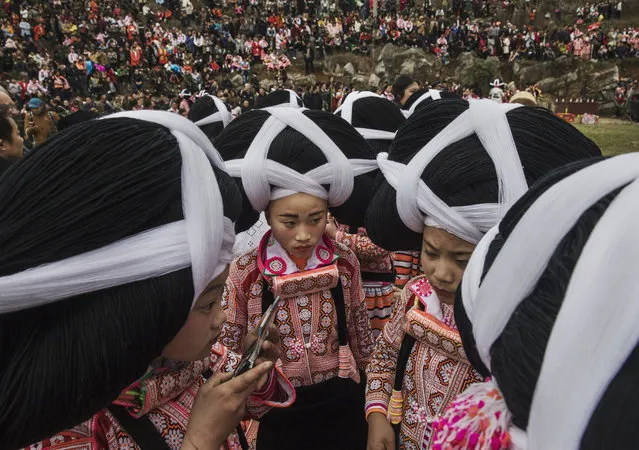
Girls of the Long Horn Miao ethnic minority group wear headdresses as they prepare gather for Tiaohua or Flower Festival as part of the Lunar New Year on February 6, 2017 in Longga village, Guizhou province, southern China. The Long Horn Miao are recognized for their declining practice of wrapping a blend of linen, wool, and the hair of their ancestors around animal horns or a wooden clip to make headdresses. Many young women say they now wear the headdresses only for special occasions and festivals, as the ornaments, which are attached by the horns to their real hair, have proved impractical for modern daily life in a fast changing world. China officially recognizes 56 different ethnic minorities, and statistics show over 7 million Chinese identifying themselves as Miao. But the small Long Horn Miao community counts only around 5000 people living in 12 villages, whose age-old traditions, language, and culture are fading. It is increasingly difficult in a modernizing China, as young people are drawn from remote rural villages to opportunities in bigger cities amongst wide-scale urbanization. Farming and labour remain the mainstays of life for the Long Horn Miao, leaving the area relatively poor in comparison with many parts of China. The government has invested significant amounts into local infrastructure and the tourism industry to try to bolster the local economy. (Photo by Kevin Frayer/Getty Images)

Girls of the Long Horn Miao ethnic minority group wear headdresses as they prepare gather for Tiaohua or Flower Festival as part of the Lunar New Year on February 6, 2017 in Longga village, Guizhou province, southern China. (Photo by Kevin Frayer/Getty Images)
Details
13 Feb 2017 00:01:00


“The Trabant is a car that was produced by former East German auto maker VEB Sachsenring Automobilwerke Zwickau in Zwickau, Sachsen. It was the most common vehicle in East Germany, and was also exported to countries both inside and outside the communist bloc. The main selling points was that it had room for four adults and luggage in a compact, light and durable shell and that it was fast (when introduced) and durable. With its mediocre performance, smoky two-stroke engine, and production shortages, the Trabant is often cited as an example of the disadvantages of centralized planning; on the other hand, it is regarded with derisive affection as a symbol of the failed former East Germany and of the fall of communism (in former West Germany, as many East Germans streamed into West Berlin and West Germany in their Trabants after the opening of the Berlin Wall in 1989). It was in production without any significant changes for nearly 30 years with 3,096,099 Trabants produced in total”. – Wikipedia

Photo: Enthusiasts weared in uniforms of the former eastern german army trive in a military Trabant car as fans and owners of East German-era Trabant cars gather at the 2011 International Trabantfahrer Treffen (International Trabant Drivers Meeting) on June 26, 2011 in Zwickau, Germany. The Trabant, also known as the Trabi, was among the main cars produced in communist East Germany and built by VEB Sachsenring Automobilwerke in Zwickau for 30 years until 1989. Today the car has cult status for many followers and one company, IndiKar, is even seeking to revive the brand in a modern, electric version. (Photo by Carsten Koall/Getty Images)
Details
27 Jun 2011 12:21:00
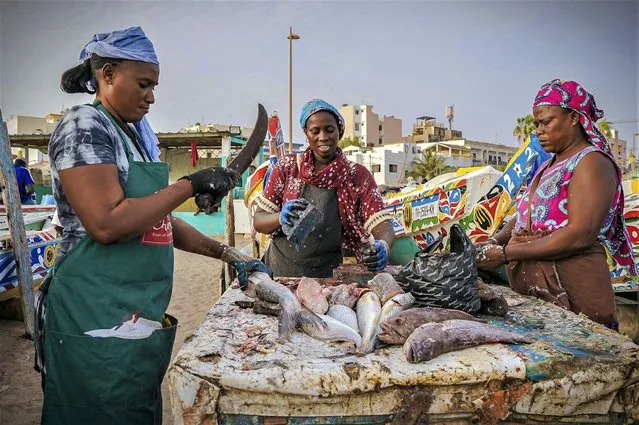
Fishmongers cut and clean fish at the Soumbedioune fish market in Dakar, Senegal, May 31, 2022. In Senegal, fish and seafood represent more than 40% of the animal protein intake in the diet. According to a U.S. report, one in six people work in the fisheries sector. (Photo by Grace Ekpu/AP Photo)

Fishmongers cut and clean fish at the Soumbedioune fish market in Dakar, Senegal, May 31, 2022. In Senegal, fish and seafood represent more than 40% of the animal protein intake in the diet. According to a U.S. report, one in six people work in the fisheries sector. (Photo by Grace Ekpu/AP Photo)

Details
04 Jul 2023 02:04:00
Plants grow on houses in the abandoned fishing village of Houtouwan on the island of Shengshan July 26, 2015. (Photo by Damir Sagolj/Reuters)

Plants grow on houses in the abandoned fishing village of Houtouwan on the island of Shengshan July 26, 2015. Just a handful of people still live in a village on Shengshan Island east of Shanghai that was once home to more than 2,000 fishermen. Every day hundreds of tourists visit Houtouwan, making their way on narrow footpaths past tumbledown houses overtaken by vegetation. The remote village, on one of more than 400 islands in the Shengsi archipelago, was abandoned in the early 1990s as first wealthy residents then others moved away, aiming to leave problems with education and food delivery behind them. (Photo by Damir Sagolj/Reuters)
Details
30 Jul 2015 12:24:00
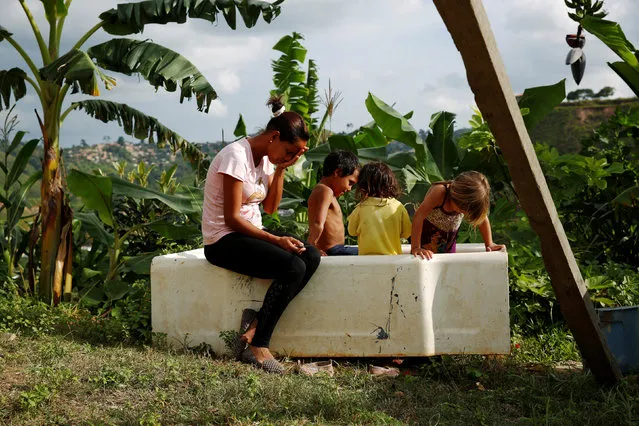
Lisibeht Martinez (L), 30, who was sterilized one year ago, sits next to her children while they play in a bathtub in the backyard of their house in Los Teques, Venezuela July 19, 2016. (Photo by Carlos Garcia Rawlins/Reuters)

Venezuela's food shortages, inflation and crumbling medical sector have become such a source of anguish that a growing number of young women are reluctantly opting for sterilizations rather than face the hardship of pregnancy and child-rearing. Traditional contraceptives like condoms or birth control pills have virtually vanished from store shelves, pushing women towards the hard-to-reverse surgery. While no recent national statistics on sterilizations are available, doctors and health workers say demand for the procedure is growing. (Photo by Carlos Garcia Rawlins/Reuters)
Details
04 Aug 2016 12:22:00
Spectacular images offering insight into the lives of the Huaorani people in the Ecuadorian Amazon have been revealed showing how they use traditional methods to hunt monkeys for food. The stunning pictures were taken by conservation photographer Pete Oxford from Torquay, Devon in the Ecuadorian Amazon. “The Huaorani Indians are a forest people highly in tune with their environment. Many are now totally acculturated since the 1950s by missionaries”, said Pete. “Today they face radical change to their culture to the proximity of oil exploration within their territory and the Yasuni National Park and Biosphere Reserve, they are vastly changed. Some still live very traditionally and for this shoot, through my Huaorani friend, a direct relative of those photographed he wanted to depict them as close to their original culture as possible. They still largely hunt with blow pipes and spears eating a lot of monkeys and peccaries”. The Huaorani are also known as the Waorani, Waodani or the Waos and are native Amerindians. Their lands are located between the Curaray and Napo rivers and speak the Huaorani language. Pete says that during his visit he was welcomed into the group and hopes that ancient cultures can be saved. Here: The tribe were seen celebrating after a hunter returned to camp with a wild pig. (Photo by Pete Oxford/Mediadrumworld.com)

Spectacular images offering insight into the lives of the Huaorani people in the Ecuadorian Amazon have been revealed showing how they use traditional methods to hunt monkeys for food. The stunning pictures were taken by conservation photographer Pete Oxford from Torquay, Devon in the Ecuadorian Amazon. Here: The tribe were seen celebrating after a hunter returned to camp with a wild pig. (Photo by Pete Oxford/Mediadrumworld.com)
Details
20 Jan 2017 07:58:00
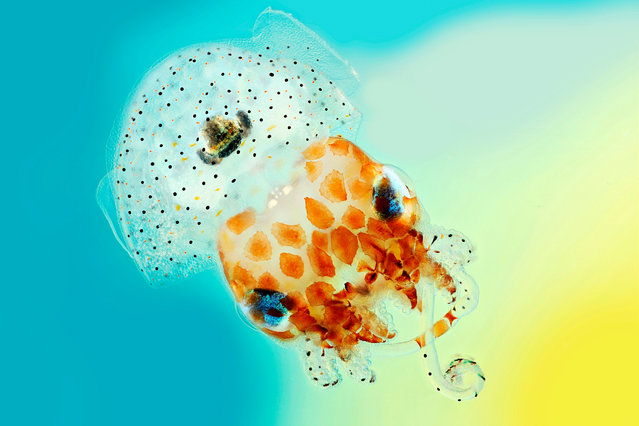
With its huge eyes, comical name and diminutive size, Mark R. Smith’s image of a baby Hawaiian bobtail squid can’t help but raise a smile. A curiously endearing creature, the cephalopod is just 1.5cm across, its mantle cavity bearing more than a passing resemblance to a rather natty shower cap. But it is also a beautiful example of symbiosis – nature’s version of “I’ll scratch your back if you scratch mine” – for on the underside of the squid is a light organ which houses bioluminescent bacteria. The squid offers the bacteria protection and food, while the bacteria emit a glow – a handy trait that the squid uses to offset its silhouette, helping it to evade predators in the depths below. Mark R. Smith’s entry combines several images of a Hawaiian bobtail squid with different focus lengths to create a final picture with greater depth of field than normal. (Photo by Mark R. Smith/Wellcome Images/Macroscopic Solutions)

With its huge eyes, comical name and diminutive size, Mark R. Smith’s image of a baby Hawaiian bobtail squid can’t help but raise a smile. A curiously endearing creature, the cephalopod is just 1.5cm across, its mantle cavity bearing more than a passing resemblance to a rather natty shower cap. But it is also a beautiful example of symbiosis – nature’s version of “I’ll scratch your back if you scratch mine” – for on the underside of the squid is a light organ which houses bioluminescent bacteria. The squid offers the bacteria protection and food, while the bacteria emit a glow – a handy trait that the squid uses to offset its silhouette, helping it to evade predators in the depths below. Mark R. Smith’s entry combines several images of a Hawaiian bobtail squid with different focus lengths to create a final picture with greater depth of field than normal. (Photo by Mark R. Smith/Wellcome Images/Macroscopic Solutions)
Details
08 Mar 2017 00:05:00