Loading...
Done
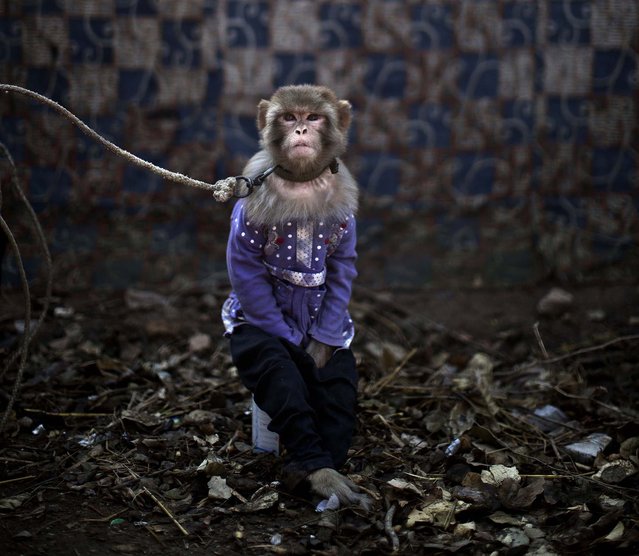
In this Tuesday, February 11, 2014, photo, a trained monkey, that makes a living for her Pakistani owner by performing to a crowd in public and private places, sits held by a leash, in Rawalpindi, Pakistan. For Pakistanis who raise and train the monkeys they are an important source of income in an impoverished country, and they form a strong bond with the animals. The monkeys are usually captured in the wild when they are babies and then trained. A trained monkey can fetch 20,000 to 30,000 rupees ($190 to $285). (Photo by Muhammed Muheisen/Associated Press)

In this Tuesday, February 11, 2014, photo, a trained monkey, that makes a living for her Pakistani owner by performing to a crowd in public and private places, sits held by a leash, in Rawalpindi, Pakistan. For Pakistanis who raise and train the monkeys they are an important source of income in an impoverished country, and they form a strong bond with the animals. The monkeys are usually captured in the wild when they are babies and then trained. A trained monkey can fetch 20,000 to 30,000 rupees ($190 to $285). (Photo by Muhammed Muheisen/Associated Press)
Details
23 Feb 2014 09:50:00
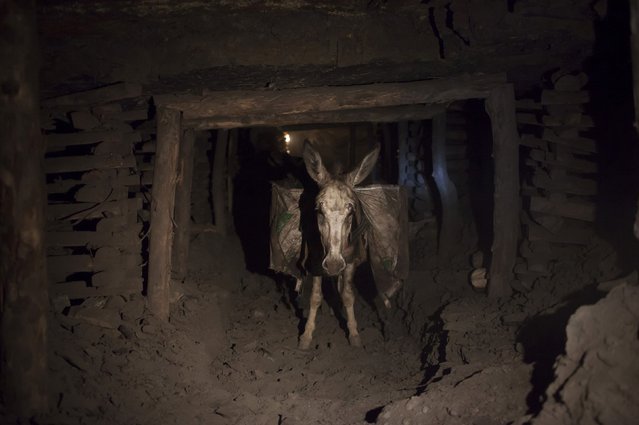
A donkey carrying sacks of coal walks through the narrow tunnels of a coal mine, in Choa Saidan Shah in Punjab province April 29, 2014. (Photo by Sara Farid/Reuters)

A donkey carrying sacks of coal walks through the narrow tunnels of a coal mine, in Choa Saidan Shah in Punjab province April 29, 2014. Coal miners in Chao Saidan Shah use donkeys to transport coal from the depths of the mines to the surface. (Photo by Sara Farid/Reuters)
Details
11 May 2014 12:03:00
Pineapple

“One Third” – a project on food waste by an Austrian photography Klaus Pichler. According to a UN study one third of the world's food goes to waste – the largest part thereof in the industrialized nations of the global north. Equally, 925 million people around the world are threatened by starvation. The series “One Third” describes the connection between individual wastage of food and globalized food production.

Photo: Pineapple. Place of production: Guayaquil, Ecuador. Cultivation method: Outdoor plantation • Time of harvest: All- season. Transporting distance: 10.666 km (linear distance) • Means of transportation: Aircraft, truck. Carbon footprint (total) per kg: 11,94 kg • Water requirement (total) per kg: 360 l. Price: 2,10 € / kg. (Photo by Klaus Picher)
Details
02 May 2012 11:01:00
A cadet lies on the grass after collapsing during a promotion ceremony at a police school in Bogota December 7, 2012. (Photo by John Vizcaino/Reuters)

A cadet lies on the grass after collapsing during a promotion ceremony at a police school in Bogota December 7, 2012. (Photo by John Vizcaino/Reuters)
Details
19 Dec 2012 12:32:00


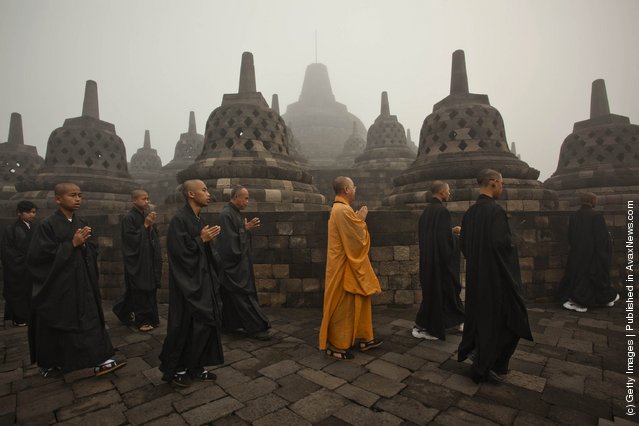
Buddhist monks pray at Borobudur temple on Vesak Day, commonly known as “Buddha's birthday”, at the Borobudur Mahayana Buddhist monument on May 17, 2011 in Magelang, Indonesia. (Photo by Ulet Ifansasti/Getty Images)
Details
17 May 2011 12:03:00


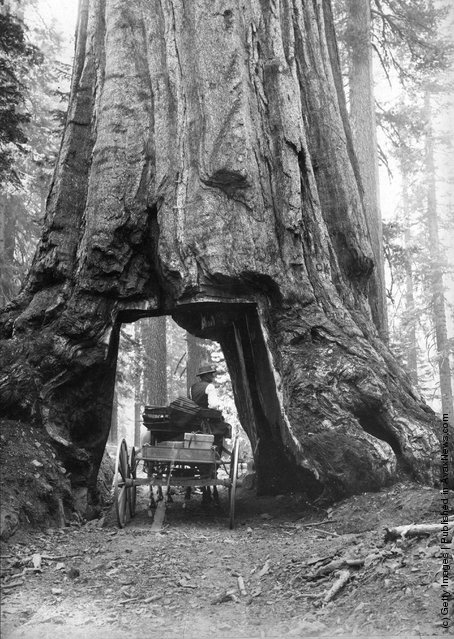
A horse-drawn cart passing through a section cut out of the base of a giant sequoia tree in the Mariposa groves of Yosemite Park, California. (Photo by Carleton E Watkins/Getty Images). 1870
Details
07 Jul 2011 10:16:00


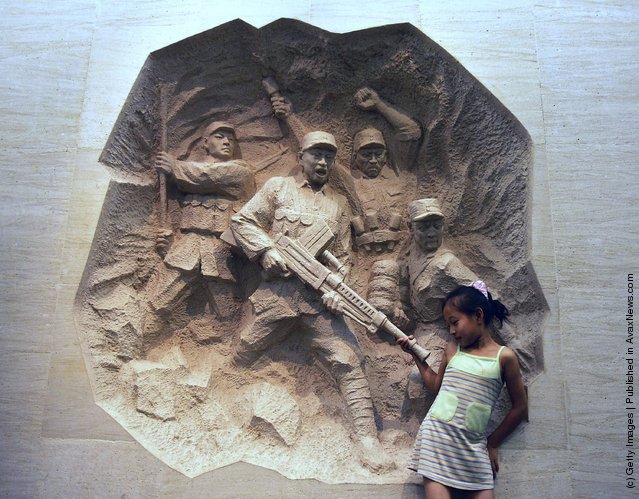
A Chinese girl touches the gun of a relievo featuring Chinese soldiers fighting with Japanese troops during World War II at an exhibition at the Anti-Japan War Museum to mark the 60th Anniversary of the Victory of the Chinese People's War of Resistance Against Japan on August 18, 2005 in Beijing, China. (Photo by Cancan Chu/Getty Images)
Details
30 Jul 2011 13:51:00
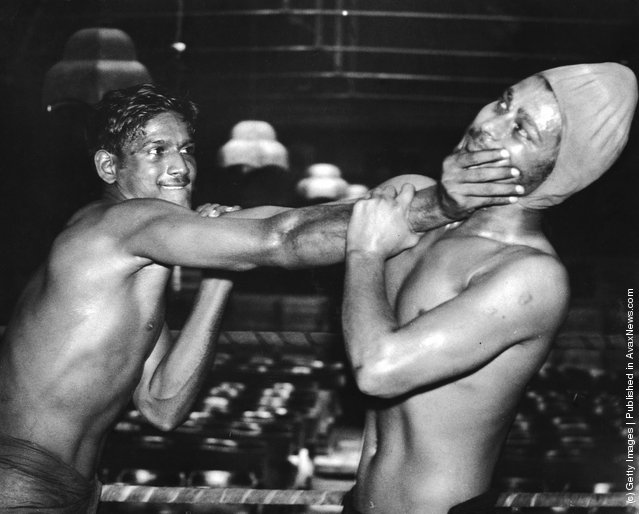
Indian wrestlers

Indian wrestlers Rashid Anwar (left) and Ajaib Singh in a training bout at Lane's Club in Baker Street London before the Empire Games, 19th July 1934. (Photo by Keystone/Hulton Archive/Getty Images)
Details
14 Aug 2013 13:27:00