Loading...
Done
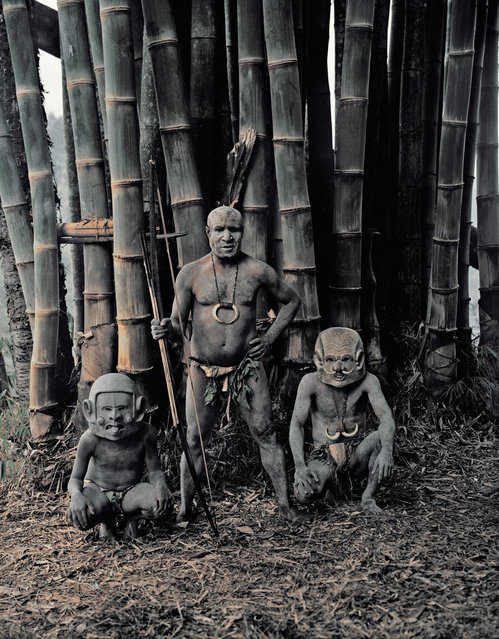
“Asaro from the Eastern Highlands”. The mudmen could not cover their faces with mud because the people of Papua New Guinea thought that the mud from the Asaro river was poisonous. So instead of covering their faces with this alleged poison, they made masks from pebbles that they heated and water from the waterfall, with unusual designs such as long or very short ears either going down to the chin or sticking up at the top, long joined eyebrows attached to the top of the ears, horns and sideways mouths. (Jimmy Nelson)

“Asaro from the Eastern Highlands”. The mudmen could not cover their faces with mud because the people of Papua New Guinea thought that the mud from the Asaro river was poisonous. So instead of covering their faces with this alleged poison, they made masks from pebbles that they heated and water from the waterfall, with unusual designs such as long or very short ears either going down to the chin or sticking up at the top, long joined eyebrows attached to the top of the ears, horns and sideways mouths. (Photo and caption by Jimmy Nelson)
Details
20 Oct 2013 08:54:00
A woman wearing a wedding dress takes part in the so-called “brides' match” at the FIFA Fan Fest in Kazan, a host city for the 2018 FIFA World Cup, Russia June 30, 2018. (Photo by Alexey Nasyrov/Reuters)

A woman wearing a wedding dress takes part in the so-called “brides' match” at the FIFA Fan Fest in Kazan, a host city for the 2018 FIFA World Cup, Russia June 30, 2018. (Photo by Alexey Nasyrov/Reuters)
Details
02 Jul 2018 08:23:00
Zhao Deli waves as he pilots his self-made “flying scooter” in Dongguan, Guangdong Province, China, 12 August 2018 (issued 16 August 2018). Inspired by a cartoon he watched as a child, Zhao Deli sold off his apartment in pursuit of his dream of building a flying scooter. (Photo by Aleksandar Plavevski/EPA/EFE)

Zhao Deli waves as he pilots his self-made “flying scooter” in Dongguan, Guangdong Province, China, 12 August 2018 (issued 16 August 2018). Inspired by a cartoon he watched as a child, Zhao Deli sold off his apartment in pursuit of his dream of building a flying scooter. (Photo by Aleksandar Plavevski/EPA/EFE)
Details
06 Sep 2018 00:05:00

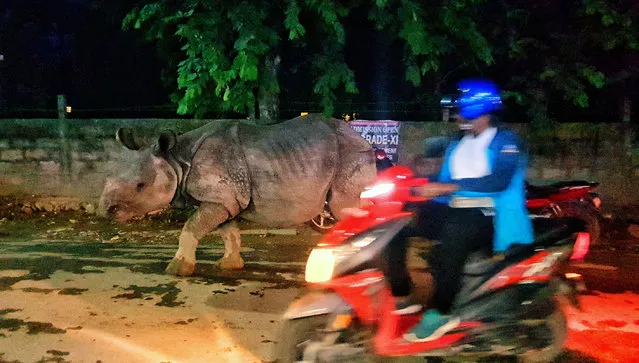
A one-horned rhino walks on the street of Sauraha, a tourism hub in southwest Nepal’s Chitwan district on July 10, 2018. (Photo by Sunil Sharma/Xinhua News Agency/Alamy Stock Photo)

A one-horned rhino walks on the street of Sauraha, a tourism hub in southwest Nepal’s Chitwan district on July 10, 2018. (Photo by Sunil Sharma/Xinhua News Agency/Alamy Stock Photo)
Details
06 Nov 2018 00:01:00
Ethnic Miao women in traditional costumes take part in a tug of war as they celebrate the local ethnic Miao's new year at a village in Rongshui Miao Autonomous county, Guangxi Zhuang Autonomous Region, China January 5, 2019. (Photo by Reuters/China Stringer Network)

Ethnic Miao women in traditional costumes take part in a tug of war as they celebrate the local ethnic Miao's new year at a village in Rongshui Miao Autonomous county, Guangxi Zhuang Autonomous Region, China January 5, 2019. (Photo by Reuters/China Stringer Network)
Details
19 Jan 2019 00:01:00
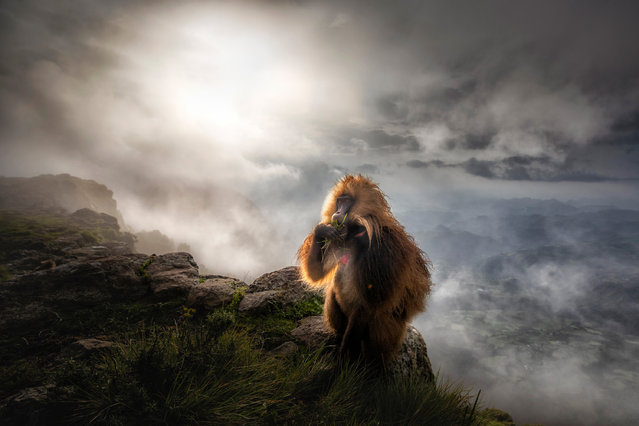
Highly commended, mammals: Gelada after the storm – Marco Gaiotti (Italy). “Gelada baboons are the only monkey species in the world that feed on grasses. They are native to the tableland of Ethiopia. Every morning large family groups wander from their sleeping places in the steep rock face, up to 1,000 metres high, to the feeding grounds at the tablelands. This image clearly depicts their feeding strategy: they pull out bunches of grass, sort the stalks and then lift them to their mouth. This shot was taken towards the end of the rainy season after a heavy storm”. (Photo by Marco Gaiotti/2019 GDT European Wildlife Photographer of the Year)

Highly commended, mammals: Gelada after the storm – Marco Gaiotti (Italy). “Gelada baboons are the only monkey species in the world that feed on grasses. They are native to the tableland of Ethiopia. Every morning large family groups wander from their sleeping places in the steep rock face, up to 1,000 metres high, to the feeding grounds at the tablelands. This image clearly depicts their feeding strategy: they pull out bunches of grass, sort the stalks and then lift them to their mouth. This shot was taken towards the end of the rainy season after a heavy storm”. (Photo by Marco Gaiotti/2019 GDT European Wildlife Photographer of the Year)
Details
31 Oct 2019 00:03:00


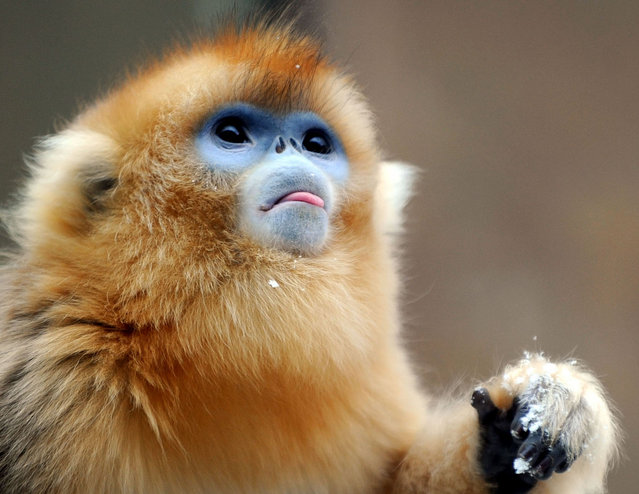
The golden monkey (Cercopithecus kandti) is a species of Old World monkey found in the Virunga volcanic mountains of Central Africa, including four national parks: Mgahinga, in south-west Uganda; Volcanoes, in north-west Rwanda; and Virunga and Kahuzi-Biéga, in the eastern Democratic Republic of Congo. It is restricted to highland forest, especially near bamboo.
Details
07 May 2012 04:39:00


“Snowflake (c. 1964 – November 24, 2003) was an albino gorilla. He was the only known albino gorilla so far, and the most popular resident of the Barcelona Zoo in Catalonia, Spain. Originally named Nfumu Ngui in Fang language ("white gorilla") by his captor, he was then nicknamed Floquet de Neu (Catalan for little snowflake) by his keeper Jordi Sabater Pi. On his arrival to Barcelona where he was given an official reception by the then Mayor of Barcelona, Josep Maria de Porcioles, in November 1966, he was called Blancanieves (“Snow White”) in the newspaper Tele/Exprés. But he became famous with the name given to him by Sabater when National Geographic Magazine featured him on the main page in March 1967, with the English name Snowflake. This name spread among the press (Stern, Life, Paris-Match) and was later translated to Spanish as Copito de Nieve. Sabater himself called the gorilla Floquet or Copi, and in the later years Nfumu. The asteroid 95962 Copito, discovered by Catalan astronomer J. Manteca, is named in his honour”.
Details
07 Mar 2011 15:50:00