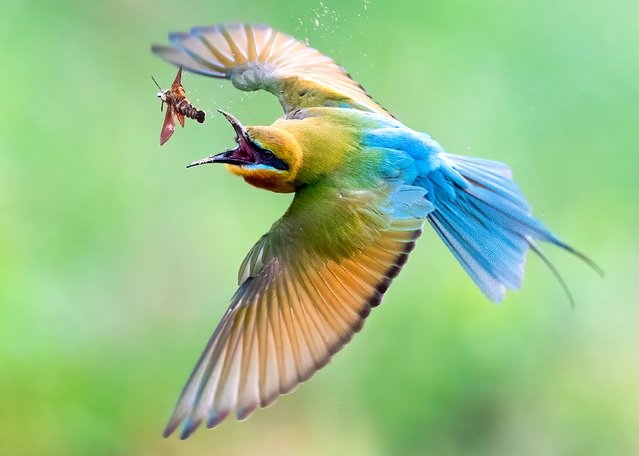
A blue-tailed bee-eater chases down its prey along the banks of the Kaveri River on the outskirts of the city of Mysore, India in the last decade of June 2025. (Photo by Nitin Jain/Solent News)
Domestic tourists visit the beach at Wonsan Kalma Coastal Tourist Area in Wonsan, North Korea's Kangwon Province on July 1, 2025. North Korea opened a massive resort area on its east coast, state media said on July 2, with the tourism pet project of leader Kim Jong Un reportedly set to welcome Russian guests later this month. (Photo by Kim Won Jin/AFP Photo)
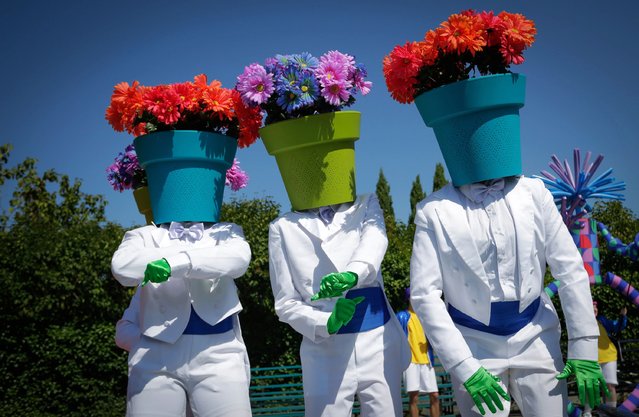
Performers dressed with flower pots on their heads perform during a media preview of the Pacific National Exhibition Fair in Vancouver, British Columbia, Canada, August 15, 2024. Marking its 114th year, the Pacific National Exhibition (PNE) Fair, one of the longest running events in Canada, runs from Aug. 17 to Sept. 2 here this year. (Photo by Xinhua News Agency/Rex Features/Shutterstock)
People participate in a Labor Day parade on September 2, 2024 in Marlborough, Massachusetts. The festival is a new event this year added by Mayor J. Christian Dumais in an effort to bring the community together on Labor Day weekend. The festival included musical and artistic performances, children's games and activities, touch-a-truck, a beer garden, food trucks, vendors and more. (Photo by Zhu Ziyu/VCG via Getty Images)
Syrian civil defence volunteers, known as the White Helmets, rescue a boy from the rubble following a reported barrel bomb attack on the Bab al- Nairab neighbourhood of the northern Syrian city of Aleppo on November 24, 2016. (Photo by Ameer Alhalbi/AFP Photo)
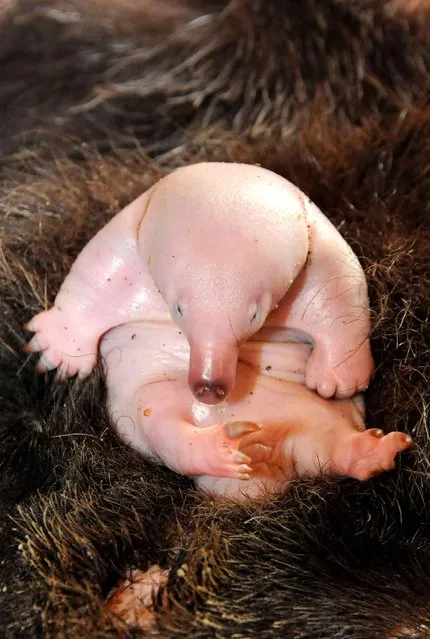
It's a 30-day-old Echidna baby, known as a “puggle” – one of only 24 ever bred in captivity. The proud parents are Tippy and Pickle of Australia Zoo. The tiny baby, whose s*x has not yet been identified, hatched from a soft egg and will continue to develop and nurse inside Tippy's warm pouch. (Photo by Australia Zoo/Rex/Sipa Press)
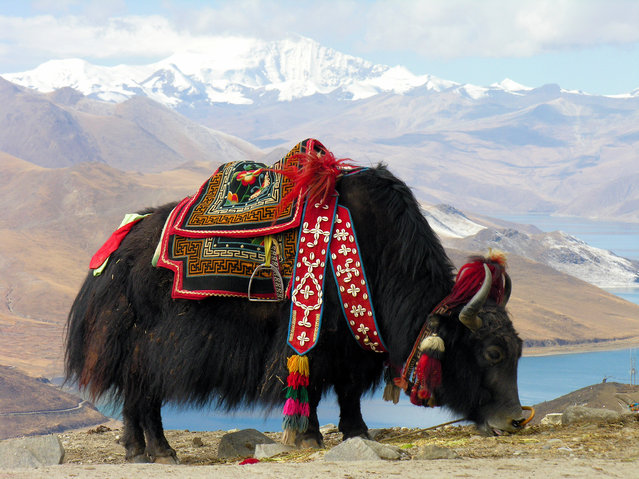
Yak near Yamdrok lake, Tibet. It is a long-haired bovinae found throughout the Himalayan region of south Central Asia, the Tibetan Plateau and as far north as Mongolia and Russia. The Tibetan economy is dominated by subsistence agriculture. Due to limited arable land, the primary occupation of the Tibetan Plateau is raising livestock, such as sheep, cattle, goats, camels, yaks, dzo, and horses. The Tibetan yak is an integral part of Tibetan life. (Photo by Dennis Jarvis)