People take part in mass water fights during the first day of Songkran, or Thai New Year, on Khao San Road in Bangkok on April 13, 2023. (Photo by Lillian Suwanrumpha/AFP Phoot)
Singers “Elle & The Pocket Belles” attend day 3 “Ladies Day” of the Qatar Goodwood Festival on August 3, 2017 in Chichester, England. (Photo by David Hartley/PA Wire)
Elderly women wait for customers as they sell their self-made food products at a street market, with a graffiti depicting Russian President Vladimir Putin on the wall of a house seen in the background, in the town of Kashira, outside Moscow, Russia on October 10, 2017. (Photo by Andrey Volkov/Reuters)
Hindu devotees (not pictured) touch a child with their feet as part of a ritual to bless him during a religious procession held to mark the Gajan festival in Kolkata, India, April 13, 2018. (Photo by Rupak De Chowdhuri/Reuters)
A heavily tattooed Japanese woman poses for photographs near Asakusa Temple during the third and final day of Sanja Festival, on May 20, 2018 in Tokyo, Japan. Sanja Festival is one of Japan's major festivals and is held annually in the Asakusa area of Tokyo. (Photo by Carl Court/Getty Images)
“Today, we take photography for granted. Anyone can take a photograph simply by pressing a button. Yet, it was not always so simple. The invention of photography was announced in 1839, but during its first fifty years taking a photograph was a complicated and expensive business. In 1888, all this was to change following the appearance of a camera that was to revolutionize photography. Popular photography can properly be said to have started 120 years ago with the introduction of the Kodak”. – The UK National Media Museum. Photo: Two men on the deck of a ship, about 1890. (Photo by Collection of National Media Museum/Kodak Museum)
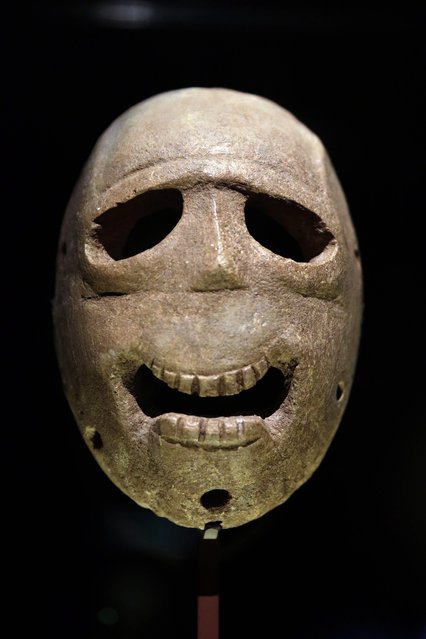
In this Monday, March 10, 2014 photo, a 9,000 year-old mask is on display at the Israel Museum in Jerusalem. The exhibition called “Face To Face” shows eleven stone masks, said to have been discovered in the Judean desert and hills near Jerusalem, which date back 9,000 years and offer a rare glimpse at some of civilization's first communal rituals. (Photo by Tsafrir Abayov/AP Photo)
“Tardigrades (commonly known as waterbears or moss piglets) are small, water-dwelling, segmented animals with eight legs. Tardigrades were first discovered in 1773 by Johann August Ephraim Goeze, who called them kleiner Wasserbär, meaning “little water bear” in German. The name Tardigrada means “slow walker” and was given by Lazzaro Spallanzani in 1777. The name water bear comes from the way they walk, reminiscent of a bear's gait. The biggest adults may reach a body length of 1.5 millimetres (0.059 in), the smallest below 0.1 mm. Freshly hatched tardigrades may be smaller than 0.05 mm”. – Wikipedia. Photo: Tardigrades. (Photo by SPL/East News)