Kim Goodman, from Chicago, Illinois, US, holds the record for the farthest eyeball protrusion, at 12mm. (Photo by Paul Michael Hughes/Guinness World Records/PA Wire Press Association)
Kaye Don seated in the cockpit of his new racing car the “Silver Bullet” at Wolverhampton, England on February 21, 1930, in which he will attempt to beat world land speed record at Daytona. It has two 12-cylinder V shaped engines and each develops 2,000-h.p. The theoretical speed of the car is 275 m.p.h. but the designer estimated that will be able to reach 250 m.p.h. allowing for wind pressures. (Photo by AP Photo/Staff/Puttnam)
A young girl walks with a Ukrainian flag during an event for Ukrainian Independence Day in the historical Grand Place of Brussels, Wednesday, August 24, 2022. European leaders are pledging unwavering support for Ukraine as the war-torn country marks its Independence Day. The commemorations Wednesday coincide with the six-month milestone of Russia's invasion. (Photo by Virginia Mayo/AP Photo)
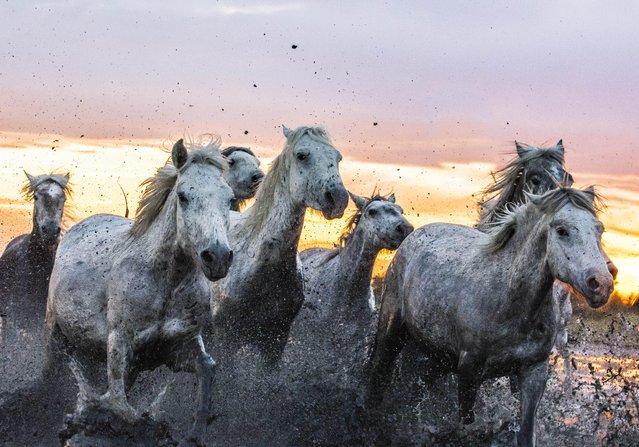
White horses of the Camargue thunder through the shallow salt flats at sunset on December 8, 2022. Known as Horses of the Sea, the breed native to the wetlands in southern France is one of the oldest in the world. (Photo by Nathalie Mountain/Media Drum Images)
Indian girl, Amrita Bannerjee, gets dressed as the Goddess Durga, during Kumari Puja ritual as part of the Durga Puja festival at Shidaspur village, far north of Kolkata, India, 30 September 2025. During the Kumari Puja, devotees worship a girl aged between six and twelve, symbolizing the Kanya Kumari (virgin) form of the Goddess Durga Devi. Hindu devotees believe that Kanya is a living embodiment of the goddess Durga. (Photo by Piyal Adhikary/EPA)
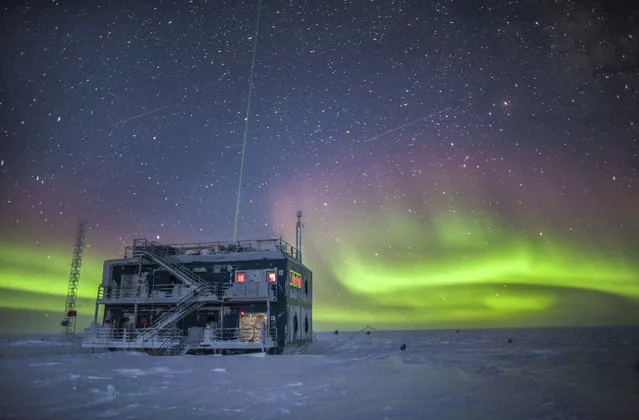
This undated photo provided by NOAA in May 2018 shows aurora australis near the South Pole Atmospheric Research Observatory in Antarctica. When a hole in the ozone formed over Antarctica, countries around the world in 1987 agreed to phase out several types of ozone-depleting chemicals called chlorofluorocarbons (CFCs). Production was banned, emissions fell and the hole shriveled. But according to a study released on Wednesday, May 16, 2018, scientists say since 2013, there’s more of a banned CFC going into the atmosphere. (Photo by Patrick Cullis/NOAA via AP Photo)