Loading...
Done
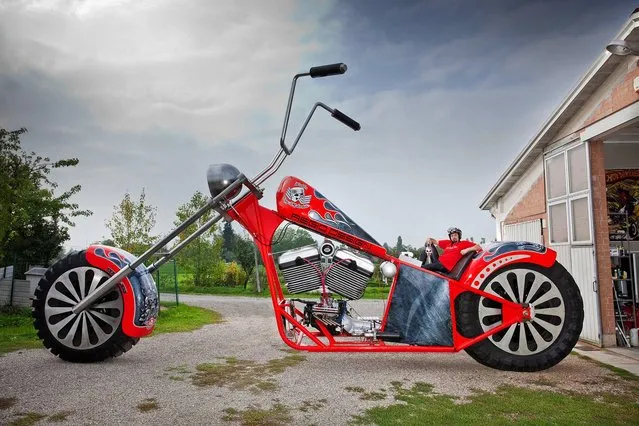
Undated handout photo issued by Guinness World Records of Fabio Reggiani from Italy who has made it into the Guinness Book of World Records for constructing the worlds largest rideable motorcycle measuring 5.10 meters (16ft 8.78 in) from the ground to the top of the handlebars. Six times larger than a normal motorcycle, it's 10.03 m long, 2.5 m wide, and weighs approximately 5,000 kg (5 tonnes). (Photo by Guinness World Records/PA Wire)

Undated handout photo issued by Guinness World Records of Fabio Reggiani from Italy who has made it into the Guinness Book of World Records for constructing the worlds largest rideable motorcycle measuring 5.10 meters (16ft 8.78 in) from the ground to the top of the handlebars. Six times larger than a normal motorcycle, it's 10.03 m long, 2.5 m wide, and weighs approximately 5,000 kg (5 tonnes). (Photo by Guinness World Records/PA Wire)
Details
14 Sep 2013 11:39:00
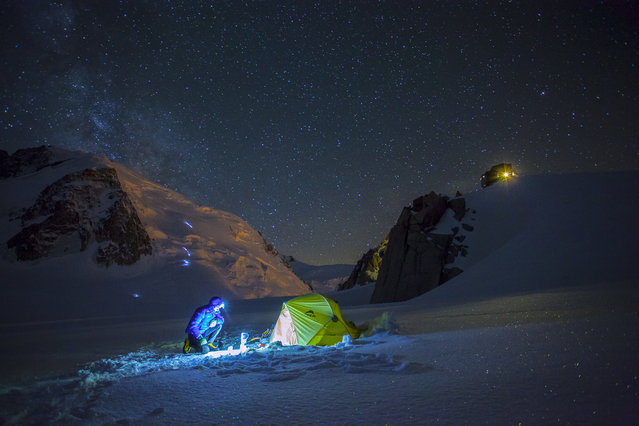
“A snapshot from mountaineer's life”. Have you ever wondered how does a mountaineer's day start? (Photo and caption by Kamil Tamiola/National Geographic Traveler Photo Contest)

“A snapshot from mountaineer's life”. Have you ever wondered how does a mountaineer's day start? I will give you a hint: you wake up at 3 am, set the stove, wake up your partner, pretend it is warm, quickly consume a high-calorie breakfast, watch your friends slowly ascending the icy slopes of your dream summit with their tiny head torches glimmering against perfectly blue ice, and hope for the good weather. One would ask: why all this trouble? The answer is easy: for the love of the adventure and the unknown. Location: Chamonix, Haute Savoye, France. (Photo and caption by Kamil Tamiola/National Geographic Traveler Photo Contest)

ATTENTION! All pictures are presented in high resolution. To see Hi-Res images – just TWICE click on any picture. In other words, click small picture – opens the BIG picture. Click BIG picture – opens VERY BIG picture.
Details
27 Jun 2013 12:47:00
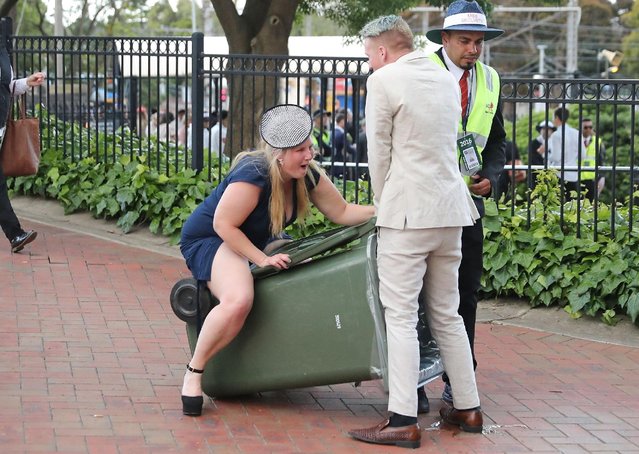
A racegoers walks into a rubbish bin following 2016 Melbourne Cup Day at Flemington Racecourse on November 1, 2016 in Melbourne, Australia. (Photo by Scott Barbour/Getty Images)

A racegoers walks into a rubbish bin following 2016 Melbourne Cup Day at Flemington Racecourse on November 1, 2016 in Melbourne, Australia. (Photo by Scott Barbour/Getty Images)
Details
02 Nov 2016 12:42:00
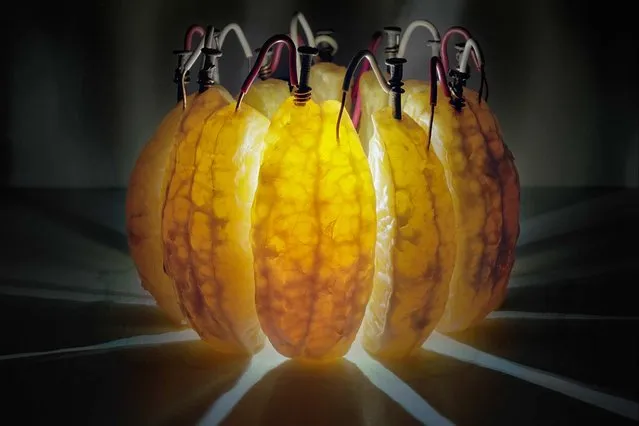
Wedges of an orange generate enough current and electrical juice – 3.5 volts – to power an LED. The fruit’s citric acid helps electrons flow from galvanized nails to copper wire in this 14-hour exposure. This image was published in September’s Visions of Earth, a trio of photos that appear in each issue of National Geographic. (Photo by Caleb Charland/National Geographic)

Wedges of an orange generate enough current and electrical juice – 3.5 volts – to power an LED. The fruit’s citric acid helps electrons flow from galvanized nails to copper wire in this 14-hour exposure. This image was published in September’s Visions of Earth, a trio of photos that appear in each issue of National Geographic. (Photo by Caleb Charland/National Geographic)
Details
06 Jan 2014 12:09:00
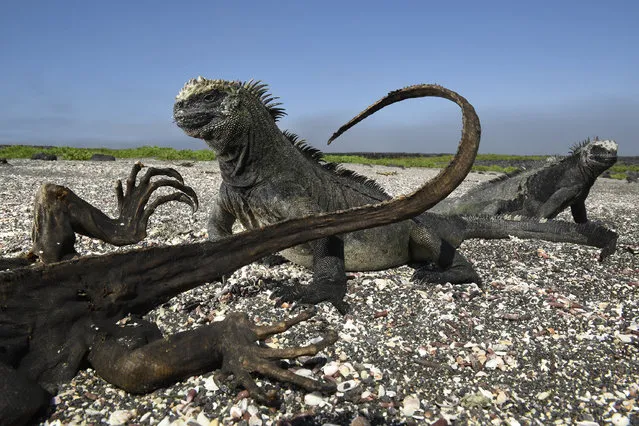
Galapagos – Rocking the Cradle: Four major ocean currents converge along the Galapagos archipelago, creating the conditions for an extraordinary diversity of animal life, April 25, 2016. The islands are home to at least 7,000 flora and fauna species, of which 97 percent of the reptiles, 80 percent of the land birds, 50 percent of the insects and 30 percent of the plants are endemic. The local ecosystem is highly sensitive to the changes in temperature, rainfall and ocean currents that characterize the climatic events known as El Niño and La Niña. These changes cause marked fluctuations in weather and food availability. Many scientists expect the frequency of El Niño and La Niña to increase as a result of climate change, making the Galapagos a possible early-warning location for its effects. (Photo by Thomas P. Peschak for National Geographic/World Press Photo)

Galapagos – Rocking the Cradle: Four major ocean currents converge along the Galapagos archipelago, creating the conditions for an extraordinary diversity of animal life, April 25, 2016. The islands are home to at least 7,000 flora and fauna species, of which 97 percent of the reptiles, 80 percent of the land birds, 50 percent of the insects and 30 percent of the plants are endemic. (Photo by Thomas P. Peschak for National Geographic/World Press Photo)
Details
16 Apr 2018 00:01:00
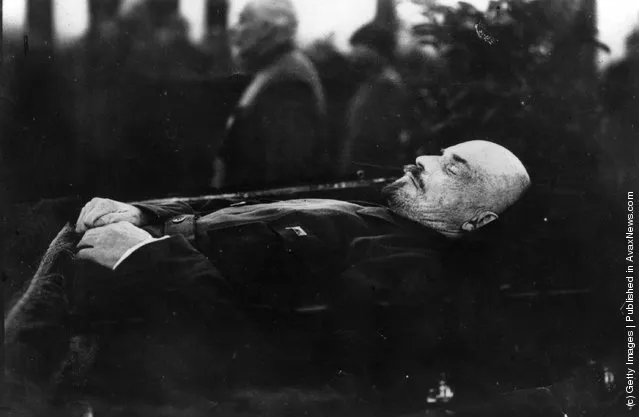
1924:  Vladimir Ilyich Lenin lying in state in the Kremlin

Photo: Vladimir Ilyich Lenin (1870 – 1924) lying in state in the Kremlin. (Photo by Hulton Archive/Getty Images). 1924

Important! For the same article in Russian language click here.

Something quite intriguing is happening within Russian-speaking internet during the last few – should you type a fully academic inquiry (at least, according to Russian academic requirements) in national search engines for "Lenin's mausoleum" – the first thing you get (even in top 10 searches) is website pages talking about black magic and occult. Website authors view this construction differently, but unconditionally agree on one thing: the mausoleum of the "leader of the world proletariat” – the essence of a magical artifact, a sort of “energy vampire”. It was built with a certain purpose: to drain the energy out of miserable Soviet citizens on one hand; and to poison the anthroposphere of one-sixth part of the earth with its vibes (the exact territory that was occupied by the former Soviet Union), depriving the Russian people of will to resist on the other hand. Complete nonsense? No doubt. Nevertheless, an intriguing one. Well, probably because some oddities do exist in mausoleum's history. These oddities are the thing we are going to discuss this time. First, let me refresh you memory on the subject.
Details
16 Oct 2011 11:27:00
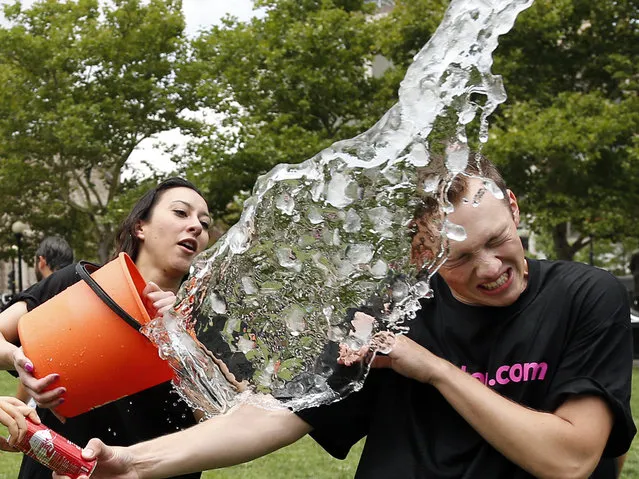
Beryl Lipton, left, douses Matt Lee during the ice bucket challenge at Boston's Copley Square, Thursday, August 7, 2014 to raise funds and awareness for ALS. The idea is: pay up for charity or get doused. The fund-raising phenomenon is catching on fast, propelled by popular videos of the dunkers and the dunked – including famous athletes and entertainers – posted on social media sites. (Photo by Elise Amendola/AP Photo)

Beryl Lipton, left, douses Matt Lee during the ice bucket challenge at Boston's Copley Square, Thursday, August 7, 2014 to raise funds and awareness for ALS. The idea is: pay up for charity or get doused. The fund-raising phenomenon is catching on fast, propelled by popular videos of the dunkers and the dunked – including famous athletes and entertainers – posted on social media sites. And the challenges are raising tens of thousands of dollars and immeasurable awareness for causes from ALS to breast cancer to a camp for kids who've lost a father to war. (Photo by Elise Amendola/AP Photo)
Details
16 Aug 2014 11:08:00
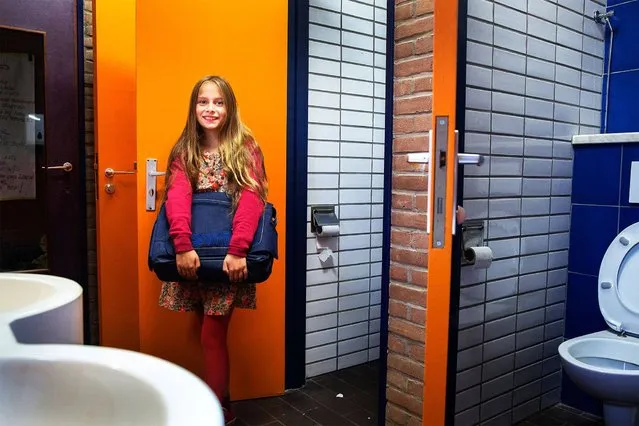
Belgium. Rosalie, 9, goes to school in Brussels. “At my school we have separate toilets for girls and boys on every floor. My classroom is on the 3rd floor. We have 22 toilets, which are shared between 230 pupils and 20 adults. The teachers at school let us go to the toilet whenever we need to”. (Photo by Tim Dirven/WSUP/Panos)

Belgium. Rosalie, 9, goes to school in Brussels. “At my school we have separate toilets for girls and boys on every floor. My classroom is on the 3rd floor. We have 22 toilets, which are shared between 230 pupils and 20 adults. The teachers at school let us go to the toilet whenever we need to”. (Photo by Tim Dirven/WSUP/Panos)
Details
25 Nov 2014 11:16:00