Loading...
Done
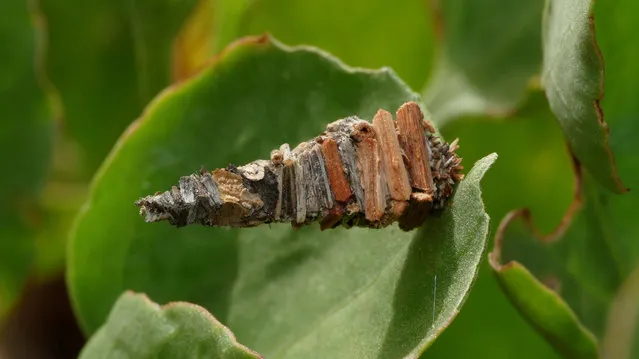
An undated handout photo made available by the Zerynthia Association shows the pupa of an amicta moneiba, a recently discovered species of moth endemic to La Gomera and El Hierro islands in the Canary Islands, Spain (issued 01 July 2020), as those two islands pulled apart from the rest of the Canary Islands 2.5 million years ago. The Institute of Evolutionary Biology of the Spanish National Research Council (CSIC) and the Zerynthia Association have recently discovered two new moth species in El Hierro and La Gomera. (Photo by Yeray Monasterio/Zerynthia/EPA/EFE)

An undated handout photo made available by the Zerynthia Association shows the pupa of an amicta moneiba, a recently discovered species of moth endemic to La Gomera and El Hierro islands in the Canary Islands, Spain (issued 01 July 2020), as those two islands pulled apart from the rest of the Canary Islands 2.5 million years ago. The Institute of Evolutionary Biology of the Spanish National Research Council (CSIC) and the Zerynthia Association have recently discovered two new moth species in El Hierro and La Gomera. (Photo by Yeray Monasterio/Zerynthia/EPA/EFE)
Details
11 Oct 2020 00:01:00
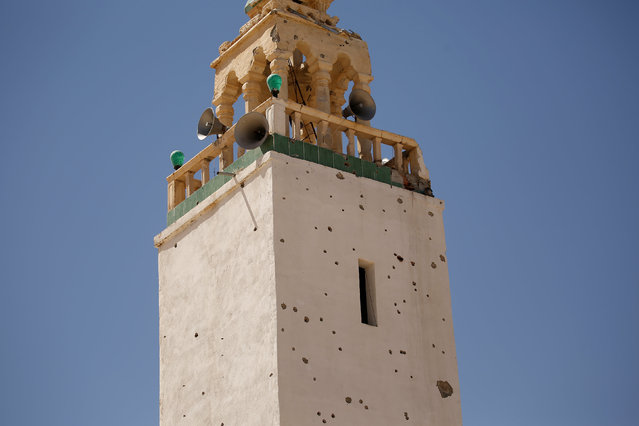
A minaret, that was damaged during fighting between Islamic State jihadists and government forces, is seen in Ben Guerdane, near the Libyan border, Tunisia April 10, 2016. After a U.S. air strike killed a Tunisian jihadist commander in western Libya in late February, dozens of Islamic State fighters sneaked across the border into Tunisia and attacked an army barracks and police bases in the town of Ben Guerdane. (Photo by Zohra Bensemra/Reuters)

A minaret, that was damaged during fighting between Islamic State jihadists and government forces, is seen in Ben Guerdane, near the Libyan border, Tunisia April 10, 2016. After a U.S. air strike killed a Tunisian jihadist commander in western Libya in late February, dozens of Islamic State fighters sneaked across the border into Tunisia and attacked an army barracks and police bases in the town of Ben Guerdane. (Photo by Zohra Bensemra/Reuters)
Details
26 May 2016 12:29:00
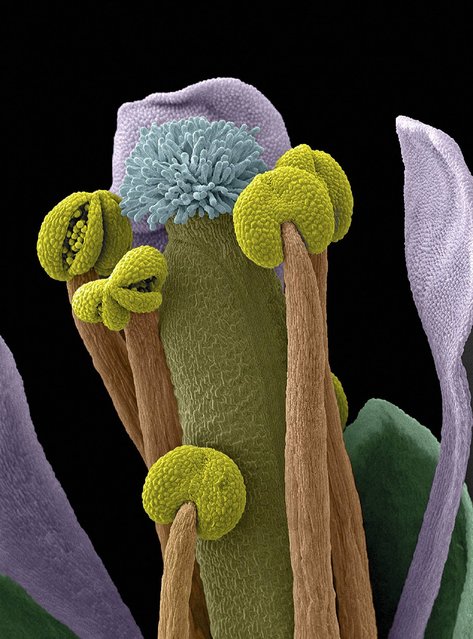
Scanning electron micrograph (SEM) of an Arabidopsis thaliana flower, also commonly known as thale cress. Some of the anthers are open, revealing pollen grains ready for dispersal. Arabidopsis was the first plant to have its entire genome sequenced and is widely used as a model organism in molecular and plant biology. Horizontal width of image is 1200 microns. Magnification 100x. (Photo by Stefan Eberhard/Wellcome Images)

Beautiful, strange and occasionally alarming pictures from the shortlist for this year’s Wellcome image awards – which celebrate the very best in science photography and imaging – from an x-ray of a bat to a micrograph of a kidney stone. The exhibition opens on 12 March at three science centres and the Museum of Science and Industry in Manchester. Photo: Scanning electron micrograph (SEM) of an Arabidopsis thaliana flower, also commonly known as thale cress. Some of the anthers are open, revealing pollen grains ready for dispersal. Arabidopsis was the first plant to have its entire genome sequenced and is widely used as a model organism in molecular and plant biology. Horizontal width of image is 1200 microns. Magnification 100x. (Photo by Stefan Eberhard/Wellcome Images)
Details
11 Mar 2014 05:58:00
Freshmen in Zhengzhou Institute of Aeronautical Industry Management head bottles of mineral water for upright stand during military training on September 17, 2015 in Zhengzhou, Henan Province of China. More than 6,800 freshmen in the school are required to take part in the military training. (Photo by ChinaFotoPress/ChinaFotoPress via Getty Images)

Freshmen in Zhengzhou Institute of Aeronautical Industry Management head bottles of mineral water for upright stand during military training on September 17, 2015 in Zhengzhou, Henan Province of China. More than 6,800 freshmen in the school are required to take part in the military training. (Photo by ChinaFotoPress/ChinaFotoPress via Getty Images)
Details
02 Oct 2015 08:02:00
Sumo wrestler Kaiho eats a “chanko” meal in Nagoya, Japan on July 18, 2017. After ending practice at 10:30 a.m., the wrestlers mingle with fans, sign autographs and pose for photos before the first of their two daily meals. (Photo by Issei Kato/Reuters)

Sumo wrestler Kaiho eats a “chanko” meal in Nagoya, Japan on July 18, 2017. After ending practice at 10:30 a.m., the wrestlers mingle with fans, sign autographs and pose for photos before the first of their two daily meals. (Photo by Issei Kato/Reuters)
Details
20 Jul 2017 07:49:00
Devotees of International Society for Krishna Consciousness (ISKCON) celebrate Holi, the Hindu spring festival of colours, at a temple on the outskirts of Amritsar on March 13, 2025. (Photo by Narinder Nanu/AFP Photo)

Devotees of International Society for Krishna Consciousness (ISKCON) celebrate Holi, the Hindu spring festival of colours, at a temple on the outskirts of Amritsar on March 13, 2025. (Photo by Narinder Nanu/AFP Photo)
Details
02 Apr 2025 04:16:00
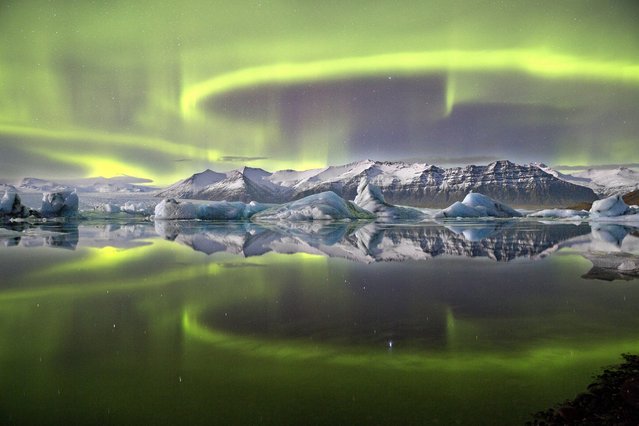
“Aurora over a glacier lagoon”. A vivid green overheaded aurrora pictured in Iceland's Vatnajokull National Park reflected almost symetrically in Jokulsrlon Glacier lagoon. A complete lack of wind and currrent combin in this sheltred lagoon scene to crete an arresting mirror effect giving the image a sensation of utter stillness. Despite theis there is motion on a suprising scale, as the loops and arcs of the aurora are shaped by the shifting forces of the Earth's magnetic field. (Photo by  James Woodend/The Astronomy Photographer of the Year 2014 Contest)

“Aurora over a glacier lagoon”. A vivid green overheaded aurrora pictured in Iceland's Vatnajokull National Park reflected almost symetrically in Jokulsrlon Glacier lagoon. A complete lack of wind and currrent combin in this sheltred lagoon scene to crete an arresting mirror effect giving the image a sensation of utter stillness. Despite theis there is motion on a suprising scale, as the loops and arcs of the aurora are shaped by the shifting forces of the Earth's magnetic field. James Woodend of Great Britain won the grand prize with the image, beating out more than 2,500 other entries. The Astronomy Photographer of the Year 2014 contest is judged by the Royal Observatory Greenwich and BBC Sky at Night magazine. (Photo by James Woodend/The Astronomy Photographer of the Year 2014 Contest)
Details
26 Sep 2014 13:39:00
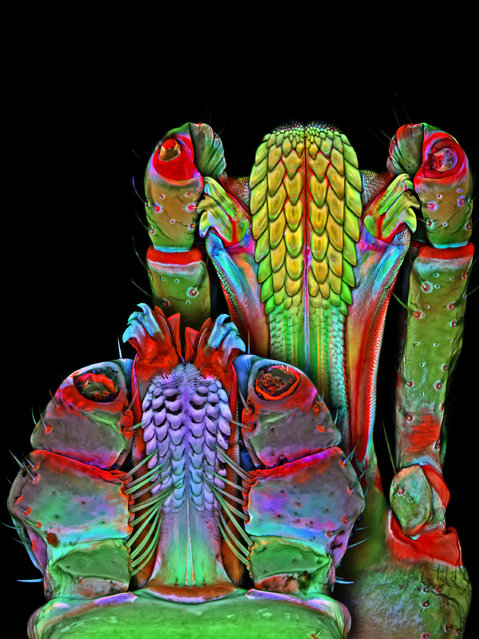
Underside of the Brown dog tick and Lonestar tick mouthparts; Confocal, 100X. Janelia Farm Research Campus, Howard Hughes Medical Institute (HHMI), Ashburn, Virginia, USA. (Photo by Dr. Igor Robert Siwanowicz/Nikon Small World 2014)

Now celebrating its 40th year, Nikon Small World is widely regarded as the leading forum to recognize proficiency and photographic excellence of photography taken under the microscope. To select the winners, competition judges analyzed entries from all over the world covering subjects ranging from chemical compounds to up-close-and-personal looks at biological specimens. The 2014 winners will be revealed on October 30th. In 2014, the competition received over 1,200 entries from more than 79 countries around the world. (Photo by Dr. Igor Robert Siwanowicz/Nikon Small World 2014)
Details
17 Oct 2014 13:10:00