A robot takes part in what is billed as the world's first robot half marathon during the Humanoid Robot Half-Marathon held in Beijing on Saturday, April 19, 2025. (Photo by Ng Han Guan/AP Photo)
Matilda Thurston 10, enjoys a warm day at Hathersage Swimming Pool in Hathersage on April 27, 2025. A mini heatwave is set to hit parts of the UK with temperatures reaching 27 degrees next week. (Photo by Ioannis Alexopoulos/London News Pictures)
Children walk behind their Morrocoye, a terrestrial tortoise native to South America, before a tortoise race held to celebrate the upcoming feast day of Saint Francis of Assisi, the patron saint of animals, in the town of San Francisco de Asis, Venezuela, on October 3, 2025. (Photo by /Juan Carlos Hernandez/Reuters)
A child sits in a walkway at a shelter for families displaced by gang violence, in Port-au-Prince, Haiti, Thursday, May 22, 2025. (Photo by Odelyn Joseph/AP Photo)
Models showcase designs aboard fishing boats off Ngor Island during the 23rd Dakar Fashion Week, organized by Senegalese-French designer Adama N'Diaye, founder of the brand “Adama Paris”, on December 6, 2025, in Dakar, Senegal. (Photo by Cem Ozdel/Anadolu via Getty Images)
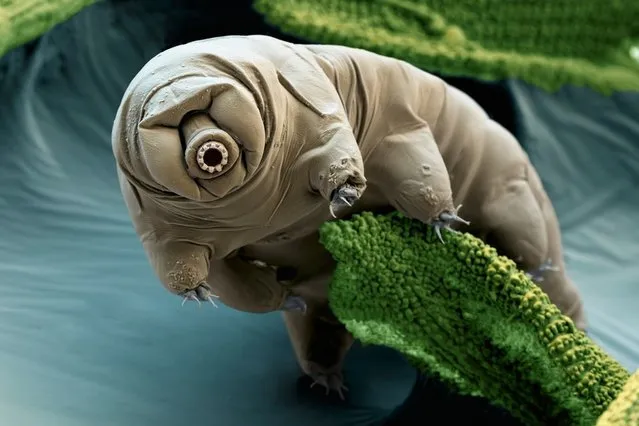
“Tardigrades (commonly known as waterbears or moss piglets) are small, water-dwelling, segmented animals with eight legs. Tardigrades were first discovered in 1773 by Johann August Ephraim Goeze, who called them kleiner Wasserbär, meaning “little water bear” in German. The name Tardigrada means “slow walker” and was given by Lazzaro Spallanzani in 1777. The name water bear comes from the way they walk, reminiscent of a bear's gait. The biggest adults may reach a body length of 1.5 millimetres (0.059 in), the smallest below 0.1 mm. Freshly hatched tardigrades may be smaller than 0.05 mm”. – Wikipedia. Photo: Tardigrades. (Photo by SPL/East News)
A Russian trenchmortar crew run to take up a new firing position in the Stalingrad area during the Great Patriotic War. (Photo by Keystone/Getty Images). October 1942