Loading...
Done
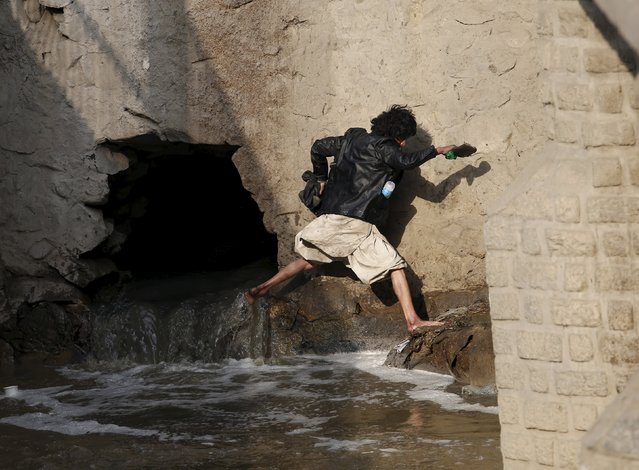
A man runs away during a police round up of suspected drug addicts in Kabul, Afghanistan December 27, 2015. Afghan officials have opened a new drug treatment centre in an abandoned NATO military base in Kabul, in the latest attempt to stamp out the country's massive problem of drug abuse. Camp Phoenix, a former training camp on the edges of Kabul set up by the U.S. army in 2003, will take in around 1,000 homeless drug addicts who will receive food, medical attention and treatment, said Public Health Minister Ferozuddin Feroz. (Photo by Ahmad Masood/Reuters)

A man runs away during a police round up of suspected drug addicts in Kabul, Afghanistan December 27, 2015. Afghan officials have opened a new drug treatment centre in an abandoned NATO military base in Kabul, in the latest attempt to stamp out the country's massive problem of drug abuse. Camp Phoenix, a former training camp on the edges of Kabul set up by the U.S. army in 2003, will take in around 1,000 homeless drug addicts who will receive food, medical attention and treatment, said Public Health Minister Ferozuddin Feroz. (Photo by Ahmad Masood/Reuters)
Details
11 Jan 2016 08:00:00
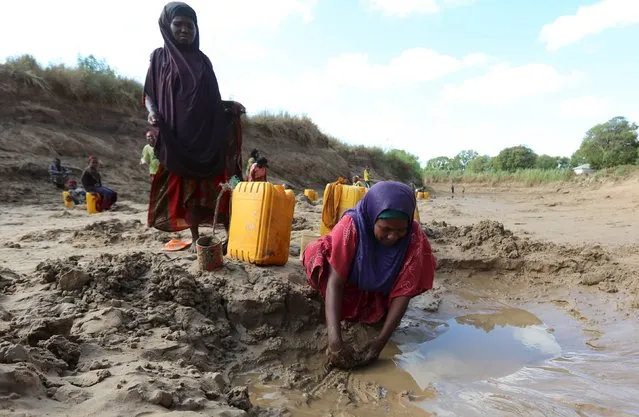
People collect water from shallow wells dug along the Shabelle River bed, which is dry due to drought in Somalia's Shabelle region, March 19, 2016. The cabinet ministers of the federal republic of Somalia have held on Thursday their weekly meeting in Mogadishu and discussed on the drought situation in parts of the country and its humanitarian consequences. Chaired by the acting PM and justice minister Abdullah Ahmed Jama (Ilka-Jir), the cabinet noted with deep concern the the prevailing situation in Somalia, with one of the worst ever drought in two decades. (Photo by Feisal Omar/Reuters)

People collect water from shallow wells dug along the Shabelle River bed, which is dry due to drought in Somalia's Shabelle region, March 19, 2016. The cabinet ministers of the federal republic of Somalia have held on Thursday their weekly meeting in Mogadishu and discussed on the drought situation in parts of the country and its humanitarian consequences. Chaired by the acting PM and justice minister Abdullah Ahmed Jama (Ilka-Jir), the cabinet noted with deep concern the the prevailing situation in Somalia, with one of the worst ever drought in two decades. (Photo by Feisal Omar/Reuters)
Details
20 Mar 2016 11:38:00
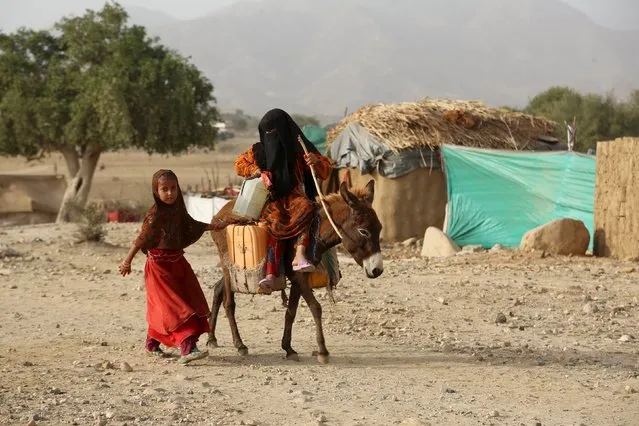
A girl rides a donkey as another walks by at the Shawqaba camp for internally displaced people who were forced to leave their villages by the war in Yemen's northwestern province of Hajjah March 12, 2016. In northwest Yemen, one of the poorest countries in the Middle East, about 400 families uprooted by the war have been stuck in the Shawqaba camp in Hajjah province for the past year. Residents live in poorly built huts that protect them neither from summer heat nor winter cold in a camp that lacks the most basic services. (Photo by Abduljabbar Zeyad/Reuters)

A girl rides a donkey as another walks by at the Shawqaba camp for internally displaced people who were forced to leave their villages by the war in Yemen's northwestern province of Hajjah March 12, 2016. In northwest Yemen, one of the poorest countries in the Middle East, about 400 families uprooted by the war have been stuck in the Shawqaba camp in Hajjah province for the past year. Residents live in poorly built huts that protect them neither from summer heat nor winter cold in a camp that lacks the most basic services. (Photo by Abduljabbar Zeyad/Reuters)
Details
09 Apr 2016 13:16:00
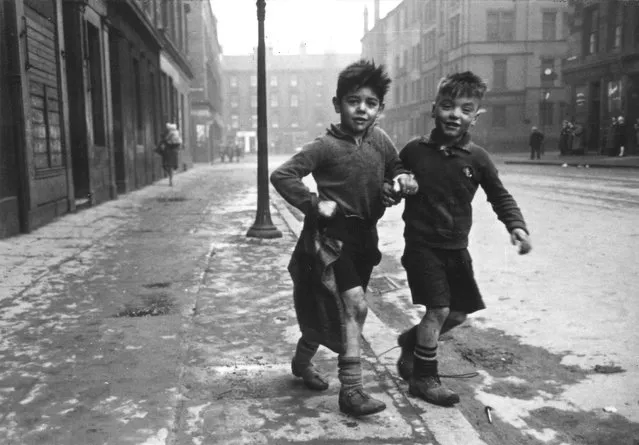
Two boys in the Gorbals area of Glasgow, UK on January 31, 1948. The Gorbals tenements were built quickly and cheaply in the 1840s, providing housing for Glasgow's burgeoning population of industrial workers. Conditions were appalling; overcrowding was standard and sewage and water facilities inadequate. The tenements housed about 40,000 people with up to eight family members sharing a single room, 30 residents sharing a toilet and 40 sharing a tap. By the time this photograph was taken 850 tenements had been demolished since 1920. Redevelopment of the area began in the late 1950s and the tenements were replaced with a modern tower block complex in the sixties. (Photo by Bert Hardy/Getty Images)

Two boys in the Gorbals area of Glasgow, UK on January 31, 1948. The Gorbals tenements were built quickly and cheaply in the 1840s, providing housing for Glasgow's burgeoning population of industrial workers. Conditions were appalling; overcrowding was standard and sewage and water facilities inadequate. The tenements housed about 40,000 people with up to eight family members sharing a single room, 30 residents sharing a toilet and 40 sharing a tap. By the time this photograph was taken 850 tenements had been demolished since 1920. Redevelopment of the area began in the late 1950s and the tenements were replaced with a modern tower block complex in the sixties. (Photo by Bert Hardy/Getty Images)
Details
09 Mar 2017 00:03:00
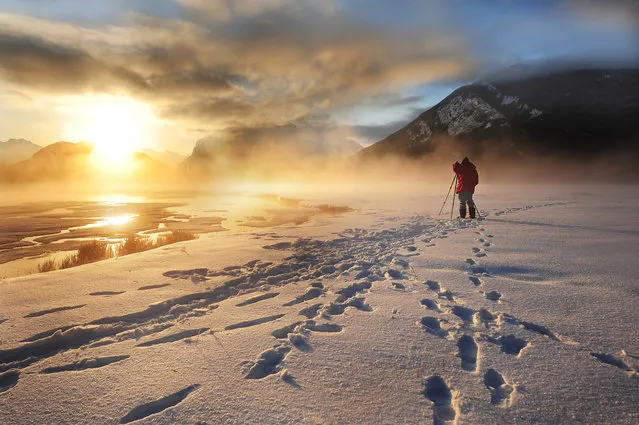
“Artist of the light”. While shooting sunrise in the Vermilion lakes area of Banff national park, Canada, I met a fellow photographer on the scene. Most of the time, we tried not to get in each other's way, however, just by accident, I snapped a picture with him in it working on his tripod settings, and it turned out to be a great photo compared to my sunrise shots. (Photo and caption by Victor Liu/National Geographic Traveler Photo Contest)

“Artist of the light”. While shooting sunrise in the Vermilion lakes area of Banff national park, Canada, I met a fellow photographer on the scene. Most of the time, we tried not to get in each other's way, however, just by accident, I snapped a picture with him in it working on his tripod settings, and it turned out to be a great photo compared to my sunrise shots. (Photo and caption by Victor Liu/National Geographic Traveler Photo Contest)

ATTENTION! All pictures are presented in high resolution. To see Hi-Res images – just TWICE click on any picture. In other words, click small picture – opens the BIG picture. Click BIG picture – opens VERY BIG picture.
Details
27 Jun 2013 13:11:00
The Breitling DC-3, HB-IRJ, plane fly escorted by Italian Air Force's aerobatic demonstration team, the Frecce Tricolori, during the last stage of its world tour two days ahead of the International Sion Air Show, in Sion, Switzerland, 13 September 2017. From March to September 2017, the Breitling DC-3 from 1940 has done a grand world tour in several stages, over 28 countries and flies 50000km, an amazing accomplishment for this legendary plane that will be celebrating its 77th birthday. (Photo by Christian Merz/EPA/EFE)

The Breitling DC-3, HB-IRJ, plane fly escorted by Italian Air Force's aerobatic demonstration team, the Frecce Tricolori, during the last stage of its world tour two days ahead of the International Sion Air Show, in Sion, Switzerland, 13 September 2017. From March to September 2017, the Breitling DC-3 from 1940 has done a grand world tour in several stages, over 28 countries and flies 50000km, an amazing accomplishment for this legendary plane that will be celebrating its 77th birthday. (Photo by Christian Merz/EPA/EFE)
Details
14 Sep 2017 08:25:00
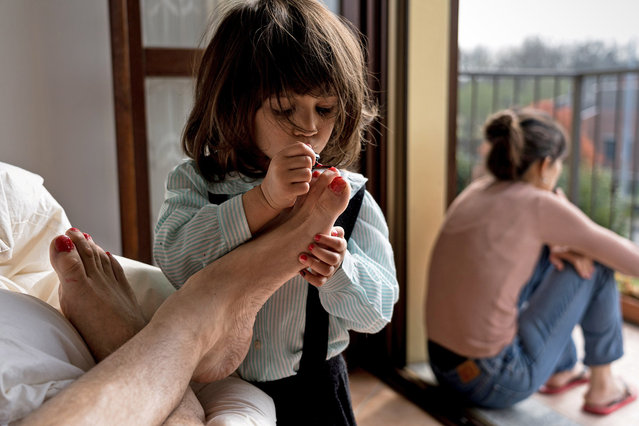
Life in lockdown: Schoolteacher Marzio Toniolo, 35, takes a picture of his two-year-old daughter Bianca painting his toenails as they while away time at home in San Fiorano, one of the original “red zone” towns in northern Italy that has now been extended to the whole country, as his wife, Bianca's mum Chiara Zuddas looks out from their balcony, March 20, 2020. Toniolo has been documenting how his family has dealt with being under quarantine since it began for them in February. (Photo by Marzio Toniolo via Reuters)

Life in lockdown: Schoolteacher Marzio Toniolo, 35, takes a picture of his two-year-old daughter Bianca painting his toenails as they while away time at home in San Fiorano, one of the original “red zone” towns in northern Italy that has now been extended to the whole country, as his wife, Bianca's mum Chiara Zuddas looks out from their balcony, March 20, 2020. Toniolo has been documenting how his family has dealt with being under quarantine since it began for them in February. (Photo by Marzio Toniolo via Reuters)
Details
09 Apr 2020 00:03:00
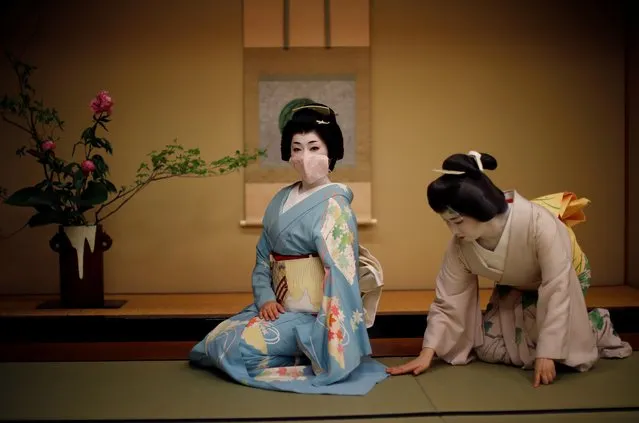
Mayu adjusts Koiku’s kimono, as Koiku wears a protective face mask while posing for a photograph, before they work at a party where they will entertain with other geisha at Japanese luxury restaurant Asada in Tokyo, Japan, June 23, 2020. The coronavirus pandemic has made Tokyo's geisha fear for their centuries-old profession as never before. Though the number of geisha - famed for their witty conversation, beauty and skill at traditional arts - has been falling for years, they were without work for months due to Japan's state of emergency and now operate under awkward social distancing rules. Engagements are down 95 percent, and come with new rules: no pouring drinks for customers or touching them even to shake hands, and sitting 2 meters apart. Masks are hard to wear with their elaborate wigs, so they mostly don't. “I was just full of anxiety”, said Mayu, 47. “I went through my photos, sorted my kimonos ... The thought of a second wave is terrifying”. (Photo by Kim Kyung-Hoon/Reuters)

Mayu adjusts Koiku’s kimono, as Koiku wears a protective face mask while posing for a photograph, before they work at a party where they will entertain with other geisha at Japanese luxury restaurant Asada in Tokyo, Japan, June 23, 2020. (Photo by Kim Kyung-Hoon/Reuters)
Details
23 Jul 2020 00:03:00