Loading...
Done
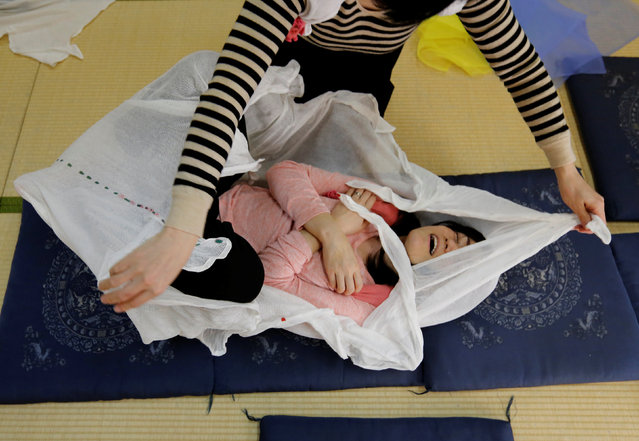
A woman reacts after performing Otonamaki, which translates as “adult wrapping”, a new form of therapy where people are wrapped in large swaddling cloth to alleviate posture problems and stiffness, at a session in Asaka, Saitama prefecture, Japan, February 4, 2017. (Photo by Toru Hanai/Reuters)

A woman reacts after performing Otonamaki, which translates as “adult wrapping”, a new form of therapy where people are wrapped in large swaddling cloth to alleviate posture problems and stiffness, at a session in Asaka, Saitama prefecture, Japan, February 4, 2017. (Photo by Toru Hanai/Reuters)
Details
06 Feb 2017 01:05:00
Malian workers haul out a boat they use to carry sand collected from the river bed during a routine maintenance on October 7, 2018, in the port of Bamako. (Photo by Michele Cattani/AFP Photo)

Malian workers haul out a boat they use to carry sand collected from the river bed during a routine maintenance on October 7, 2018, in the port of Bamako. Increasing construction in the Malian capital has boosted the demand for bricks made out of high-quality Niger River sand. (Photo by Michele Cattani/AFP Photo)
Details
25 Oct 2018 00:05:00
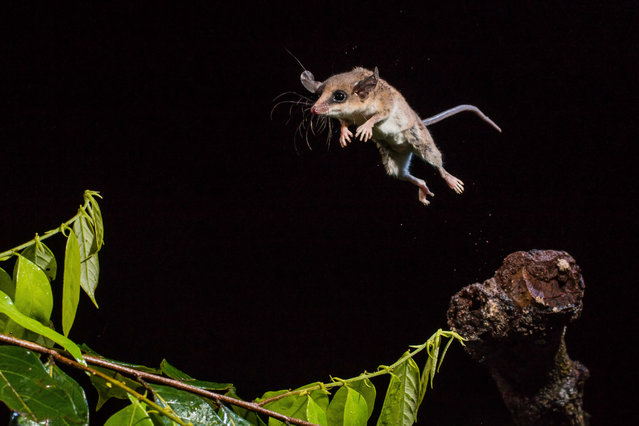
Tropical acrobatics by Adrià López Baucells in Manaus, Brazil. An unidentified South American marsupial, although the characteristic black markings on its face indicate it may be a mouse opossum. These small creatures are nocturnal and feed on bugs, fruit and bird eggs. (Photo by Adrià López Baucells/2019 Royal Society of Biology Photography Competition)

Tropical acrobatics by Adrià López Baucells in Manaus, Brazil. An unidentified South American marsupial, although the characteristic black markings on its face indicate it may be a mouse opossum. These small creatures are nocturnal and feed on bugs, fruit and bird eggs. (Photo by Adrià López Baucells/2019 Royal Society of Biology Photography Competition)
Details
10 Oct 2019 00:03:00


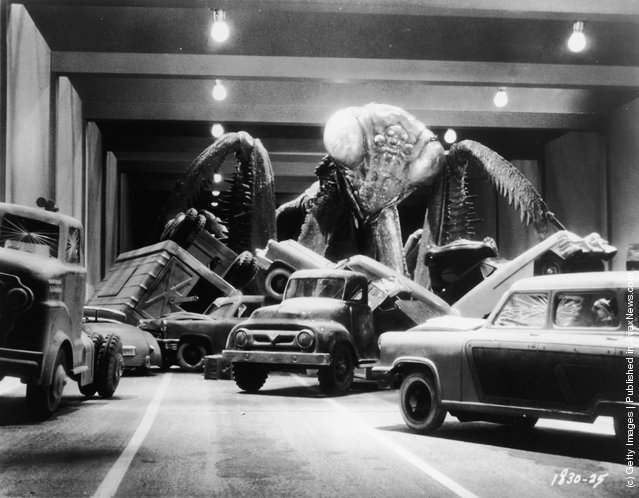
An oversized, prehistoric praying mantis wreaks havoc in a freeway underpass as it overturns cars and trucks, in a film still from “The Deadly Mantis”, directed by Nathan Juran, 1957. (Photo by Universal Pictures/Courtesy of Getty Images)
Details
10 Apr 2011 06:59:00
Hanging bird cages are displayed on poles during a bird-singing contest in the Rueso district in Thailand's southern province of Narathiwat on March 23, 2014. Hundreds of bird owners from Thailand, Malaysia and Singapore took part in the traditional contest held every year. (Photo by Madaree Tohlala/AFP Photo)

Hanging bird cages are displayed on poles during a bird-singing contest in the Rueso district in Thailand's southern province of Narathiwat on March 23, 2014. Hundreds of bird owners from Thailand, Malaysia and Singapore took part in the traditional contest held every year. (Photo by Madaree Tohlala/AFP Photo)
Details
25 Mar 2014 08:35:00
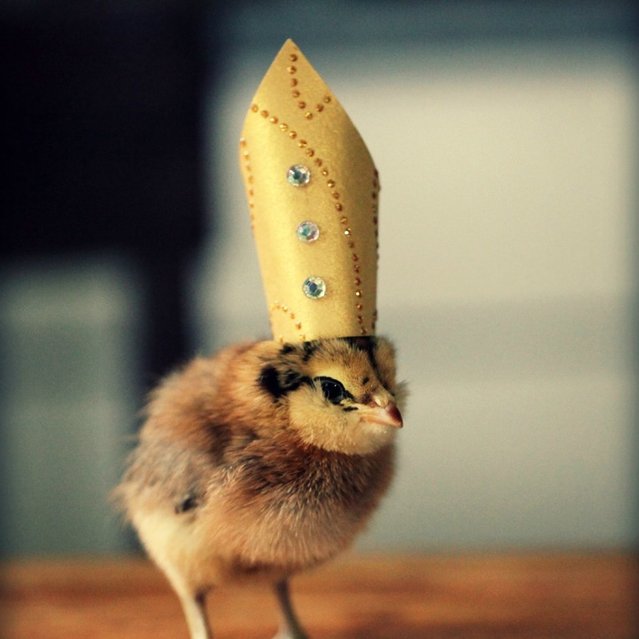
Adorable Baby Chicks Wearing Funny Little Hats

Chicks in Hats is one of those photo projects that will bring a huge smile to your face! There is something inherently funny about animals wearing people's clothing. Maine-based artist Julie Persons created this series simply because she says, "I like to put hats on my chicks and take photographs of them."
Details
06 Jan 2013 11:26:00
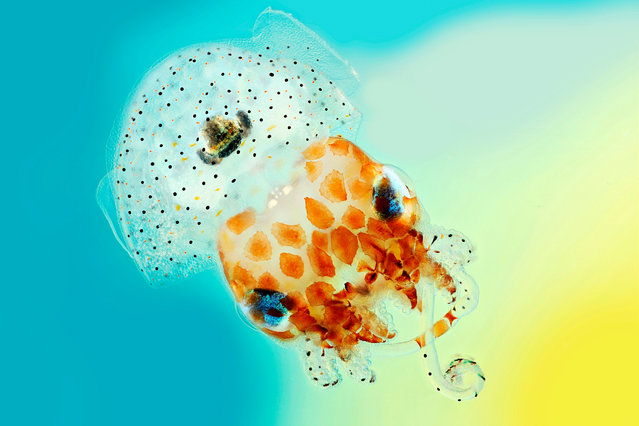
With its huge eyes, comical name and diminutive size, Mark R. Smith’s image of a baby Hawaiian bobtail squid can’t help but raise a smile. A curiously endearing creature, the cephalopod is just 1.5cm across, its mantle cavity bearing more than a passing resemblance to a rather natty shower cap. But it is also a beautiful example of symbiosis – nature’s version of “I’ll scratch your back if you scratch mine” – for on the underside of the squid is a light organ which houses bioluminescent bacteria. The squid offers the bacteria protection and food, while the bacteria emit a glow – a handy trait that the squid uses to offset its silhouette, helping it to evade predators in the depths below. Mark R. Smith’s entry combines several images of a Hawaiian bobtail squid with different focus lengths to create a final picture with greater depth of field than normal. (Photo by Mark R. Smith/Wellcome Images/Macroscopic Solutions)

With its huge eyes, comical name and diminutive size, Mark R. Smith’s image of a baby Hawaiian bobtail squid can’t help but raise a smile. A curiously endearing creature, the cephalopod is just 1.5cm across, its mantle cavity bearing more than a passing resemblance to a rather natty shower cap. But it is also a beautiful example of symbiosis – nature’s version of “I’ll scratch your back if you scratch mine” – for on the underside of the squid is a light organ which houses bioluminescent bacteria. The squid offers the bacteria protection and food, while the bacteria emit a glow – a handy trait that the squid uses to offset its silhouette, helping it to evade predators in the depths below. Mark R. Smith’s entry combines several images of a Hawaiian bobtail squid with different focus lengths to create a final picture with greater depth of field than normal. (Photo by Mark R. Smith/Wellcome Images/Macroscopic Solutions)
Details
08 Mar 2017 00:05:00
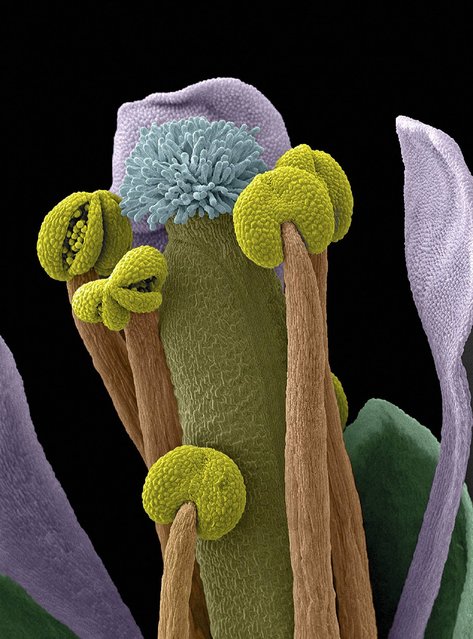
Scanning electron micrograph (SEM) of an Arabidopsis thaliana flower, also commonly known as thale cress. Some of the anthers are open, revealing pollen grains ready for dispersal. Arabidopsis was the first plant to have its entire genome sequenced and is widely used as a model organism in molecular and plant biology. Horizontal width of image is 1200 microns. Magnification 100x. (Photo by Stefan Eberhard/Wellcome Images)

Beautiful, strange and occasionally alarming pictures from the shortlist for this year’s Wellcome image awards – which celebrate the very best in science photography and imaging – from an x-ray of a bat to a micrograph of a kidney stone. The exhibition opens on 12 March at three science centres and the Museum of Science and Industry in Manchester. Photo: Scanning electron micrograph (SEM) of an Arabidopsis thaliana flower, also commonly known as thale cress. Some of the anthers are open, revealing pollen grains ready for dispersal. Arabidopsis was the first plant to have its entire genome sequenced and is widely used as a model organism in molecular and plant biology. Horizontal width of image is 1200 microns. Magnification 100x. (Photo by Stefan Eberhard/Wellcome Images)
Details
11 Mar 2014 05:58:00