Loading...
Done
Director Taro Kambe directs as he watches acting with VR headset during a rehearsal for ROCKET's 3D virtual reality adult film at the company's studio in Tokyo, Japan, July 31, 2017. (Photo by Kim Kyung-Hoon/Reuters)

Director Taro Kambe directs as he watches acting with VR headset during a rehearsal for ROCKET's 3D virtual reality adult film at the company's studio in Tokyo, Japan, July 31, 2017. Japan is the world's second biggest virtual reality market after the United States and the adult entertainment industry and gaming sector are turning to VR as a new way to distribute content. (Photo by Kim Kyung-Hoon/Reuters)
Details
10 Apr 2018 00:05:00
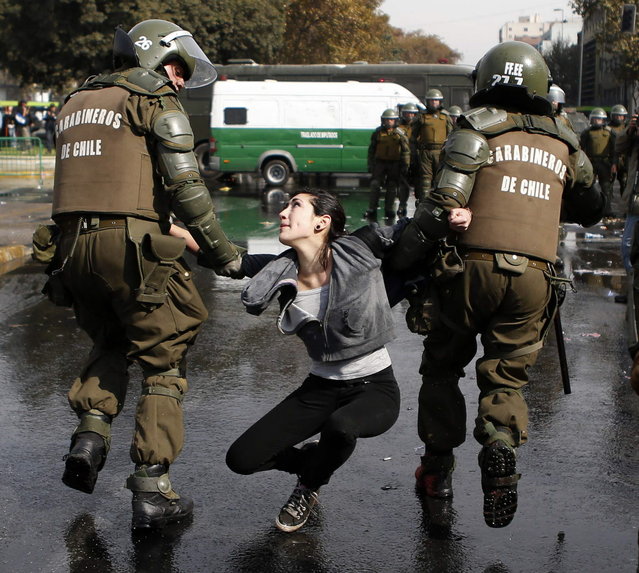
A demonstrator is detained during May Day rallies in Santiago May 1, 2013. (Photo by Ivan Alvarado/Reuters)

A demonstrator is detained during May Day rallies in Santiago May 1, 2013. (Photo by Ivan Alvarado/Reuters)
Details
03 May 2013 07:59:00
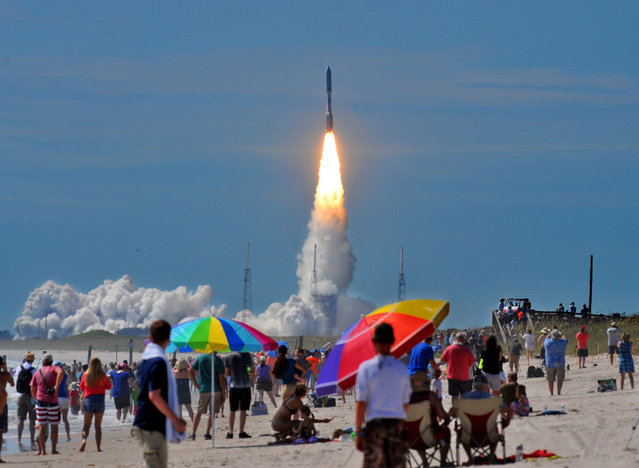
Hundreds of people pack the Canaveral national seashore's Playalinda Beach as a United Launch Alliance Atlas V rocket, carrying a U.S. Navy communications satellite, lifts off from Complex 41 at the Cape Canaveral Air Force Station, Friday, June 24, 2016, in Cape Canaveral, Fla. The satellite is designed to significantly improve ground communications for U.S. forces on the move. (Photo by Craig Rubadoux/Florida Today via AP Photo)

Hundreds of people pack the Canaveral national seashore's Playalinda Beach as a United Launch Alliance Atlas V rocket, carrying a U.S. Navy communications satellite, lifts off from Complex 41 at the Cape Canaveral Air Force Station, Friday, June 24, 2016, in Cape Canaveral, Fla. The satellite is designed to significantly improve ground communications for U.S. forces on the move. (Photo by Craig Rubadoux/Florida Today via AP Photo)
Details
25 Jun 2016 12:23:00
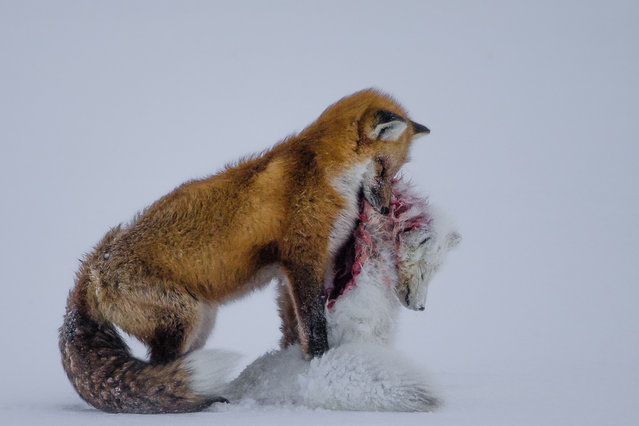
A tale of two foxes. Surprising behaviour, witnessed in Wapusk national park, on Hudson Bay, Canada, in early winter. Red foxes don’t actively hunt Arctic foxes, but where the ranges of two predators overlap, there can be conflict. Though the light was poor, the snow-covered tundra provided the backdrop for the moment that the red fox paused with the smaller fox in its mouth in a grim pose. (Photo by Don Gutoski/2015 Wildlife Photographer of the Year)

A tale of two foxes. Surprising behaviour, witnessed in Wapusk national park, on Hudson Bay, Canada, in early winter. Red foxes don’t actively hunt Arctic foxes, but where the ranges of two predators overlap, there can be conflict. Though the light was poor, the snow-covered tundra provided the backdrop for the moment that the red fox paused with the smaller fox in its mouth in a grim pose. (Photo by Don Gutoski/2015 Wildlife Photographer of the Year)
Details
20 Oct 2015 08:02:00
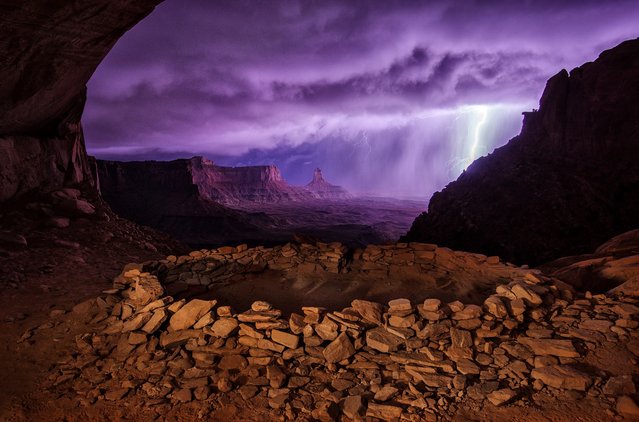
Second Place Winner: “Thunderstorm at False Kiva”. I hiked out to these ruins at night hoping to photograph them with the Milky Way, but instead a thunderstorm rolled through, creating this dramatic image. – Max Seigal. (Photo and caption by Max Seigal/National Geographic Traveler Photo Contest)

Second Place Winner: “Thunderstorm at False Kiva”. I hiked out to these ruins at night hoping to photograph them with the Milky Way, but instead a thunderstorm rolled through, creating this dramatic image. – Max Seigal. National Geographic Traveler Director of Photography Dan Westergren, one of this year's judges, shares his thoughts on the second place winner: “This photo combines two different scenes into one: the small kiva in a cliff dwelling and the grand vista of Canyonlands National Park across the valley. I really like the two different color palettes – warm inside and purple outside. This two-for-one scene was caused by the lightning storm outside the dwelling, which lit up the landscape like it was a huge electronic flash. Looking at this picture I can imagine what a wonderful sight it must have been for the ancient people who lived here. It doesn't seem too amazing now in our modern world, but might have been mind-blowing for the prehistoric residents”. Location: Utah. (Photo and caption by Max Seigal/National Geographic Traveler Photo Contest)
Details
02 Aug 2013 06:16:00
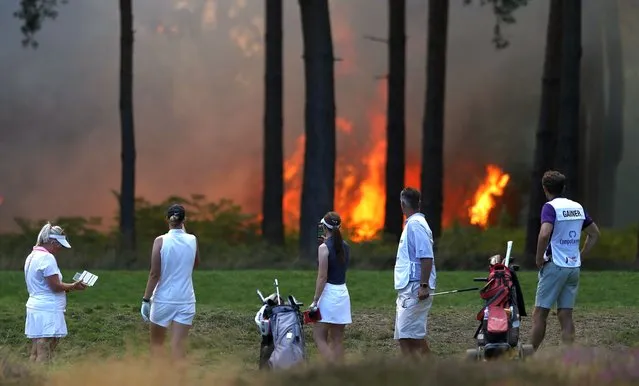
Players, Sophie Powell, Cara Gainer and Gabriella Cowley and their caddies look on as a fire nears the 10th hole during day three of The Rose Ladies Series on The West Course in the first ever ladies professional event at Wentworth Golf Club on August 07, 2020 in Virginia Water, England. (Photo by Naomi Baker/Getty Images)

Players, Sophie Powell, Cara Gainer and Gabriella Cowley and their caddies look on as a fire nears the 10th hole during day three of The Rose Ladies Series on The West Course in the first ever ladies professional event at Wentworth Golf Club on August 07, 2020 in Virginia Water, England. (Photo by Naomi Baker/Getty Images)
Details
04 Sep 2020 00:03:00
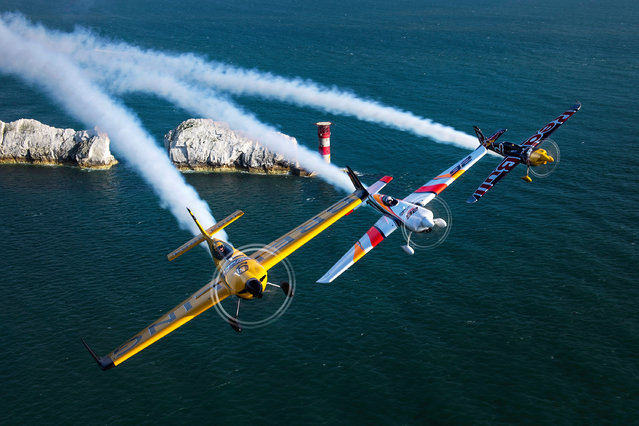
Nigel Lamb from Great Britain, left, leading Juan Velarde of Spain, centre, and Martin Šonka of Czech Republic in the FAI Red Bull air race, Isle of Wight, UK on August 9, 2016. (Photo by Joerg Mitter/Red Bull/Global New/PA Wire)

Nigel Lamb from Great Britain, left, leading Juan Velarde of Spain, centre, and Martin Šonka of Czech Republic in the FAI Red Bull air race, Isle of Wight, UK on August 9, 2016. (Photo by Joerg Mitter/Red Bull/Global New/PA Wire)
Details
11 Aug 2016 15:06:00
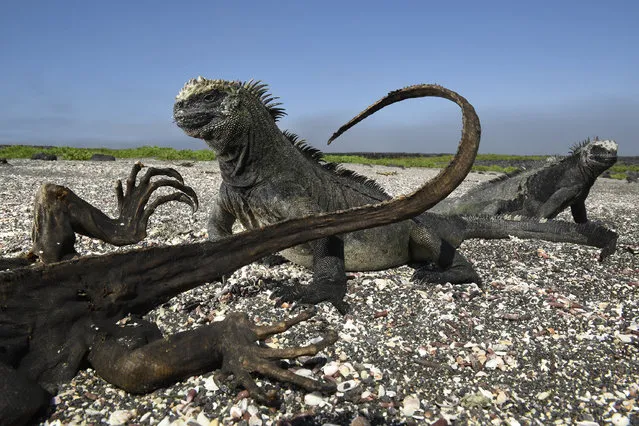
Galapagos – Rocking the Cradle: Four major ocean currents converge along the Galapagos archipelago, creating the conditions for an extraordinary diversity of animal life, April 25, 2016. The islands are home to at least 7,000 flora and fauna species, of which 97 percent of the reptiles, 80 percent of the land birds, 50 percent of the insects and 30 percent of the plants are endemic. The local ecosystem is highly sensitive to the changes in temperature, rainfall and ocean currents that characterize the climatic events known as El Niño and La Niña. These changes cause marked fluctuations in weather and food availability. Many scientists expect the frequency of El Niño and La Niña to increase as a result of climate change, making the Galapagos a possible early-warning location for its effects. (Photo by Thomas P. Peschak for National Geographic/World Press Photo)

Galapagos – Rocking the Cradle: Four major ocean currents converge along the Galapagos archipelago, creating the conditions for an extraordinary diversity of animal life, April 25, 2016. The islands are home to at least 7,000 flora and fauna species, of which 97 percent of the reptiles, 80 percent of the land birds, 50 percent of the insects and 30 percent of the plants are endemic. (Photo by Thomas P. Peschak for National Geographic/World Press Photo)
Details
16 Apr 2018 00:01:00