Loading...
Done
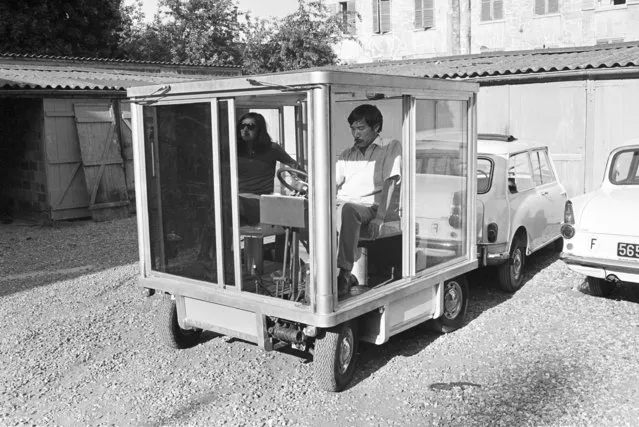
South Vietnamese-born designer Quasar drives the six-foot long square-shaped plastic car he built and which is scheduled to be a hit with the young driving set, in Paris, June 23, 1967. The car can be driven at speeds of up to 60 mph  (Photo by Michel Laurent/AP Photo)

South Vietnamese-born designer Quasar drives the six-foot long square-shaped plastic car he built and which is scheduled to be a hit with the young driving set, in Paris, June 23, 1967. The car can be driven at speeds of up to 60 mph (Photo by Michel Laurent/AP Photo)
Details
07 Oct 2017 07:37:00
Dancers pose for a photo as they prepare during Festival Cilung or “Love the Environment” Festival, where boats made from recycled materials, mostly plastic bottles, sail on the Ciliwung River, one of the most polluted rivers in the world, to raise public awareness about river pollution, in Jakarta, Indonesia, on September 28, 2025. (Photo by Willy Kurniawan/Reuters)

Dancers pose for a photo as they prepare during Festival Cilung or “Love the Environment” Festival, where boats made from recycled materials, mostly plastic bottles, sail on the Ciliwung River, one of the most polluted rivers in the world, to raise public awareness about river pollution, in Jakarta, Indonesia, on September 28, 2025. (Photo by Willy Kurniawan/Reuters)
Details
08 Nov 2025 04:13:00
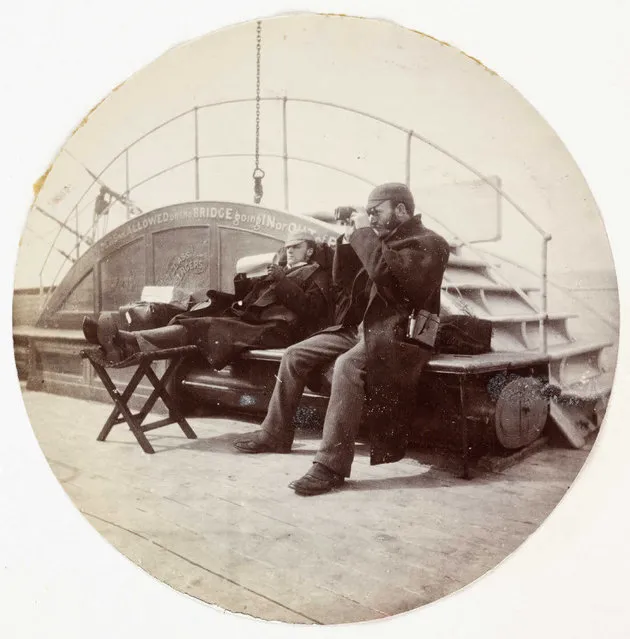
Two men on the deck of a ship, about 1890. (Photo by Collection of National Media Museum/Kodak Museum)

“Today, we take photography for granted. Anyone can take a photograph simply by pressing a button. Yet, it was not always so simple. The invention of photography was announced in 1839, but during its first fifty years taking a photograph was a complicated and expensive business. In 1888, all this was to change following the appearance of a camera that was to revolutionize photography. Popular photography can properly be said to have started 120 years ago with the introduction of the Kodak”. – The UK National Media Museum. Photo: Two men on the deck of a ship, about 1890. (Photo by Collection of National Media Museum/Kodak Museum)
Details
27 May 2014 10:31:00
Peruvian surfer Carlos “Huevito” Areola rides a reed board, or “caballito” (little horse), into a wave at Sydney's Bondi Beach, February 24, 2016. (Photo by Jason Reed/Reuters)

Peruvian surfer Carlos “Huevito” Areola rides a reed board, or “caballito” (little horse), into a wave at Sydney's Bondi Beach, February 24, 2016. Areola is part of a group of Peruvian surfers touring Australia’s east coast to promote the use of the “caballito”. The “caballito” is thought to have been invented around 3,000 BC in northern Peru. (Photo by Jason Reed/Reuters)
Details
25 Feb 2016 11:46:00
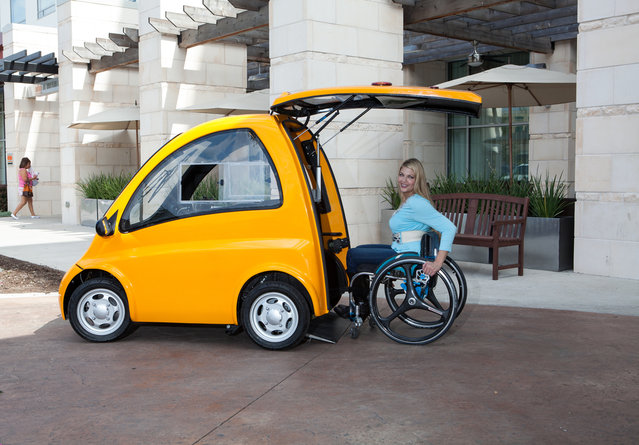
Kenguru Electric Car For Disabled People

Never before was there a car designed exclusively for handicapped people that can only move around in a wheelchair. In the past, such people had to rely on others to drive them. Thus, it was impossible to be spontaneous and drive somewhere on a whim. Now, however, a completely revolutionary vehicle has been invented. Kenguru electric car allows for the person to roll into the back of it right on their wheelchair, strap in, and start driving. Though this vehicle might not be very fast with the maximum speed of 25 mph, it is will certainly make the lives of countless people much easier. (Photo by Kenguru.com)
Details
20 Oct 2014 08:38:00
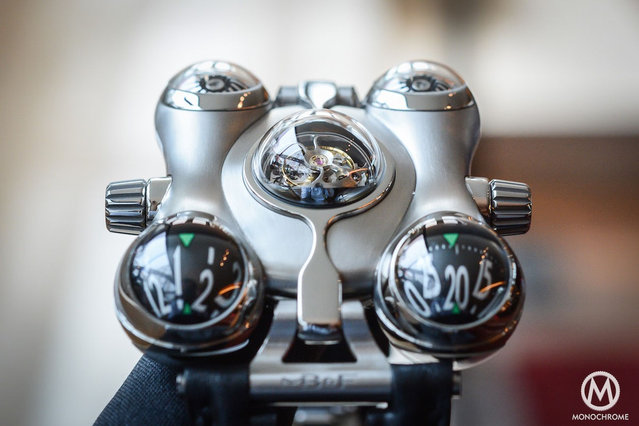
MB&F Horological Machine No. 6 Space Pirate

All throughout history of mankind people were fascinated by time, its flow, and how to measure it. Thus, the science of horology can into being, as people invented more and more sophisticated ways of measuring the passage of time. Truly, it’s one of the most profound characteristics of being a human, to feel and to ponder the meaning of time, its properties, and will we ever be able to move through it, not with it. Now, however, horology is mainly referred to the art of mechanical watchmaking. (Photo by MB&F)
Details
14 Nov 2014 13:51:00
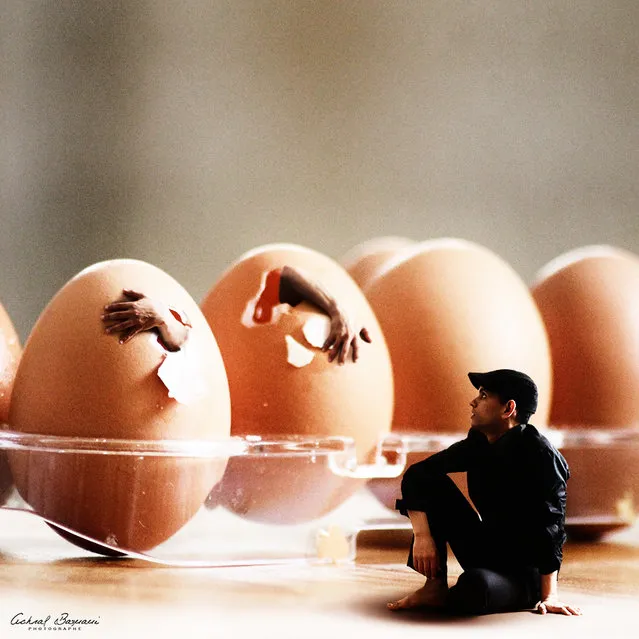
Inside My Dreams By Achraf Baznani

Moroccan photographer and filmmaker Achraf Baznani carries on the traditions of Surrealism with his wild, imaginative, and wholly impractical imagery. Among his inventive scenarios, small human figures—often the artist himself—appear trapped within glass jars or the size of a camera lens; in other works, Baznani more or less dissects his body, as for example, in one, he cleanly removes his brain from his cranium, or in another, twists off his hand, much as if it were a light bulb. Imparted throughout such works are strong senses of humor and wonder, and as such, Baznani’s art offers a Surrealistic take on life experience in the digital age.
Details
03 Aug 2014 12:04:00
In this July 15, 2015 photo, Nepalese amputee victims Khendo Tamang, left, and Nirmala Pariyar, both 8, share a single pair of shoes at the Bir Trauma Center in Kathmandu, Nepal. After suffering serious leg wounds in Nepal's massive 2015 earthquake that killed and injured thousands, both girls were brought to the Bir Trauma Center in Kathmandu, to receive single leg amputations. Following their surgeries, Nirmala's relentless cheerfulness drew a still very depressed Khendo close and both found an inseparable friendship which has helped their emotional wounds heal. (Photo by Niranjan Shrestha/AP Photo)

In this July 15, 2015 photo, Nepalese amputee victims Khendo Tamang, left, and Nirmala Pariyar, both 8, share a single pair of shoes at the Bir Trauma Center in Kathmandu, Nepal. After suffering serious leg wounds in Nepal's massive 2015 earthquake that killed and injured thousands, both girls were brought to the Bir Trauma Center in Kathmandu, to receive single leg amputations. Following their surgeries, Nirmala's relentless cheerfulness drew a still very depressed Khendo close and both found an inseparable friendship which has helped their emotional wounds heal. (Photo by Niranjan Shrestha/AP Photo)
Details
23 Apr 2016 13:48:00