Loading...
Done
The Japanese Use A Real Rabbits As Case For Smartphone

If you see a weird trend or a mind boggling commercial, you know that it’s from Japan. Take the latest one for example. You might be misled be the title into thinking that those bloody bastards are killing poor rabbits and making iPhone cases out of them. However, the reality is much more adorable. The new trend is placing iPhones on rabbit’s tummies and taking pictures of it. Rabbits make the perfect iPhone holders! Not only are they fluffy as hell, they can also nibble on your fingers while you try to type a message, or try voiding your iPhone’s warranty by shaking your iPhone off while trying to escape this humiliation.
Details
27 Oct 2014 11:53:00
A woman cries as she cannot find her 4-year-old daughter and husband on the top of the ruins of a destroyed school in earthquake-hit Beichuan county, Sichuan province, May 17, 2008

“The 2008 Sichuan earthquake or the Great Sichuan Earthquake was a deadly earthquake that measured at 8.0 Ms and 7.9 Mw occurred at 14:28:01 CST (06:28 UTC) on Monday, May 12, 2008 in Sichuan province of China, killing an estimated 68,000 people”. – Wikipedia

Photo: A woman cries as she cannot find her 4-year-old daughter and husband on the top of the ruins of a destroyed school in earthquake-hit Beichuan county, Sichuan province, May 17, 2008. (Photo by Jason Lee/Reuters)
Details
18 Apr 2012 12:32:00
This handout picture released by the Gagarin Cosmonauts' Training Centre on October 17, 2023 shows Marina Vasilevskaya (L) flying during a parabolic flight aboard a zero-gravity simulator, a Russian IL-76 MDK aircraft used for cosmonauts' training flights in weightlessness, in Star City outside Moscow. Belavia flight attendant and spaceflight participant Marina Vasilevskaya of Belarus, along with NASA astronaut Tracy Dyson and Roscosmos cosmonaut Oleg Novitskiy, will blast off to the International Space Station (ISS) aboard the Soyuz MS-25 spacecraft in March 2024 and will spend approximately 12 days aboard the orbital complex. (Photo by Pavel Shvets/Gagarin Cosmonaut Training Center/AFP Photo)

This handout picture released by the Gagarin Cosmonauts' Training Centre on October 17, 2023 shows Marina Vasilevskaya (L) flying during a parabolic flight aboard a zero-gravity simulator, a Russian IL-76 MDK aircraft used for cosmonauts' training flights in weightlessness, in Star City outside Moscow. (Photo by Pavel Shvets/Gagarin Cosmonaut Training Center/AFP Photo)
Details
31 Oct 2023 06:26:00
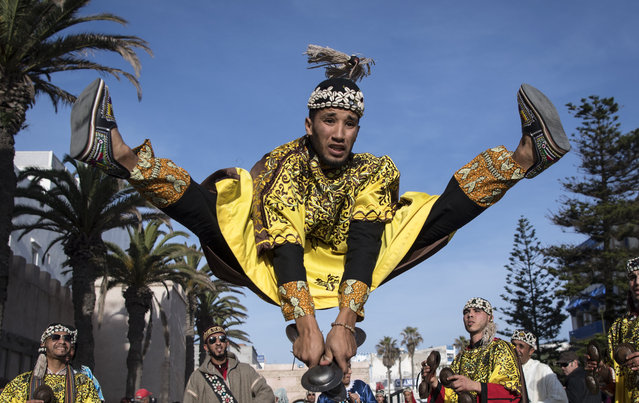
A Gnawa traditional group performs in the city of Essaouira on December 14, 2019, to celebrate the decision of adding the Gnawa culture to UNESCO's list of Intangible Cultural Heritage of Humanity. Gnawa culture, a centuries-old Moroccan practice rooted in music, African rituals and Sufi traditions, was added to UNESCO's list of Intangible Cultural Heritage of Humanity earlier in the week. Gnawa refers to a “set of musical productions, fraternal practices and therapeutic rituals where the secular mixes with the sacred”, according to the nomination submitted by Morocco. Often dressed in colourful outfits, Gnawa musicians play the guenbri, a type of lute with three strings, accompanied by steel castanets called krakebs. (Photo by Fadel Senna/AFP Photo)

A Gnawa traditional group performs in the city of Essaouira on December 14, 2019, to celebrate the decision of adding the Gnawa culture to UNESCO's list of Intangible Cultural Heritage of Humanity. Gnawa culture, a centuries-old Moroccan practice rooted in music, African rituals and Sufi traditions, was added to UNESCO's list of Intangible Cultural Heritage of Humanity earlier in the week. Gnawa refers to a “set of musical productions, fraternal practices and therapeutic rituals where the secular mixes with the sacred”, according to the nomination submitted by Morocco. Often dressed in colourful outfits, Gnawa musicians play the guenbri, a type of lute with three strings, accompanied by steel castanets called krakebs. (Photo by Fadel Senna/AFP Photo)
Details
18 Dec 2019 00:05:00
Flossis By Rosalie

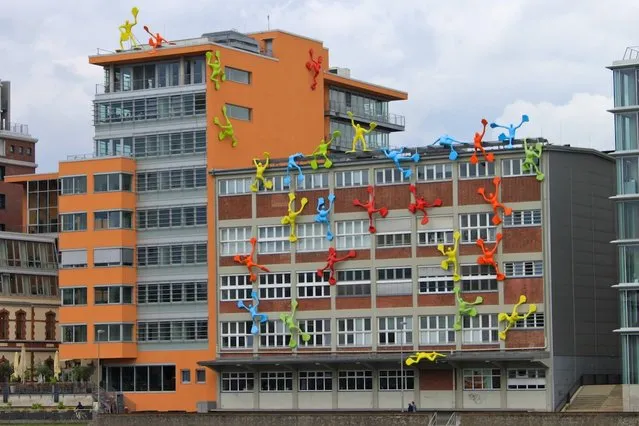
Flossis by the artist Rosalie are known far beyond the boundaries of Dьsseldorf, Germany. In this city on the Rhine, the Flossis became famous. Many buildings’ outer walls are decorated with these figures. Flossis by Rosalie come in different variants of small to large and they are popular among young and old. Flossis are made of resin and resist temperatures under -15 degrees. Below that, they should be brought to the warm inside of the building. The currently most sold Flossi, is the “type I” in red, like shown in the following illustration.
Details
12 Jun 2013 12:30:00
Some women doing yoga pose on the hammocks during the Anti-Gravity yoga class at Svarga e-Motion Sanctuary at Dharmawangsa Square, Jakarta, Saturday, April 18, 2015. (Photo by Jurnasyanto Sukarno/JG Photo)

Some women doing yoga pose on the hammocks during the Anti-Gravity yoga class at Svarga e-Motion Sanctuary at Dharmawangsa Square, Jakarta, Saturday, April 18, 2015. Anti-Gravity Yoga or “aerial yoga”, is a new type of yoga, originating in New York but now being practised in several countries, which combines the traditional yoga poses, pilates and dance with the use of a hammock. (Photo by Jurnasyanto Sukarno/JG Photo)
Details
21 Apr 2015 10:39:00
A baby wallaby

“Very small forest-dwelling wallabies are known as pademelons (genus Thylogale) and dorcopsises (genera Dorcopsis and Dorcopsulus). The name wallaby comes from the Eora Aboriginal tribe who were the original inhabitants of the Sydney area. Wallabies are herbivores whose diet consists of a wide range of grasses, vegetables, leaves, and other types of foliage”. – Wikipedia

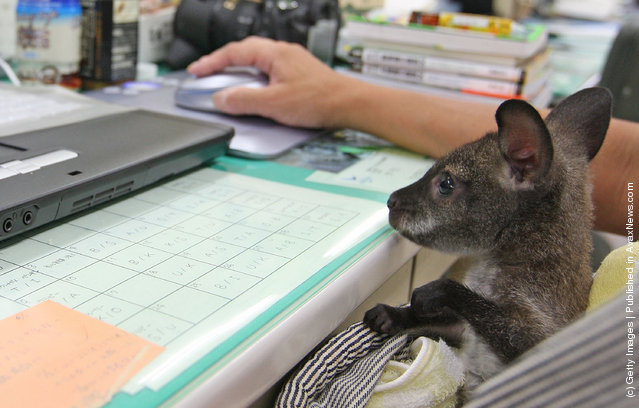
Photo: A baby wallaby sits in a zoo attendant's lap at Edogawa Natural Zoo on August 4, 2009 in Tokyo, Japan. The staff of the zoo have raised the young wallaby after her mother neglected her. (Photo by Junko Kimura/Getty Images)
Details
07 Sep 2011 13:33:00
Cordwood Construction - Natural Building

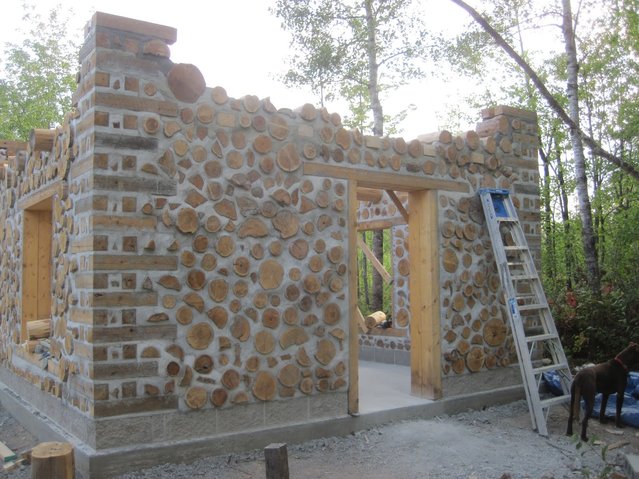
Cordwood construction is a method of natural building that originated roughly one thousand years ago in Greece and Siberia. This method involves using pieces of wood that slightly protrude from the mortar, giving the walls an attractive appearance. Usually, the walls are made 12 to 24 inches thick. However, in some parts of Canada, the walls can be as thick as 36 inches. This method appeals to many people due to its ease of construction economy of resources. Cordwood Construction can be separated into two main types: mortar-insulation-mortar (M-I-M) and Throughwall. M-I-M is a more preferable and widely used choice as it allows for better insulating properties.
Details
27 Nov 2014 15:10:00