Loading...
Done
A Loshadka party in St. Petersburg, 2010. (Photo by Alexander Lepeshkin)

Photographer Alexander Lepeshkin spends whole nights at Clumba parties, or costume parties where the young creatives of Russia put on their most flashy and drink. His photos capture candid moments of alcohol-enhanced connections and collapses, but he says he’s not a party photographer – he’s a youth photographer. Photo: A Loshadka party in St. Petersburg, 2010. (Photo by Alexander Lepeshkin)
Details
04 Sep 2014 08:26:00
Funny Drawings By Aleks Nocny

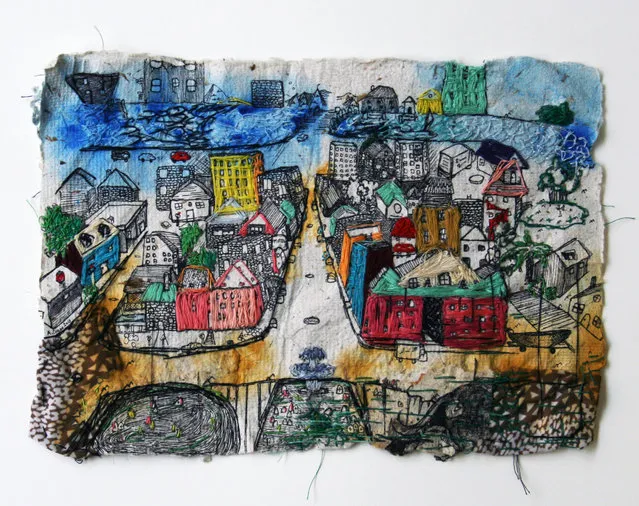
How to make the world a brighter using pen? You just have to complement conventional photographs persons toon, and immediately transformed the world. Aleks Nocny uses simple tools: pens, scraps of paper and your imagination. And the most simple pictures of people on the streets are transformed into a work of art.
Details
10 Oct 2014 10:56:00
While the lido was described as bringing “modernism to the masses” on the British coast it was just the latest example of a trend that had been developing since Victorian times – transforming seaside towns into resorts for leisure and entertainment. In the latter half of the nineteenth century, the fashion was for local authorities to build great piers stretching from the promenade out into the sea

While the lido was described as bringing “modernism to the masses” on the British coast it was just the latest example of a trend that had been developing since Victorian times – transforming seaside towns into resorts for leisure and entertainment. In the latter half of the nineteenth century, the fashion was for local authorities to build great piers stretching from the promenade out into the sea. The Eastbourne Pier, pictured here in May 1931, was erected between 1866 and 1870 to an ingenious design by Eugenius Birch, which saw the structure sitting on special cups allowing the supporting struts to “move” in bad weather. Arranged on the pier's 1,000-foot length were kiosks, a theatre, a ballroom and a camera obscura. 1931. (Photo by Aerofilms Collection via “A History of Britain From Above”)
Details
25 Feb 2014 12:59:00
Cornish students (R) Nina Brooke, 21 and (L) Bonnie Mably, 20, laugh as they pose for a photograph as they try a Cornish pasty that has been baked as part of the World Cornish Pasty Championships at The Eden Project

“A Cornish pasty, sometimes known as a pastie or British pasty in the United States, is a filled pastry case, associated in particular with Cornwall in Great Britain. It is made by placing the uncooked filling on a flat pastry circle, and folding it to wrap the filling, crimping the edge at the side or top to form a seal. The result is a raised semicircular package”. – Wikipedia

Photo: Cornish students (R) Nina Brooke, 21 and (L) Bonnie Mably, 20, laugh as they pose for a photograph as they try a Cornish pasty that has been baked as part of the World Cornish Pasty Championships at The Eden Project on March 3, 2012 in St Austell, England. (Photo by Matt Cardy/Getty Images)
Details
04 Mar 2012 11:49:00
Abdulahi Yaroow, 13, smokes a cigarette while chewing khat at the same time in Mogadishu August 10, 2014. (Photo by Thomas Mukoya/Reuters)

Abdulahi Yaroow, 13, smokes a cigarette while chewing khat at the same time in Mogadishu August 10, 2014. Grown on plantations in the highlands of Kenya and Ethiopia, tonnes of khat, or qat, dubbed “the flower of paradise” by its users, are flown daily into Mogadishu airport, to be distributed from there in convoys of lorries to markets across Somalia. Britain, whose large ethnic Somali community sustained a lucrative demand for the leaves, banned khat from July as an illegal drug. This prohibition jolted the khat market, creating a supply glut in Somalia and pushing down prices, to the delight of the many connoisseurs of its amphetamine-like high. (Photo by Thomas Mukoya/Reuters)
Details
28 Aug 2014 10:35:00
A festival goer uses a hula hoop, as revelers gather ahead of this weekends Glastonbury Festival of Music and Performing Arts on Worthy Farm in Somerset. (Photo by Leon Neal/AFP Photo)

A festival goer uses a hula hoop, as revelers gather ahead of this weekends Glastonbury Festival of Music and Performing Arts on Worthy Farm in Somerset, southwest England, on June 25, 2014. US metal giants Metallica will play this year's coveted Saturday night headline spot at Britain's Glastonbury festival, organisers announced Thursday. It will be the “Master of Puppets” four-piece's first appearance at the legendary festival, held in south west England, following on from The Rolling Stones' Worthy Farm debut last year. (Photo by Leon Neal/AFP Photo)
Details
26 Jun 2014 11:33:00


“The Lovell Telescope is a radio telescope at Jodrell Bank Observatory, near Goostrey, Cheshire in the north-west of England. When it was constructed in 1955, the telescope was the largest steerable dish radio telescope in the world at 76.2 m (250 ft) in diameter; it is now the third largest, after the Green Bank telescope in West Virginia, USA, and the Effelsberg telescope in Germany. It was originally known as the 250 ft (76 m) telescope or the Radio Telescope at Jodrell Bank, before becoming the Mark I telescope around 1961 when future telescopes (the Mark II, III, and IV) were being discussed. It was renamed to the Lovell Telescope in 1987 after Bernard Lovell, and became a Grade I listed building in 1988. The telescope forms part of the MERLIN and European VLBI Network arrays of radio telescopes”. – Wikipedia

Photo: The Lovell Telescope listens to the night sky for radio signals from space at Jodrell Bank on June 22, 2011 in Holmes Chapel, England. Jodrell Bank Centre for Astrophysics and it's world famous Lovell Telescope is on the shortlist of Britain's submission for Unesco World Heritage Site status. (Photo by Christopher Furlong/Getty Images)
Details
24 Jun 2011 09:34:00
A dhobi, or a washerman washes cloths on the banks of the River Gomti in Lucknow, India, Saturday, September 12, 2020. Dhobis are traditional laundry workers who wash clothes by hand and dry them in the sun, an occupation which has been in existence for generations. Most cities in India have a Dhobi Ghat, or washermen's area, where the city's pile of clothes is laundered. This practice is still popular in India, despite of modern technology. Around 1,000 families work in Lucknow's Dhobi Ghat. However, in light of the novel coronavirus, their wages have decreased drastically. With each family earning around US$100-200 per month. (Photo by Rajesh Kumar Singh/AP Photo)

A dhobi, or a washerman washes cloths on the banks of the River Gomti in Lucknow, India, Saturday, September 12, 2020. Dhobis are traditional laundry workers who wash clothes by hand and dry them in the sun, an occupation which has been in existence for generations. Most cities in India have a Dhobi Ghat, or washermen's area, where the city's pile of clothes is laundered. This practice is still popular in India, despite of modern technology. Around 1,000 families work in Lucknow's Dhobi Ghat. However, in light of the novel coronavirus, their wages have decreased drastically. With each family earning around US$100-200 per month. (Photo by Rajesh Kumar Singh/AP Photo)
Details
25 Sep 2020 00:03:00