Loading...
Done


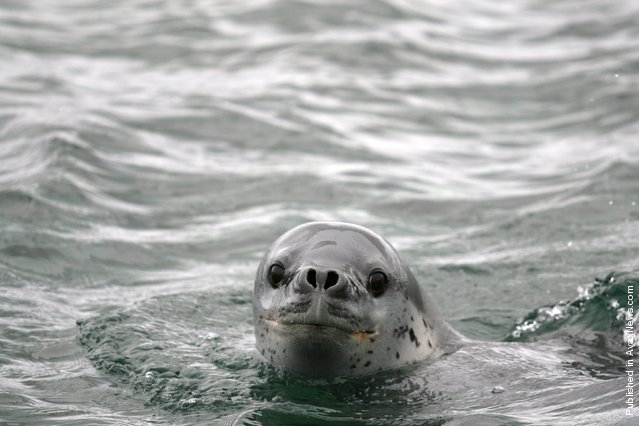
“The leopard seal (Hydrurga leptonyx), also referred to as the sea leopard, is the second largest species of seal in the Antarctic (after the southern elephant seal). It is most common in the southern hemisphere along the coast of Antarctica and on most sub-Antarctic islands, but can also be found on the coasts of southern Australia, Tasmania, South Africa, New Zealand, Lord Howe Island, Tierra del Fuego, the Cook Islands, and the Atlantic coast of South America. It can live twenty-six years, possibly more. Orcas and large sharks are the only natural predators of leopard seals”. – Wikipedia

Photo by: Gilad Rom; Source: Flickr
Details
13 Nov 2011 11:24:00
A Rohingya migrant who arrived in Indonesia by boat cries while speaking on a mobile phone with a relative in Malaysia, at a temporary shelter in Kuala Langsa in Indonesia's Aceh Province May 16, 2015. (Photo by Roni Bintang/Reuters)

A Rohingya migrant who arrived in Indonesia by boat cries while speaking on a mobile phone with a relative in Malaysia, at a temporary shelter in Kuala Langsa in Indonesia's Aceh Province May 16, 2015. Nearly 800 migrants were brought ashore in Indonesia on Friday, but other vessels crammed with them were sent back to sea despite a United Nations call to rescue thousands adrift in Southeast Asian waters with dwindling food and water. Thousands of Rohingya Muslims fleeing Myanmar and Bangladesh are stranded on boats as regional governments block them from landing. (Photo by Roni Bintang/Reuters)
Details
20 May 2015 08:53:00
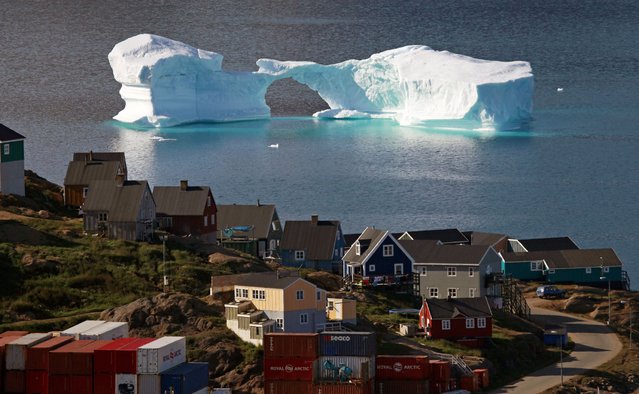
File photo of an iceberg floating near a harbour in the town of Kulusuk, east Greenland August 1, 2009. The United Nations 19th Climate Change Conference (COP19) will take place November 11-22, 2013 in Warsaw. The main goal of the talks with almost almost 200 nations assembled, is to lay the foundation for the new global climate agreement, aiming at further emission reduction, which is to be signed in 2015 in Paris and be launched in 2020. (Photo by Bob Strong/Reuters)

It's taken roughly five months, but a massive iceberg has separated from Antarctica's Pine Island Glacier. According to NASA's Earth Observatory, the estimated size of this iceberg, named B-31, is around 660 square kilometres (33 km long by 20 km wide) – a city-sized block of ice that has slowly migrated away from the continent, and is now floating out to sea. Take a look at some massive icebergs afloat in the oceans. Photo: File photo of an iceberg floating near a harbour in the town of Kulusuk, east Greenland August 1, 2009. (Photo by Bob Strong/Reuters)
Details
27 Apr 2014 07:47:00
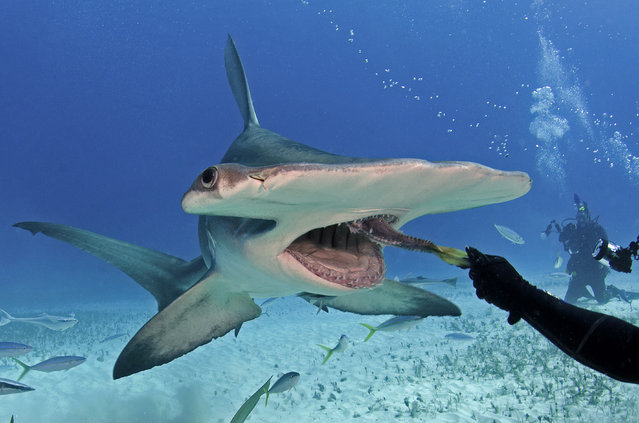
Eli Martinez with hammerhead shark. (Photo by J. P. Zegarra/Caters News)

“This is the terrifying moment a diver came head to head with a shark as it swims inches away snatching a bite for dinner. The close encounter, captured off Bimini Island in the Bahamas, shows the hammerhead approaching diver Eli Martinez who bravely stands his ground as the giant beast approaches. Eli, free diving outside of a protective cage, carefully handled the sea creature despite its menacing razor-sharp teeth – but admitted they are extremely shy and need a lot of work to allow divers close to them. After multiple trips and hours of diving nearby they finally got used to Eli in January this year – hammerheads regularly visit these waters during the winter season”. – Caters News. Photo: Eli Martinez with hammerhead shark. (Photo by J. P. Zegarra/Caters News)
Details
11 Mar 2014 09:24:00
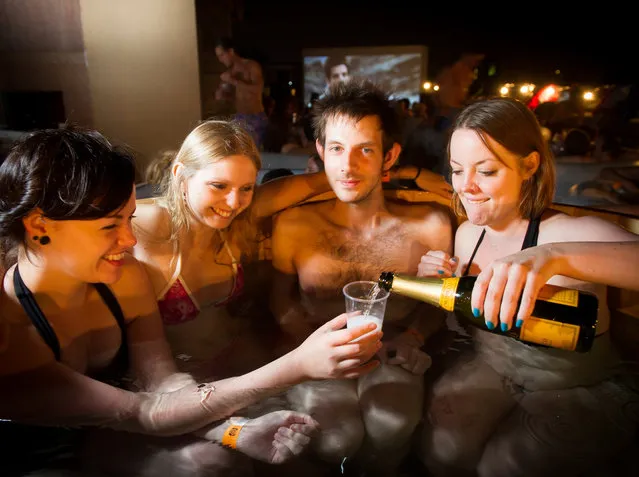
Hot Tub Cinema

Hot Tub Cinema is an experience like no other. Combining relaxing hot tubs, great films and amazing spaces, it is a luxurious event that celebrates film in a fun and engaging way. Attendees can purchase whole tubs to share with friends or buy individual tickets to share with fellow hot tubbers. The tubs are cleaned, refilled and heated before every show. Popping-up throughout the year in London and around the UK, Hot Tub Cinema is also preparing to tour internationally in the near future. During the summer, we takeover rooftops in central London with astounding views across the city's inimitable skyline. For the autumn/winter we move indoors to continue the fun hidden away from the unpredictable weather.
Details
13 Jun 2013 09:06:00
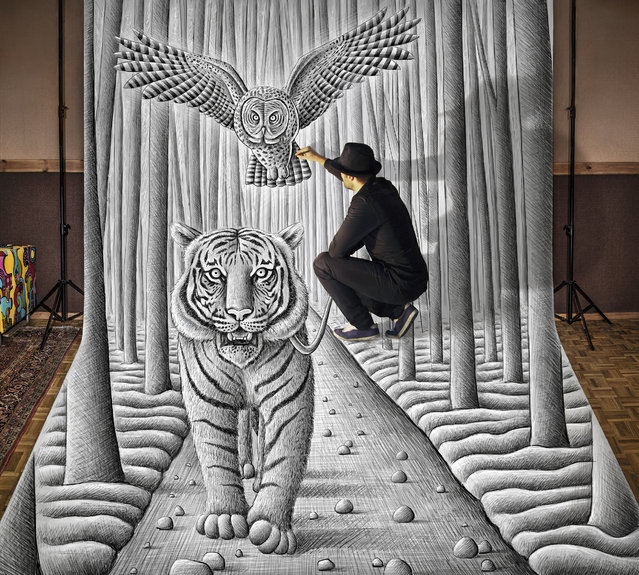
Visual artist Ben Heine at work in his studio while he creates one of his “anamorphic illusions” in Rochefort, Belgium

An arm holding a giant gun appears to explode through a wall, while elsewhere a man walks a tiger on a leash. These breathtaking pencil drawings are the work of 31-year-old artist Ben Heine, who lives and works in Rochefort, Belgium. The “anamorphic illusions”, part of the artist's “Pencil Vs Camera” series, appear slightly distorted unless viewed from the exact same perspective in which they were created. Photo: Visual artist Ben Heine at work in his studio while he creates one of his “anamorphic illusions” in Rochefort, Belgium. (Photo by Ben Heine/Barcroft Media)
Details
23 Mar 2014 11:00:00
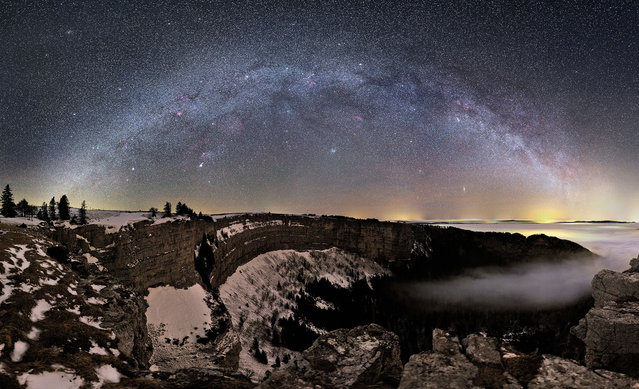
Milky Way over Switzerland

Milky Way over Switzerland

The Milky Way is the galaxy in which Earth is contained. This name derives from its appearance as a dim “milky” glowing band arching across the night sky, in which the naked eye cannot distinguish individual stars. The term “Milky Way” is a translation of the Classical Latin via lactea, from the Hellenistic Greek γαλαξίας κύκλος (pr. galaxías kýklos, “milky circle”). The Milky Way appears like a band because it is a disk-shaped structure being viewed from inside. The fact that this faint band of light is made up of stars was proven in 1610 when Galileo Galilei used his telescope to resolve it into individual stars. In the 1920s, observations by astronomer Edwin Hubble showed that the Milky Way is just one of many galaxies.


Details
20 Jun 2012 10:11:00
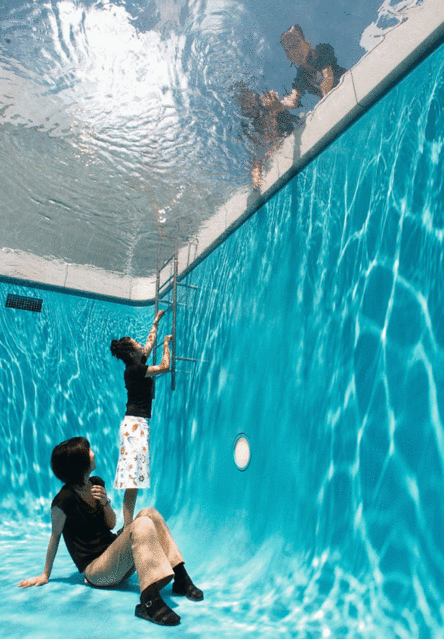
Swimming Pool Art Installation by Leandro Erlich

In one of the Museum’s courtyards is a swimming pool framed by a limestone deck. When seen from the deck, the pool appears to be filled with deep, shimmering water. In fact, however, a layer of water only some 10 centimeters deep is suspended over transparent glass. Below the glass is an empty space with aquamarine walls that viewers can enter. The work sets up an unfolding sequence of experiences—we view the pool through the glass wall enclosing the courtyard; from the deck, looking down into the pool; and from the interior of the pool, looking up. The Swimming Pool might hence be considered a place where, slowly, with time, different perspectives and perceptions of self and others all come to intersect.
Details
25 Aug 2012 07:31:00