Loading...
Done
A model walks off stage in the backstage area during Frankie's Bikinis show at Mercedes Benz Swim Fashion Week in Miami, July 18, 2014. (Photo by Carlo Allegri/Reuters)

A model walks off stage in the backstage area during Frankie's Bikinis show at Mercedes Benz Swim Fashion Week in Miami, July 18, 2014. (Photo by Carlo Allegri/Reuters)
Details
19 Jul 2014 10:37:00
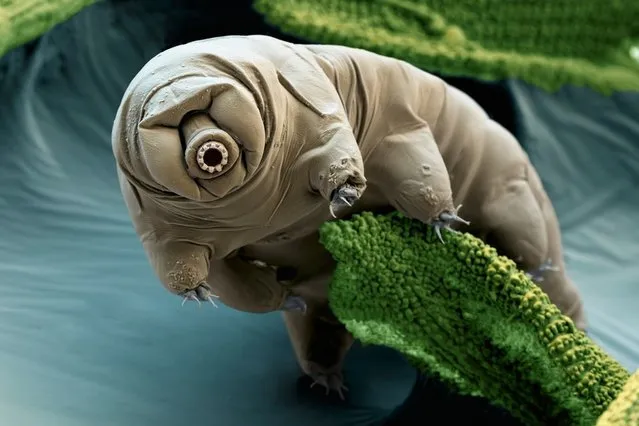
Tardigrades (commonly known as waterbears or moss piglets). (Photo by SPL/East News)

“Tardigrades (commonly known as waterbears or moss piglets) are small, water-dwelling, segmented animals with eight legs. Tardigrades were first discovered in 1773 by Johann August Ephraim Goeze, who called them kleiner Wasserbär, meaning “little water bear” in German. The name Tardigrada means “slow walker” and was given by Lazzaro Spallanzani in 1777. The name water bear comes from the way they walk, reminiscent of a bear's gait. The biggest adults may reach a body length of 1.5 millimetres (0.059 in), the smallest below 0.1 mm. Freshly hatched tardigrades may be smaller than 0.05 mm”. – Wikipedia. Photo: Tardigrades. (Photo by SPL/East News)
Details
26 Sep 2012 09:55:00
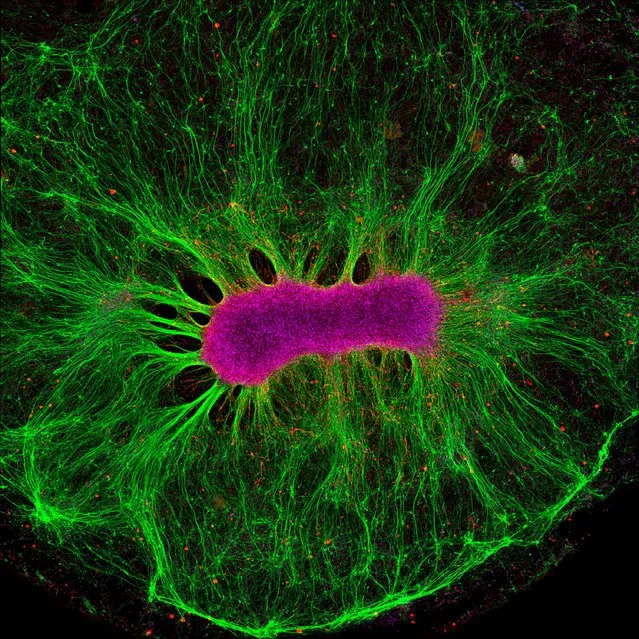
Brain-on-a-chip. Dazzling in green and magenta this image shows the nerve fibres (in green) produced by neural stem cells (in magenta) as they grow on a synthetic gel. Captured by a technique known as confocal microscopy, the image is part of research shedding light on how tinkering with the environment can affect the way in which nerve fibres grow. (Photo by Collin Edington and Iris Lee/Massachusetts Institute of Technology/Wellcome Images)

Brain-on-a-chip. Dazzling in green and magenta this image shows the nerve fibres (in green) produced by neural stem cells (in magenta) as they grow on a synthetic gel. Captured by a technique known as confocal microscopy, the image is part of research shedding light on how tinkering with the environment can affect the way in which nerve fibres grow. (Photo by Collin Edington and Iris Lee/Massachusetts Institute of Technology/Wellcome Images)
Details
17 Mar 2017 00:01:00
England football fans celebrate in Trafalgar Square as England score their second goal during extra time in the UEFA Euro womens championship final on July 31, 2022 in London, United Kingdom. England take on Germany in the final of The UEFA European Women's Championship, played at Wembley Stadium. (Photo by Chris J Ratcliffe/Getty Images)

England football fans celebrate in Trafalgar Square as England score their second goal during extra time in the UEFA Euro womens championship final on July 31, 2022 in London, United Kingdom. England take on Germany in the final of The UEFA European Women's Championship, played at Wembley Stadium. (Photo by Chris J Ratcliffe/Getty Images)
Details
01 Aug 2022 05:24:00
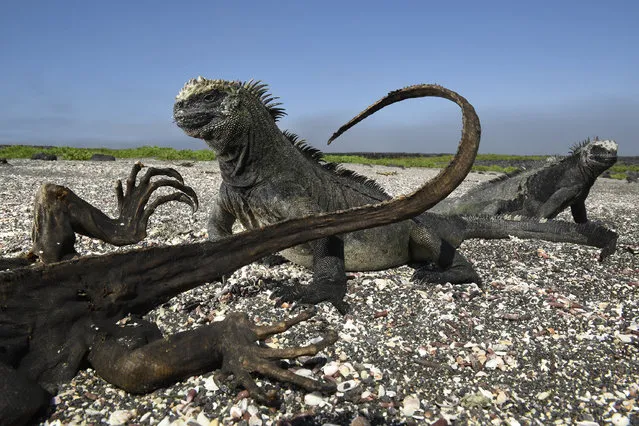
Galapagos – Rocking the Cradle: Four major ocean currents converge along the Galapagos archipelago, creating the conditions for an extraordinary diversity of animal life, April 25, 2016. The islands are home to at least 7,000 flora and fauna species, of which 97 percent of the reptiles, 80 percent of the land birds, 50 percent of the insects and 30 percent of the plants are endemic. The local ecosystem is highly sensitive to the changes in temperature, rainfall and ocean currents that characterize the climatic events known as El Niño and La Niña. These changes cause marked fluctuations in weather and food availability. Many scientists expect the frequency of El Niño and La Niña to increase as a result of climate change, making the Galapagos a possible early-warning location for its effects. (Photo by Thomas P. Peschak for National Geographic/World Press Photo)

Galapagos – Rocking the Cradle: Four major ocean currents converge along the Galapagos archipelago, creating the conditions for an extraordinary diversity of animal life, April 25, 2016. The islands are home to at least 7,000 flora and fauna species, of which 97 percent of the reptiles, 80 percent of the land birds, 50 percent of the insects and 30 percent of the plants are endemic. (Photo by Thomas P. Peschak for National Geographic/World Press Photo)
Details
16 Apr 2018 00:01:00
Members of Tom Maior Special Group samba school perform during the carnival parade at the Anhembi Sambadrome in Sao Paulo, Brazil, 22 Febr​uary 2020. (Photo by Sebastiao Moreira/EPA/EFE)

Members of Tom Maior Special Group samba school perform during the carnival parade at the Anhembi Sambadrome in Sao Paulo, Brazil, 22 Febr​uary 2020. Carnival is the biggest and most popular celebration in Brazil. (Photo by Sebastiao Moreira/EPA/EFE)
Details
26 Feb 2020 00:01:00
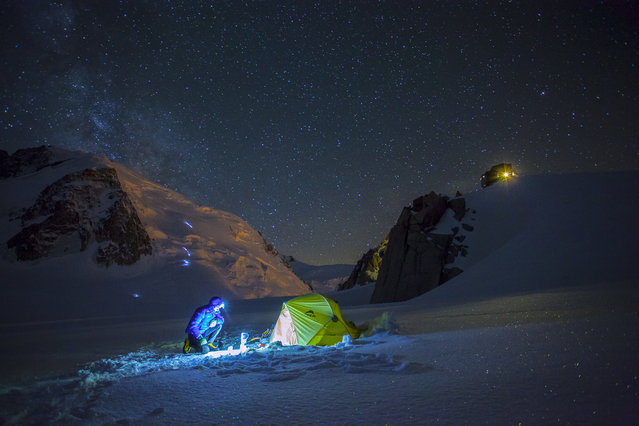
“A snapshot from mountaineer's life”. Have you ever wondered how does a mountaineer's day start? (Photo and caption by Kamil Tamiola/National Geographic Traveler Photo Contest)

“A snapshot from mountaineer's life”. Have you ever wondered how does a mountaineer's day start? I will give you a hint: you wake up at 3 am, set the stove, wake up your partner, pretend it is warm, quickly consume a high-calorie breakfast, watch your friends slowly ascending the icy slopes of your dream summit with their tiny head torches glimmering against perfectly blue ice, and hope for the good weather. One would ask: why all this trouble? The answer is easy: for the love of the adventure and the unknown. Location: Chamonix, Haute Savoye, France. (Photo and caption by Kamil Tamiola/National Geographic Traveler Photo Contest)

ATTENTION! All pictures are presented in high resolution. To see Hi-Res images – just TWICE click on any picture. In other words, click small picture – opens the BIG picture. Click BIG picture – opens VERY BIG picture.

Details
27 Jun 2013 12:47:00
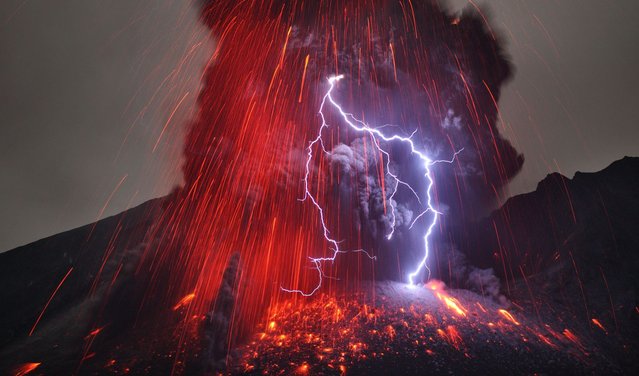
Lightning only ever strikes a volcanic eruption during heavy “vulcanian” or “plinian” explosions when the amount of red lava is very low. (Photo by Martin Rietze/Guzelian)

Martin Rietze is a “volcano-chaser”, a particular breed of photographer who takes big risks for big shots. He was able to capture destructive and beautiful forces of nature at work on a trip to Japan in February 2013. His photos show the Sakurajima Volcano, an active volcanic who's record-breaking 1914 eruption sent lava flows across the island. (Photo by Martin Rietze/Guzelian)
Details
08 Apr 2013 10:49:00