Loading...
Done
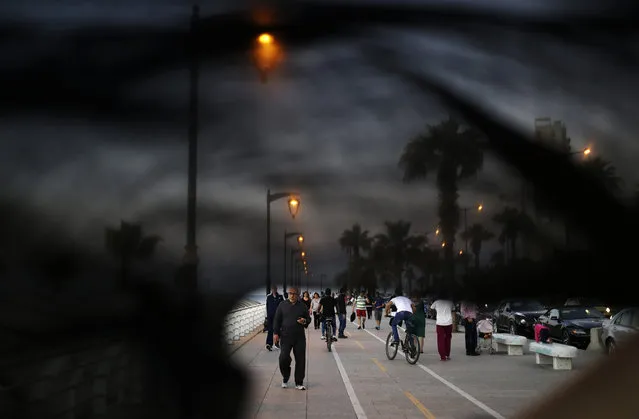
This Thursday, April 30, 2015 photo shows Lebanese citizens walking on the Corniche, or waterfront promenade in Beirut, Lebanon. (Photo by Hassan Ammar/AP Photo)

This Thursday, April 30, 2015 photo shows Lebanese citizens walking on the Corniche, or waterfront promenade in Beirut, Lebanon. This photo was shot through the lowered veil of a niqab, which is worn by some conservative Muslim women. The cloth allows women to follow a strict interpretation of their religious beliefs by preventing others from seeing their faces. (Photo by Hassan Ammar/AP Photo)
Details
18 May 2015 11:42:00
A picture made available on 08 July 2015 showsa  lightning strikes during a heavy storm over Poznan in the night of 07 July 2015. Severe storms passed last night over Poland causing lots of damages to buildings, trees, electricity and railway tractions. (Photo by Lukasz Ogrodowczyk/EPA)

A picture made available on 08 July 2015 showsa lightning strikes during a heavy storm over Poznan in the night of 07 July 2015. Severe storms passed last night over Poland causing lots of damages to buildings, trees, electricity and railway tractions. (Photo by Lukasz Ogrodowczyk/EPA)
Details
09 Jul 2015 12:13:00
U.S. Army helicopters providing support for U.S. ground troops  fly into a staging area fifty miles northeast of Saigon, Vietnam, August 28, 1966. Helicopter fuel is stored in the large rubber tanks, foreground. (Photo by Henri Huet/AP Photo)

U.S. Army helicopters providing support for U.S. ground troops fly into a staging area fifty miles northeast of Saigon, Vietnam, August 28, 1966. Helicopter fuel is stored in the large rubber tanks, foreground. (Photo by Henri Huet/AP Photo)
Details
29 Aug 2015 11:05:00
The band “Baby In Vain” and the dancegroup Corpus perform at the Gloria Stage at Roskilde Festival on July 3, 2019. (Photo by Helle Arensbak/Ritzau Scanpix/AFP Photo)

The band “Baby In Vain” and the dancegroup Corpus perform at the Gloria Stage at Roskilde Festival on July 3, 2019. (Photo by Helle Arensbak/Ritzau Scanpix/AFP Photo)
Details
05 Jul 2019 00:05:00
A 180 degrees rotated photograph shows the shadows of Polina (L), a six-year-old Belarusian first grade school girl, and her father, cast on the street while on their way to Polina's first day of school, which marks the traditional start of the academic year, in Minsk, Belarus, 02 September 2019. The start of a new academic year in Belarus, officially called Day of Knowledge, is a festive day for all school and university students in the country. (Photo by Tatyana Zenkovich/EPA/EFE)

A 180 degrees rotated photograph shows the shadows of Polina (L), a six-year-old Belarusian first grade school girl, and her father, cast on the street while on their way to Polina's first day of school, which marks the traditional start of the academic year, in Minsk, Belarus, 02 September 2019. The start of a new academic year in Belarus, officially called Day of Knowledge, is a festive day for all school and university students in the country. (Photo by Tatyana Zenkovich/EPA/EFE)
Details
05 Sep 2019 00:03:00
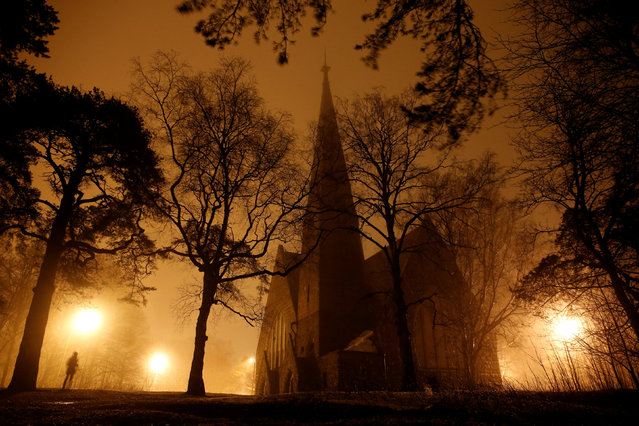
A view through mist shows the Kirk of Saint Mary Magdalene in Primorsk, Leningrad Region, Russia on March 24, 2019. (Photo by Anton Vaganov/Reuters)

A view through mist shows the Kirk of Saint Mary Magdalene in Primorsk, Leningrad Region, Russia on March 24, 2019. (Photo by Anton Vaganov/Reuters)
Details
28 Sep 2019 00:03:00
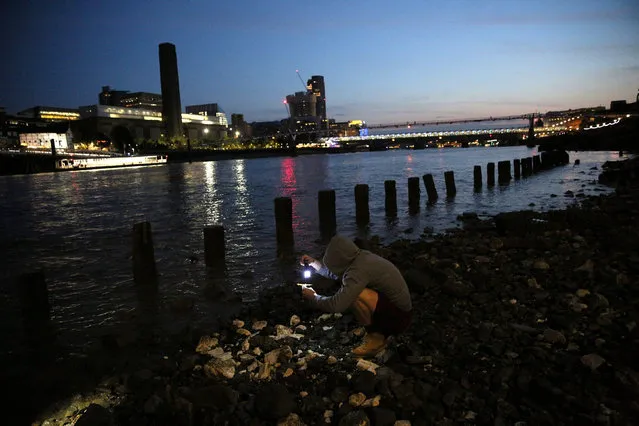
A mudlark uses a torch to look for items on the bank of the River Thames in London, Britain June 06, 2016. Mudlarking is believed to trace its origins to the 18th and 19th century, when scavengers searched the Thames' shores for items to sell. These days, history and archaeology fans are the ones hoping to find old relics such as coins, ceramics, artifacts or everyday items from across centuries. They wait for the low tide and then scour specific areas of exposed shores. "If you're in a field you could be out all day long, with the river you're restricted to about two or three hours," mudlark Nick Stevens said. While many just use the naked eye for their searches, others rely on metal detectors for which a permit from the Port of London Authority is needed. Digging also requires consent. (Photo by Neil Hall/Reuters)

A mudlark uses a torch to look for items on the bank of the River Thames in London, Britain June 06, 2016. Mudlarking is believed to trace its origins to the 18th and 19th century, when scavengers searched the Thames' shores for items to sell. These days, history and archaeology fans are the ones hoping to find old relics such as coins, ceramics, artifacts or everyday items from across centuries. their finds with the Portable Antiquities Scheme. Any item over 300 years old must be recorded. (Photo by Neil Hall/Reuters)
Details
27 Aug 2016 10:43:00
Competitors climb in front of the Matterhorn mountain at the start of the 21st Glacier Patrol race in Stafel outside the ski resort of Zermatt, Switzerland, 18 April 2018. The Glacier Patrol (Patrouille des Glaciers in French), organized by the Swiss Army, takes place from April 17 to 21. Highly-experienced hiker-skiers trek for over 53km (3994m ascent and 4090m descent) along the Haute Route along the Swiss-Italian border from Zermatt to Verbier. (Photo by Valentin Flauraud/EPA/EFE)

Competitors climb in front of the Matterhorn mountain at the start of the 21st Glacier Patrol race in Stafel outside the ski resort of Zermatt, Switzerland, 18 April 2018. The Glacier Patrol (Patrouille des Glaciers in French), organized by the Swiss Army, takes place from April 17 to 21. Highly-experienced hiker-skiers trek for over 53km (3994m ascent and 4090m descent) along the Haute Route along the Swiss-Italian border from Zermatt to Verbier. (Photo by Valentin Flauraud/EPA/EFE)
Details
19 Apr 2018 07:44:00