Loading...
Done
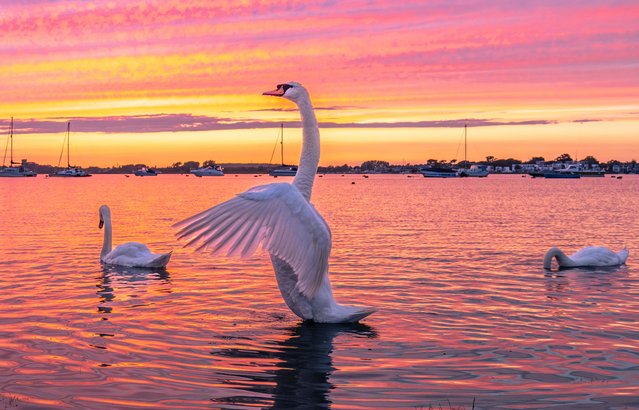
Sunset on Monday evening, June 17, 2024 at Mudeford in Dorset, UK with a swan stretching it's wings. (Photo by Cenk Albayrak-Touye/Picture Exclusive)

Sunset on Monday evening, June 17, 2024 at Mudeford in Dorset, UK with a swan stretching it's wings. (Photo by Cenk Albayrak-Touye/Picture Exclusive)
Details
21 Aug 2024 02:59:00
After a cold night the small North Devon villages of Appledore and Instow wake up to an amazing scene as the sun rises over the River Torridge estuary, Devon, UK on October 19, 2018. (Photo by Terry Mathews/Alamy Live News)

After a cold night the small North Devon villages of Appledore and Instow wake up to an amazing scene as the sun rises over the River Torridge estuary, Devon, UK on October 19, 2018. (Photo by Terry Mathews/Alamy Live News)
Details
27 Nov 2018 00:03:00
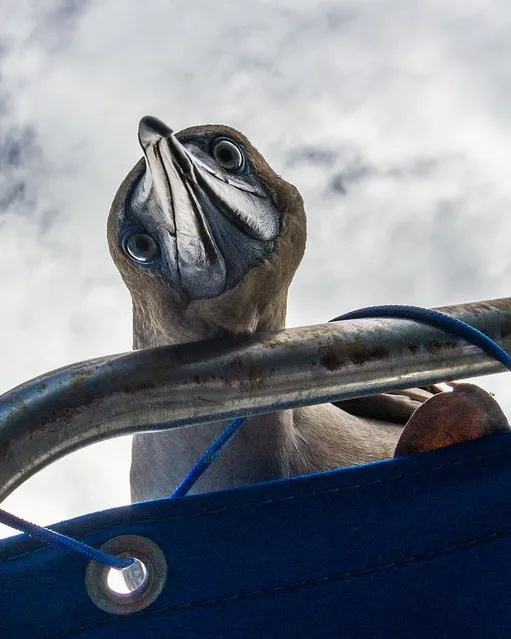
“Close-up. We had a juvenile Red-Footed Booby come visit us on the sun deck. I got some closeups with my ultrawide 11-16mm Tokina”. (Photo by Carl Fredrickson)

Situated in the Pacific Ocean some 620 miles (1,000 km) from the South American continent, these 19 islands and the surrounding marine reserve have been called a unique “living museum and showcase of evolution”. Photo: “Close-up. We had a juvenile Red-Footed Booby come visit us on the sun deck. I got some closeups with my ultrawide 11-16mm Tokina”. (Photo by Carl Fredrickson)
Details
04 Sep 2013 11:49:00
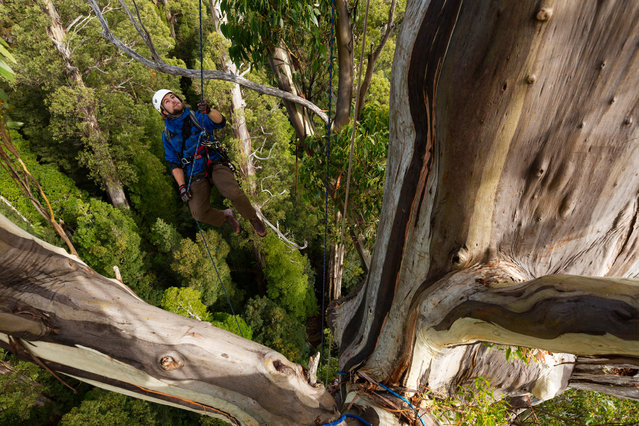
Haley nears the top of the tree. (Photo by Steven Pearce/The Tree Projects/The Guardian)

The Tree Projects team spent 67 days documenting one eucalyptus regnans in the Styx valley of Tasmania. Using a combination of tree-climbing and elaborate arboreal rigging techniques, they produced an intimate portrait from an impossible perspective of one of the world’s largest individual flowering trees, which goes by several common names. These photos document the process that resulted in an extraordinary ultra high-definition photograph. Here: Haley nears the top of the tree. (Photo by Steven Pearce/The Tree Projects/The Guardian)
Details
01 Feb 2017 06:37:00
The mudmen come from the country’s western highlands, where there are virtually no roads, cars, electricity or shops. (Photo by Jeremy Hunter/Exclusivepix Media)

For centuries the Highlands peoples of Papua New Guinea fought over land, women and pigs. Sorcery and battle skills could elevate a clan to Bigmanship, where the bigger the “presentation”, the bigger the man. Clans therefore would paint their bodies and create fearsome masks as part of their psy. Here: These are the terrifying tribe of “mudmen” from a remote part of Papua New Guinea. (Photo by Jeremy Hunter/Exclusivepix Media)
Details
08 May 2017 08:12:00
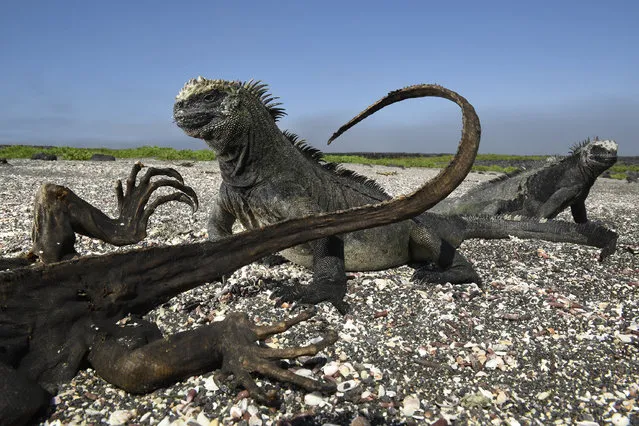
Galapagos – Rocking the Cradle: Four major ocean currents converge along the Galapagos archipelago, creating the conditions for an extraordinary diversity of animal life, April 25, 2016. The islands are home to at least 7,000 flora and fauna species, of which 97 percent of the reptiles, 80 percent of the land birds, 50 percent of the insects and 30 percent of the plants are endemic. The local ecosystem is highly sensitive to the changes in temperature, rainfall and ocean currents that characterize the climatic events known as El Niño and La Niña. These changes cause marked fluctuations in weather and food availability. Many scientists expect the frequency of El Niño and La Niña to increase as a result of climate change, making the Galapagos a possible early-warning location for its effects. (Photo by Thomas P. Peschak for National Geographic/World Press Photo)

Galapagos – Rocking the Cradle: Four major ocean currents converge along the Galapagos archipelago, creating the conditions for an extraordinary diversity of animal life, April 25, 2016. The islands are home to at least 7,000 flora and fauna species, of which 97 percent of the reptiles, 80 percent of the land birds, 50 percent of the insects and 30 percent of the plants are endemic. (Photo by Thomas P. Peschak for National Geographic/World Press Photo)
Details
16 Apr 2018 00:01:00
Snow falls as a woman walks her dog in the village of Podolye, 70 kilometers (43 miles) east of St. Petersburg, Russia, early Thursday, May 11, 2017. North winds brought snow to the east of the St. Petersburg region. (Photo by Dmitri Lovetsky/AP Photo)

Snow falls as a woman walks her dog in the village of Podolye, 70 kilometers (43 miles) east of St. Petersburg, Russia, early Thursday, May 11, 2017. North winds brought snow to the east of the St. Petersburg region. (Photo by Dmitri Lovetsky/AP Photo)
Details
21 Jun 2017 08:07:00


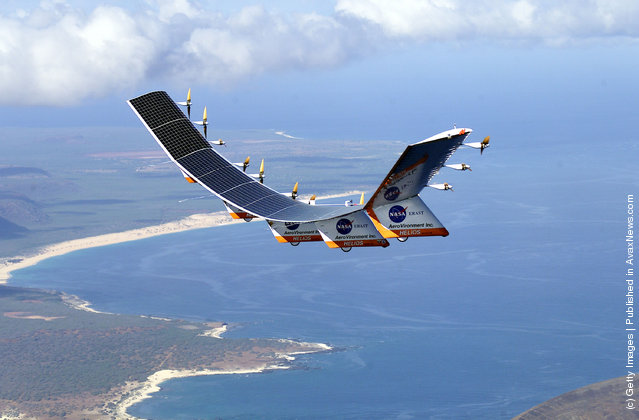
“NASA's Pathfinder, Pathfinder Plus, Centurion and Helios Prototype were an evolutionary series of solar- and fuel-cell-system-powered unmanned aerial vehicles. AeroVironment, Inc. developed the vehicles under NASA's Environmental Research Aircraft and Sensor Technology (ERAST) program. They were built to develop the technologies that would allow long-term, high-altitude aircraft to serve as “atmospheric satellites”, to perform atmospheric research tasks as well as serve as communications platforms”. – Wikipedia

Photo: The solar-electric Helios Prototype flying wing is flies over the Hawaiian islands of Niihau and Lehua during the first solar-powered test flight July 14, 2001 from the U.S. Navy's Pacific Missile Range Facility on Kauai, HI. The 18-hour flight was a functional checkout of the aircraft's systems and performance in preparation for an attempt to reach sustained flight at 100,000 feet altitude later in the summer. (Photo Courtesy of NASA/Getty Images)
Details
14 Jul 2011 09:24:00