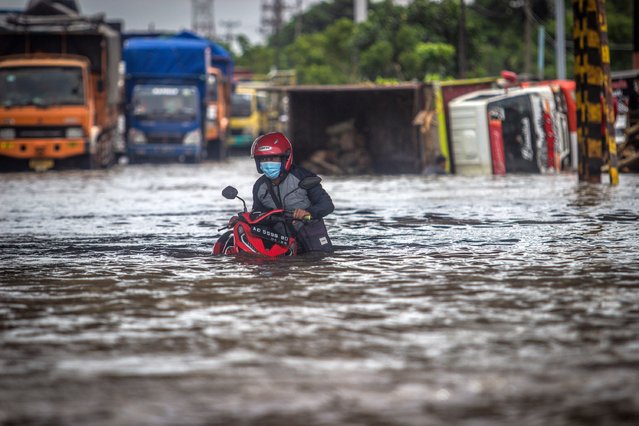
A resident pushes their motorbike through flood waters caused by torrential rain in Semarang, central Java, Indonesia on February 23, 2021. (Photo by W.F. Sihardian/NurPhoto/Rex Features/Shutterstock)
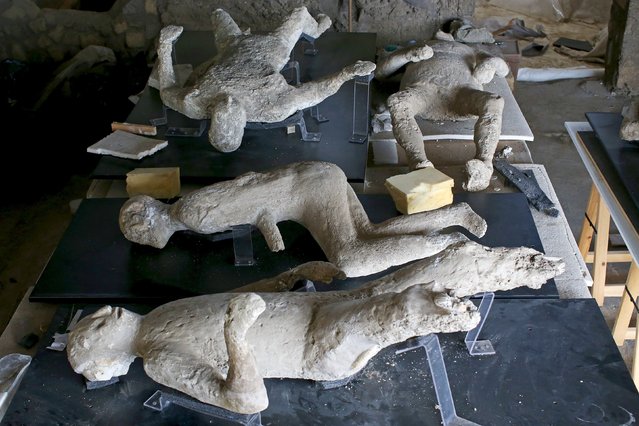
Plaster cast moulds of victims of the Mount Vesuvius eruption lie on a display table in a laboratory at Pompeii October 13, 2015. An expert team made up of archaeologists, radiologists, orthodontists and anthropologists began on September 2015 to use CAT scan technology (computerised axial tomography) to peer inside the plaster cast moulds of Pompeii's victims, in a study that has added more detail to previous findings. A 16-layer scan had to be used in order to penetrate the hardened plaster but the results showed up impressive skeletal remains and near perfect teeth. (Photo by Alessandro Bianchi/Reuters)
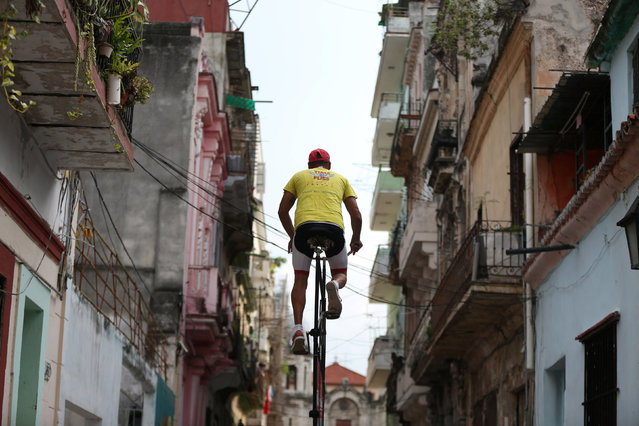
Felix Guirola, 52, rides a homemade bike with an advertising banner in Havana, Cuba, July 20, 2016. The handyman, who loves heights, provides advertising space for companies on homemade bikes that tower up to 7.5 meters (24.61 ft). He rides them around Havana in an ingenious way of getting around strict marketing regulations in the Communist-ruled island. (Photo by Alexandre Meneghini/Reuters)
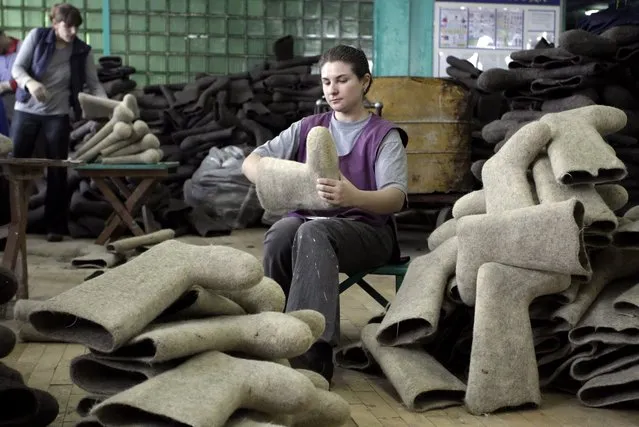
The Smilovichi Felting Factory in Belarus was founded in 1928, when Smilovichi was a small Jewish settlement of craftsmen. Five of those craftsmen organized a small artel (a cooperative association of craftsmen who all live and work together), which produced warm boots called “valenki” for cold weather. Photo: Belarusian workers works at a felt boot factory in Smilovichi, some 35km from Minsk, Belarus, 16 January 2012. (Photo by Tatyana Zenkovich/EPA)
The official name for this tiny speck of land – the size of 12 football pitches – is Hashima, but few call it that. In English, its most commonly used name means “Battleship Island” and, viewed from a certain angle offshore, its silhouette is uncannily dreadnought in nature. It was a mining facility until 1974, when it was abandoned to the elements, before partially reopening as a tourist attraction in 2009. Photo: A decades-old television. (Photo by Mark C. O'Flaherty)
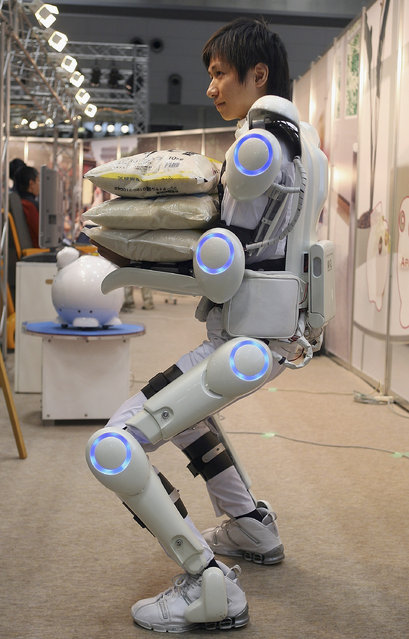
“A robot suit that can help the elderly or disabled get around was given its global safety certificate in Japan on February 27, 2013, paving the way for its worldwide roll-out”. Photo: Robot suit “Hybrid Assistive Limb (HAL)” worn by a man developed by University of Tsukuba is seen lifting a 30kg weight during 2005 International Robot Exhibition on November 30, 2005 in Tokyo, Japan. By wearing the power suit, it makes it easier to move and lift heavy things. (Photo by Koichi Kamoshida)
Artists wearing Japanese traditional clown masks march during the First Konpira Festival at Kotohiragu shrine in Tokyo Wednesday, January 10, 2018. The shrine is dedicated to sailors and seafaring. (Photo by Eugene Hoshiko/AP Photo)