Loading...
Done
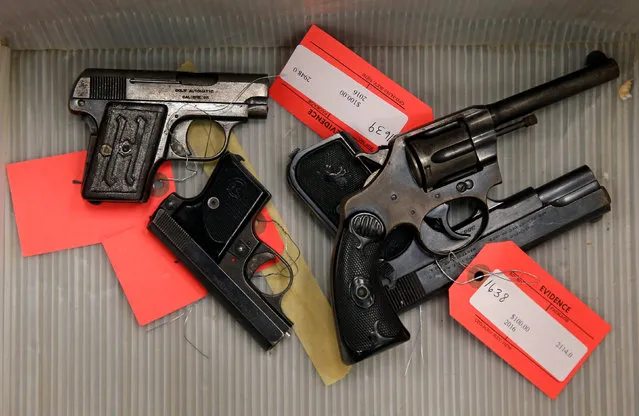
Handguns turned in from the public as part of the “Gun Turn-in” event where a gift card is given for every firearm turned over to Chicago Police are seen in a box at Universal Missionary Baptist Church in Chicago, Illinois, U.S. May 28, 2016. (Photo by Jim Young/Reuters)

Handguns turned in from the public as part of the “Gun Turn-in” event where a $100 gift card is given for every firearm and a $10 gift card for each BB-gun, air-gun, or replica firearm turned over to police at Universal Missionary Baptist Church in Chicago, Illinois, U.S. May 28, 2016. (Photo by Jim Young/Reuters)
Details
30 May 2016 08:54:00
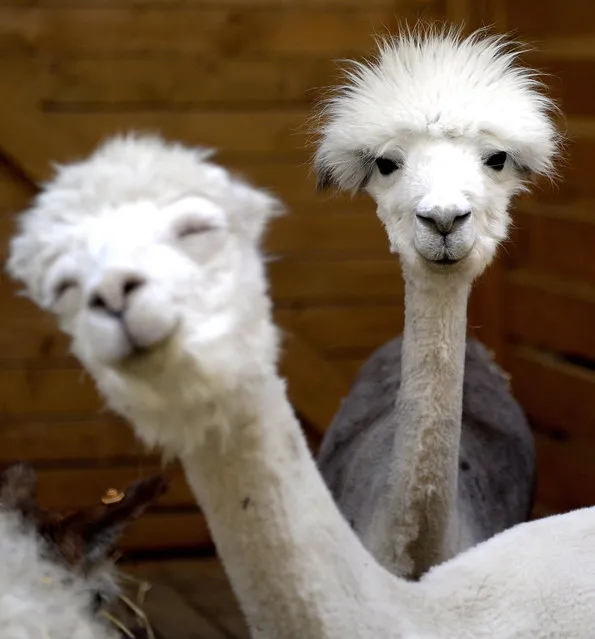
Alpacas peek out of their box in Kielnarowa, Poland, June 11, 2014. A total of 35 female and 3 male alpacas were imported from Chile by the Rzeszow University of Information Technology and Management Center Zoo to be used for the therapy of children. Alpacas also provide one of the most expensive wools. (Photo by Darek Demanowicz/EPA)

Alpacas peek out of their box in Kielnarowa, Poland, June 11, 2014. A total of 35 female and 3 male alpacas were imported from Chile by the Rzeszow University of Information Technology and Management Center Zoo to be used for the therapy of children. Alpacas also provide one of the most expensive wools. (Photo by Darek Demanowicz/EPA)
Details
14 Jun 2014 12:13:00
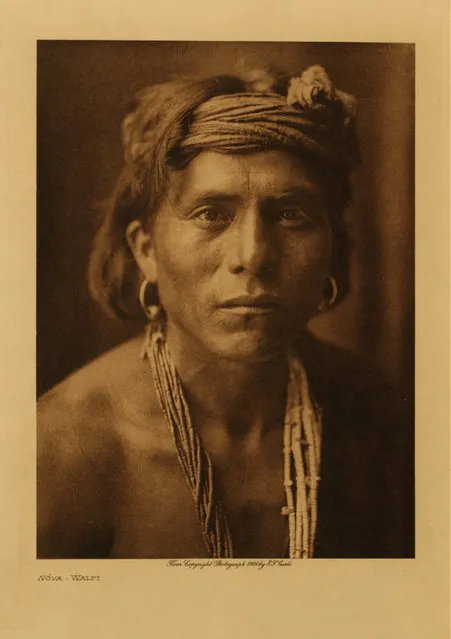
Nova, a Walpi, in 1906. (Photo by Edward S. Curtis)

At the beginning of the 20th century, Edward S. Curtis set out to document what he saw as a disappearing race: the Native American. From 1907 to 1930, Curtis took more than 2,000 photos of 80 tribes stretching from the Great Plains to the Pacific Northwest and Alaska. He then published and sold these photos, along with narrative text, in 20 volumes of work known as “The North American Indian”. It is one of the most significant collections of its kind, “probably the most important photographic document of its age and its topic,” said Jeffrey Garrett, associate university librarian for Special Libraries at Northwestern University. (Photo by Edward S. Curtis)
Details
07 Sep 2014 12:57:00
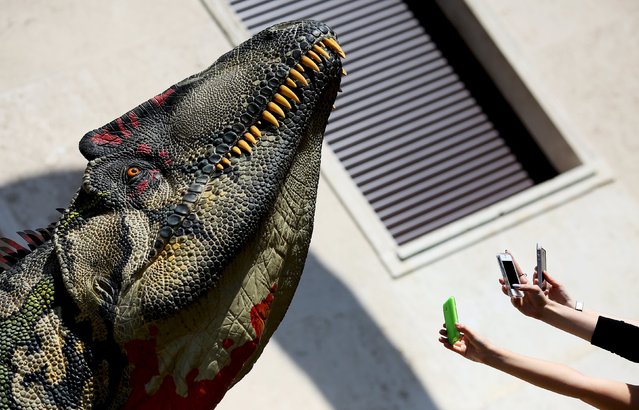
People take pictures with their mobile phone of a scale model of a dinosaur displayed in front of La Sapienza University headquarters in Rome April 10, 2015. The realistic reproductions of dinosaurs are part of the “Dinosaurs in the flesh, science and art bring to life the rulers of a lost world” exhibition. (Photo by Alessandro Bianchi/Reuters)

People take pictures with their mobile phone of a scale model of a dinosaur displayed in front of La Sapienza University headquarters in Rome April 10, 2015. The realistic reproductions of dinosaurs are part of the “Dinosaurs in the flesh, science and art bring to life the rulers of a lost world” exhibition. (Photo by Alessandro Bianchi/Reuters)
Details
11 Apr 2015 10:47:00
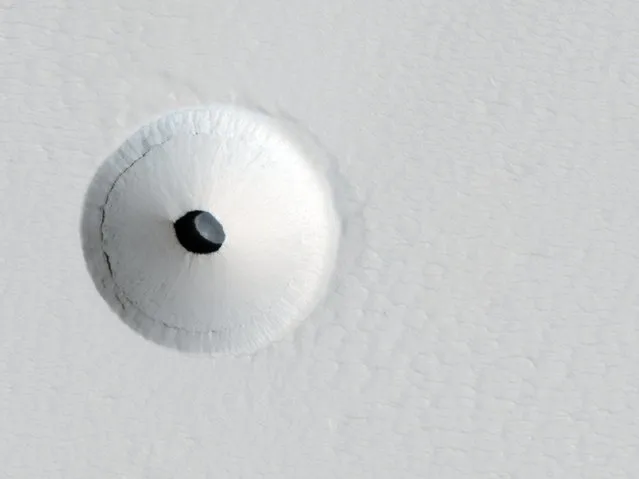
A Hole in Mars

“What created this unusual hole in Mars? The hole was discovered by chance on images of the dusty slopes of Mars' Pavonis Mons volcano taken by the HiRISE instrument aboard the robotic Mars Reconnaissance Orbiter currently circling Mars”. (Photo by NASA/JPL/University of Arizona)
Details
22 Jul 2012 07:49:00


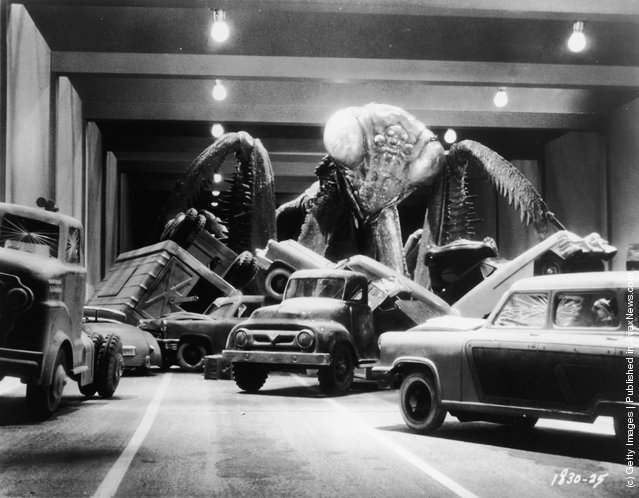
An oversized, prehistoric praying mantis wreaks havoc in a freeway underpass as it overturns cars and trucks, in a film still from “The Deadly Mantis”, directed by Nathan Juran, 1957. (Photo by Universal Pictures/Courtesy of Getty Images)
Details
10 Apr 2011 06:59:00
This Thursday, January 22, 2015 photo made with a long exposure shows the glow from a Noctiluca scintillans algal bloom along the seashore in Hong Kong. The luminescence, also called Sea Sparkle, is triggered by farm pollution that can be devastating to marine life and local fisheries, according to University of Georgia oceanographer Samantha Joye. (Photo by Kin Cheung/AP Photo)

This Thursday, January 22, 2015 photo made with a long exposure shows the glow from a Noctiluca scintillans algal bloom along the seashore in Hong Kong. The luminescence, also called Sea Sparkle, is triggered by farm pollution that can be devastating to marine life and local fisheries, according to University of Georgia oceanographer Samantha Joye. Noctiluca itself does not produce neurotoxins like other similar organisms do. But its role as both prey and predator tends can eventually magnify the accumulation of toxins in the food chain, according to R. Eugene Turner at Louisiana State University. (Photo by Kin Cheung/AP Photo)
Details
23 Jan 2015 13:12:00
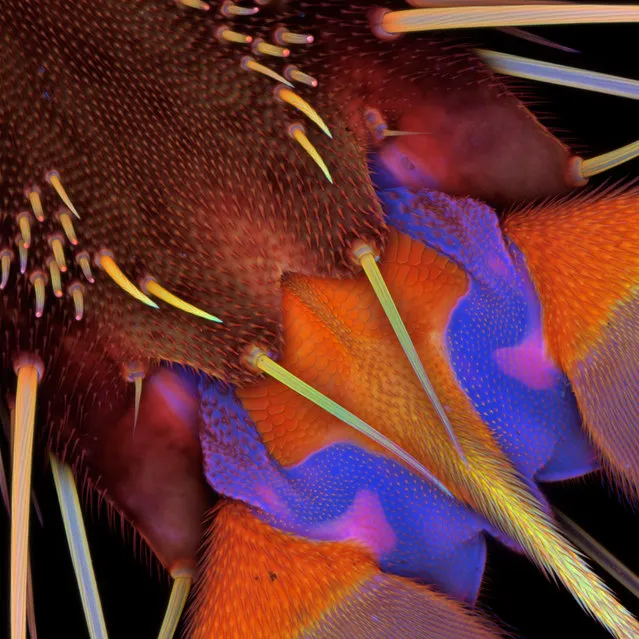
Pretarsus of the third leg of a female drone fly (Eristalis tenax), ventral view, by Dr. Jan Michels, Institute of Zoology, Christian-Albrechts-University of Kiel, Germany. (Photo by Olympus BioScapes)

“Microscope images forge an extraordinary bond between science and art, said Hidenao Tsuchiya, Olympus America's Vice President and General Manager for the Scientific Equipment Group. We founded this competition to focus on the fascinating stories coming out of today's life science research laboratories. The thousands of images that people have shared with the competition over the years reflect some of the most exciting work going on in research today – work that can help shed light on the living universe and ultimately save lives. We look at BioScapes and these beautiful images as sources of education and inspiration to us and the world”. – OlympusBioScapes

Photo: Pretarsus of the third leg of a female drone fly (Eristalis tenax), ventral view, by Dr. Jan Michels, Institute of Zoology, Christian-Albrechts-University of Kiel, Germany. (Photo by Olympus BioScapes)
Details
29 Jul 2012 09:20:00