Loading...
Done
On August 31, 2012, a long filament of solar material that had been hovering in the sun's atmosphere, the corona, erupted out into space at 4:36 p.m. EDT. The coronal mass ejection, or CME, traveled at over 900 miles per second. The CME did not travel directly toward Earth, but did connect with Earth's magnetic environment, or magnetosphere, causing aurora to appear on the night of Monday, September 3. (Photo by NASA/GSFC/SDO)

On August 31, 2012, a long filament of solar material that had been hovering in the sun's atmosphere, the corona, erupted out into space at 4:36 p.m. EDT. The coronal mass ejection, or CME, traveled at over 900 miles per second. The CME did not travel directly toward Earth, but did connect with Earth's magnetic environment, or magnetosphere, causing aurora to appear on the night of Monday, September 3. (Photo by NASA/GSFC/SDO via The Atlantic)
Details
14 Sep 2012 09:01:00
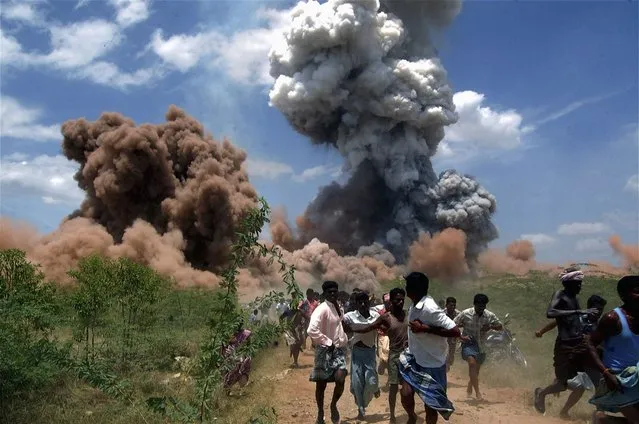
In this September 5, 2012 file photo, people run for cover as smoke rises from the site of a fire at a fireworks factory on the outskirts of Sivakasi, about 500 kilometers (310 miles) southwest of Chennai, India. Police in southern India arrested six employees of the fireworks factory for a massive blaze that killed 40 workers and injured 60 others. (Photo by AP Photo/File)

In this September 5, 2012 file photo, people run for cover as smoke rises from the site of a fire at a fireworks factory on the outskirts of Sivakasi, about 500 kilometers (310 miles) southwest of Chennai, India. Police in southern India arrested six employees of the fireworks factory for a massive blaze that killed 40 workers and injured 60 others. (Photo by AP Photo/File). P.S. I didn't publish the photos which you already saw here (Avax).
Details
04 Jan 2013 15:25:00
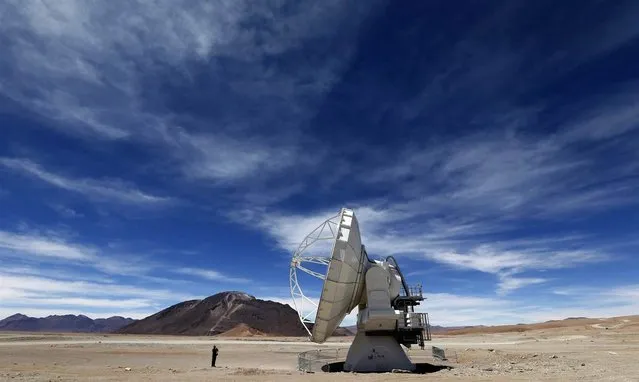
A man takes a photo of a radio antenna that's part of the Atacama Large Milimeter Array Observatory on March 12, 2013 at Llano de Chajnantor, about 43 miles (70 kilometers) from San Pedro de Atacama, Chile. The $1.5 billion ALMA facility, which had its official inauguration on March 13, is considered the world's most expensive ground-based observatory. (Photo by Felipe Trueba/EPA)

A man takes a photo of a radio antenna that's part of the Atacama Large Milimeter Array Observatory on March 12, 2013 at Llano de Chajnantor, about 43 miles (70 kilometers) from San Pedro de Atacama, Chile. The $1.5 billion ALMA facility, which had its official inauguration on March 13, is considered the world's most expensive ground-based observatory. (Photo by Felipe Trueba/EPA)
Details
03 Apr 2013 09:25:00
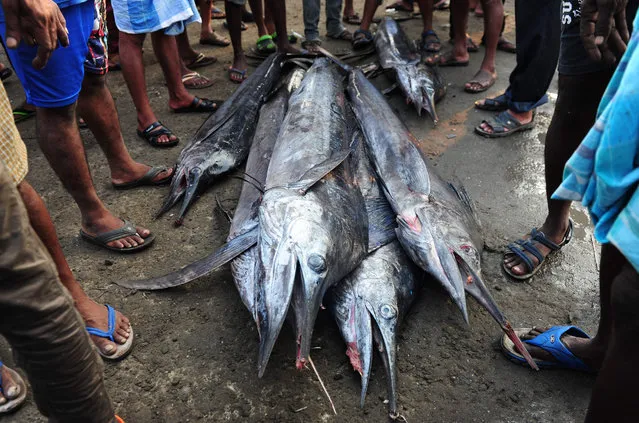
Indian men stand around sword fish for sale at a harbour a harbour in Chennai on June 5, 2016, as fishermen return with their catch after a 45-day fishing ban on the east coast of India. Authorities in the southern Indian state of Tamil Nadu had imposed a 45-day ban on fishing by mechanised vessels to protect marine life, with only “country boats” operating within five nautical miles off the coast. (Photo by Arun Sankar/AFP Photo)

Indian men stand around sword fish for sale at a harbour a harbour in Chennai on June 5, 2016, as fishermen return with their catch after a 45-day fishing ban on the east coast of India. Authorities in the southern Indian state of Tamil Nadu had imposed a 45-day ban on fishing by mechanised vessels to protect marine life, with only “country boats” operating within five nautical miles off the coast. (Photo by Arun Sankar/AFP Photo)
Details
06 Jun 2016 11:24:00
Brave slackliners have been pictured walking the ropes above Rio de Janeiro, Brazil on August 15, 2016, with the half a mile drop showing the city in all its glory. The stunning shots show the daredevils tread across an eighty-two-foot-long high line on Pedra da Gvea mountain with an amazing sunrise illuminating the city landscape behind. (Photo by Rafael Moura/Caters News Agency)

Brave slackliners have been pictured walking the ropes above Rio de Janeiro, Brazil on August 15, 2016, with the half a mile drop showing the city in all its glory. The stunning shots show the daredevils tread across an eighty-two-foot-long high line on Pedra da Gvea mountain with an amazing sunrise illuminating the city landscape behind. (Photo by Rafael Moura/Caters News Agency)
Details
25 Aug 2016 09:55:00
Developed for the British American Ambulance Corps, this new motorcycle ambulance is capable of speeding wounded soldiers 90 miles an hour from the front lines to field hospitals. Its springs are synchronized with the patient?s heartbeat to avoid increasing fever when traveling over various Terrain. Viewing it in New York  August 27, 1941, are left to right: constable Herbert Scott of England, driver; William E. Detlor, whose firm developed the vehicle; M. W. Stand, inspector-general of Civilian Defense, and Maj. Edward Riekert, also. (Photo by AP Photo)

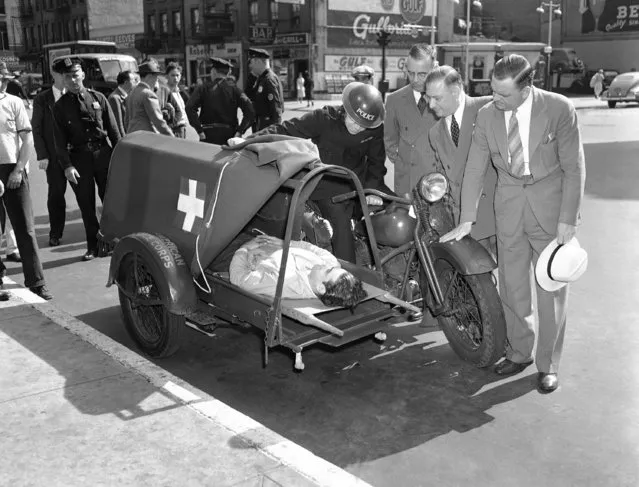
Developed for the British American Ambulance Corps, this new motorcycle ambulance is capable of speeding wounded soldiers 90 miles an hour from the front lines to field hospitals. Its springs are synchronized with the patient's heartbeat to avoid increasing fever when traveling over various Terrain. Viewing it in New York August 27, 1941, are left to right: constable Herbert Scott of England, driver; William E. Detlor, whose firm developed the vehicle; M. W. Stand, inspector-general of Civilian Defense, and Maj. Edward Riekert, also. (Photo by AP Photo)
Details
28 Aug 2015 11:51:00
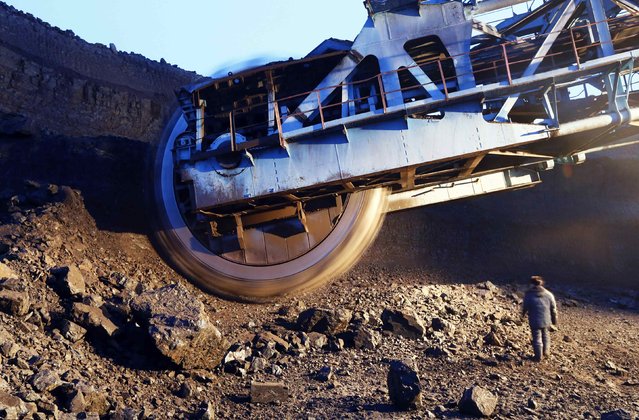
An employee walks near a rotary dredge which works on the coal face of the Borodinsky opencast colliery, near the Siberian town of Borodino, east of Krasnoyarsk, December 9, 2014. The Borodinsky colliery, 9 km (5.6 miles) long and more than 100 meters (328 feet) deep, annually produces more than 20 million tons of coal and is considered to be the biggest opencast coal mine in Russia, according to official representatives. (Photo by Ilya Naymushin/Reuters)

An employee walks near a rotary dredge which works on the coal face of the Borodinsky opencast colliery, near the Siberian town of Borodino, east of Krasnoyarsk, December 9, 2014. The Borodinsky colliery, 9 km (5.6 miles) long and more than 100 meters (328 feet) deep, annually produces more than 20 million tons of coal and is considered to be the biggest opencast coal mine in Russia, according to official representatives. (Photo by Ilya Naymushin/Reuters)
Details
11 Dec 2014 13:29:00
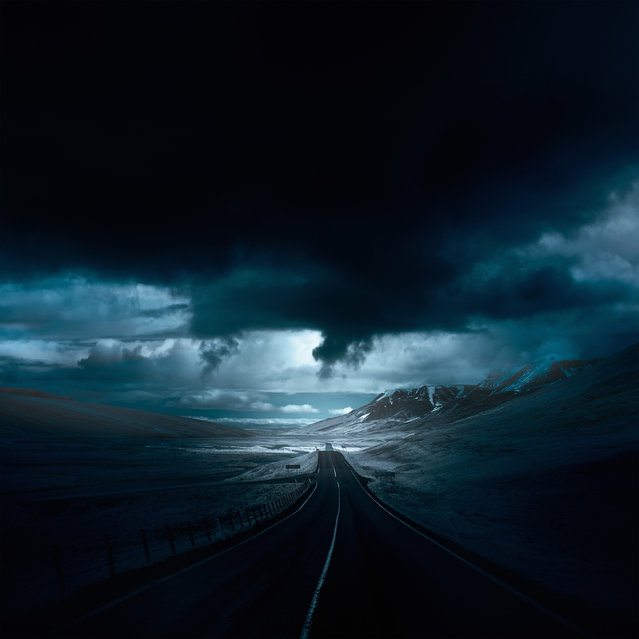
A globe-trotting photographer has captured some of the worlds most beautiful roads. Andy Lee's roads series features picturesque routes running through the likes of Iceland, Wales, England and Scotland. Here: moon sky over Hvammstangi, Iceland. (Photo by Andy Lee/Caters News)

A globe-trotting photographer has captured some of the worlds most beautiful roads. Andy Lee's roads series features picturesque routes running through the likes of Iceland, Wales, England and Scotland. The photographer, 46, began taking pictures for this series in 2013. And since then Andy, from Stackpole, Pembrokeshire, has been travelling the world for the most stunning drives. In searching for the ideal road he often drives miles upon miles in order to find a suitable, remote area. Here: moon sky over Hvammstangi, Iceland. (Photo by Andy Lee/Caters News)
Details
24 Jan 2015 14:19:00