Loading...
Done
(L-R) Ruby Zinner, 21, Caroline Reinstadler, 22, Marie Kallis, 22, and Julia Bogdanoff, 21, wearing graduation caps and gowns drink champagne while taking graduation photos in Washington Square Park amid the Coronavirus pandemic on May 09, 2021 in New York City. Due to the ongoing coronavirus pandemic NYU's commencement ceremony will be held virtually on May 19th. Students from the 2021 will be invited back for an in person graduation when public health guidelines allow. (Photo by Alexi Rosenfeld/Getty Images)

(L-R) Ruby Zinner, 21, Caroline Reinstadler, 22, Marie Kallis, 22, and Julia Bogdanoff, 21, wearing graduation caps and gowns drink champagne while taking graduation photos in Washington Square Park amid the Coronavirus pandemic on May 09, 2021 in New York City. Due to the ongoing coronavirus pandemic NYU's commencement ceremony will be held virtually on May 19th. Students from the 2021 will be invited back for an in person graduation when public health guidelines allow. (Photo by Alexi Rosenfeld/Getty Images)
Details
19 May 2021 09:28:00
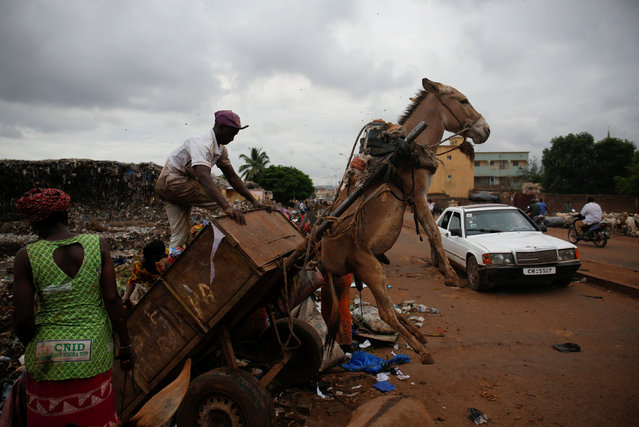
A waste picker unloads garbage at a waste transfer station in Bamako, Mali, August 19, 2018. In the Malian capital of Bamako, donkey carts driven by young men like 19-year-old Arouna Diabate play a vital role battling the fast-growing city's waste problem. Every morning before dawn, Diabate hitches his donkey to a cart and sets off on his rounds, going door-to-door to collect household garbage which he delivers to a local waste transfer station for a monthly salary of around $35. “I won't be picking up trash with a donkey cart for the rest of my life, but for now people appreciate us because we help clean up the homes of Bamako”, Diabate said. (Photo by Luc Gnago/Reuters)

A waste picker unloads garbage at a waste transfer station in Bamako, Mali, August 19, 2018. In the Malian capital of Bamako, donkey carts driven by young men like 19-year-old Arouna Diabate play a vital role battling the fast-growing city's waste problem. Every morning before dawn, Diabate hitches his donkey to a cart and sets off on his rounds, going door-to-door to collect household garbage which he delivers to a local waste transfer station for a monthly salary of around $35. “I won't be picking up trash with a donkey cart for the rest of my life, but for now people appreciate us because we help clean up the homes of Bamako”, Diabate said. (Photo by Luc Gnago/Reuters)
Details
18 Sep 2018 00:01:00
A participant jumps trying to control a bull during the annual bull taming “Jallikattu” festival in Palamedu village on the outskirts of Madurai in the southern Indian state of Tamil Nadu on January 16, 2020. (Photo by Arun Sankar/AFP Photo)

A participant jumps trying to control a bull during the annual bull taming “Jallikattu” festival in Palamedu village on the outskirts of Madurai in the southern Indian state of Tamil Nadu on January 16, 2020. (Photo by Arun Sankar/AFP Photo)
Details
27 Jan 2020 00:05:00
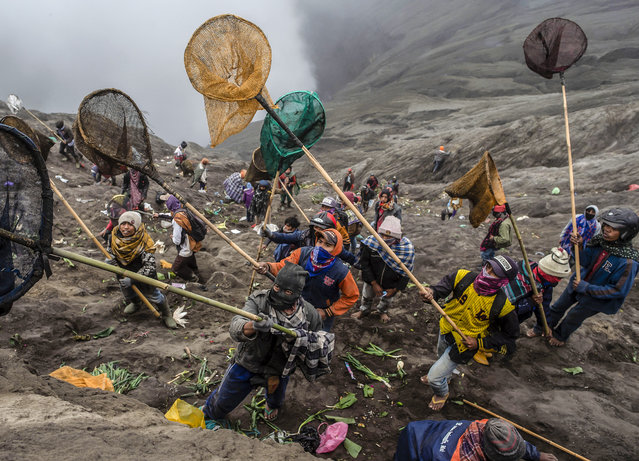
People try to catch offerings thrown off the summit of Mount Bromo volcano by Tengger tribe members and local tourists in Probolinggo, East Java province on July 18, 2019, as part of the Yadnya Kasada Festival. During the annual Yadnya Kasada festival, the Tenggerese climb Mount Bromo, an active volcano, and seek the blessing from the main deity by presenting offerings of rice, fruit, livestock and other items. (Photo by Juni Kriswanto/AFP Photo)

People try to catch offerings thrown off the summit of Mount Bromo volcano by Tengger tribe members and local tourists in Probolinggo, East Java province on July 18, 2019, as part of the Yadnya Kasada Festival. During the annual Yadnya Kasada festival, the Tenggerese climb Mount Bromo, an active volcano, and seek the blessing from the main deity by presenting offerings of rice, fruit, livestock and other items. (Photo by Juni Kriswanto/AFP Photo)
Details
22 Jul 2019 00:03:00
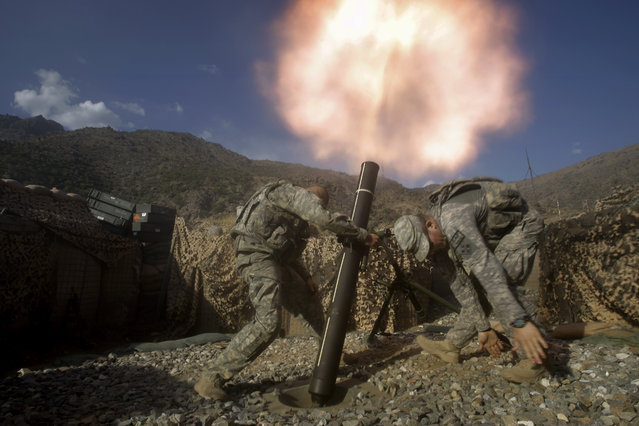
U.S. soldiers from the 2nd Battalion, 12th Infantry Regiment, 4th Brigade Combat Team, fire mortars at known enemy firing positions from a base in the Pech River Valley in Afghanistan's Kunar province, Saturday, October 24, 2009. (Photo by David Guttenfelder/AP Photo)

David Guttenfelder was born in Iowa and graduated from the University of Iowa with a Bachelor of Arts in cultural anthropology. He has worked for the AP since 1994 based in Kenya, the Ivory Coast, India and Japan. He is currently AP’s chief Asia photographer and his feature work has been used prominently in editorial publications throughout the world including Time and National Geographic. Photo: U.S. soldiers from the 2nd Battalion, 12th Infantry Regiment, 4th Brigade Combat Team, fire mortars at known enemy firing positions from a base in the Pech River Valley in Afghanistan's Kunar province, Saturday, October 24, 2009. (Photo by David Guttenfelder/AP Photo)
Details
21 Apr 2014 10:11:00
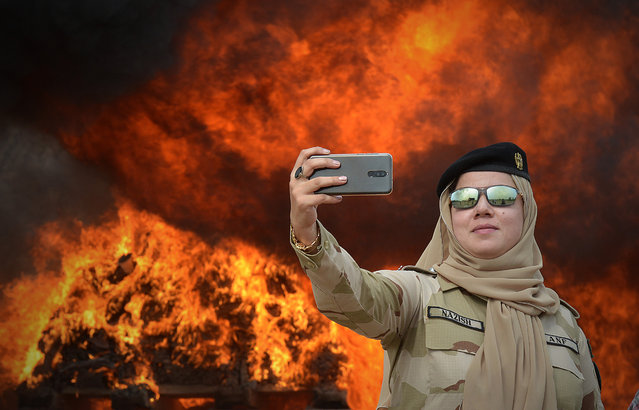
A member of the Pakistani Anti-Narcotic Force (ANF) takes a selfie beside a pile of burning drugs and liquor during a ceremony at the Kacha Ghari army firing range, on the outskirts of Peshawar on October 16, 2018, after the contraband was seized in raids across the province. (Photo by Abdul Majeed/AFP Photo)

A member of the Pakistani Anti-Narcotic Force (ANF) takes a selfie beside a pile of burning drugs and liquor during a ceremony at the Kacha Ghari army firing range, on the outskirts of Peshawar on October 16, 2018, after the contraband was seized in raids across the province. (Photo by Abdul Majeed/AFP Photo)
Details
20 Oct 2018 00:07:00
Participants get ready ahead of a fashion show organized by Daspu, a fashion house founded and run by prostitutes, during the Women of the World (WOW) festival, in Rio de Janeiro, Brazil November 18, 2018. (Photo by Pilar Olivares/Reuters)

Participants get ready ahead of a fashion show organized by Daspu, a fashion house founded and run by prostitutes, during the Women of the World (WOW) festival, in Rio de Janeiro, Brazil November 18, 2018. (Photo by Pilar Olivares/Reuters)
Details
20 Nov 2018 00:01:00
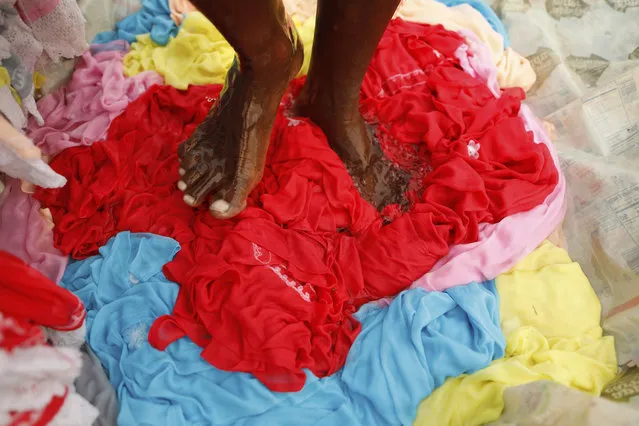
A dhobi, or a washerman washes cloths on the banks of the River Gomti in Lucknow, India, Saturday, September 12, 2020. Dhobis are traditional laundry workers who wash clothes by hand and dry them in the sun, an occupation which has been in existence for generations. Most cities in India have a Dhobi Ghat, or washermen's area, where the city's pile of clothes is laundered. This practice is still popular in India, despite of modern technology. Around 1,000 families work in Lucknow's Dhobi Ghat. However, in light of the novel coronavirus, their wages have decreased drastically. With each family earning around US$100-200 per month. (Photo by Rajesh Kumar Singh/AP Photo)

A dhobi, or a washerman washes cloths on the banks of the River Gomti in Lucknow, India, Saturday, September 12, 2020. Dhobis are traditional laundry workers who wash clothes by hand and dry them in the sun, an occupation which has been in existence for generations. Most cities in India have a Dhobi Ghat, or washermen's area, where the city's pile of clothes is laundered. This practice is still popular in India, despite of modern technology. Around 1,000 families work in Lucknow's Dhobi Ghat. However, in light of the novel coronavirus, their wages have decreased drastically. With each family earning around US$100-200 per month. (Photo by Rajesh Kumar Singh/AP Photo)
Details
25 Sep 2020 00:03:00