Loading...
Done
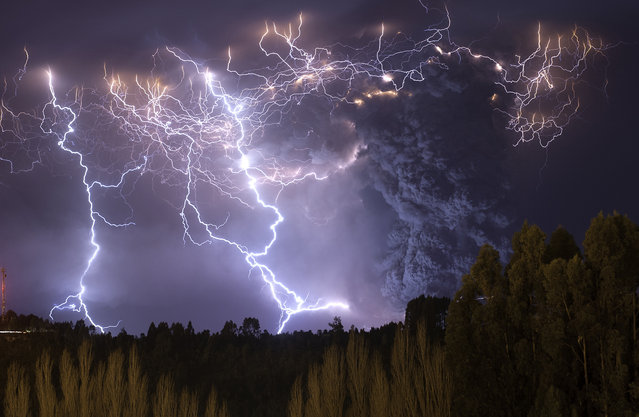
The eruption of Cordon Caulle began on June 4, 2011, located in the Region of Los Rios in Chile. For about 12 months, people and animals became accustomed to living with the daily fall of ash, which also caused problems in the air traffic in South America. The explosions and lightning during first days of the eruption could be seen from hundreds of miles around. This photograph was taken on the second night of eruption from the town of Lago Ranco. (Photo and caption by Francisco Negroni/National Geographic Traveler Photo Contest)

The eruption of Cordon Caulle began on June 4, 2011, located in the Region of Los Rios in Chile. For about 12 months, people and animals became accustomed to living with the daily fall of ash, which also caused problems in the air traffic in South America. The explosions and lightning during first days of the eruption could be seen from hundreds of miles around. This photograph was taken on the second night of eruption from the town of Lago Ranco. (Photo and caption by Francisco Negroni/National Geographic Traveler Photo Contest)

ATTENTION! All pictures are presented in high resolution. To see Hi-Res images – just TWICE click on any picture. In other words, click small picture – opens the BIG picture. Click BIG picture – opens VERY BIG picture.
Details
23 Jun 2013 11:24:00
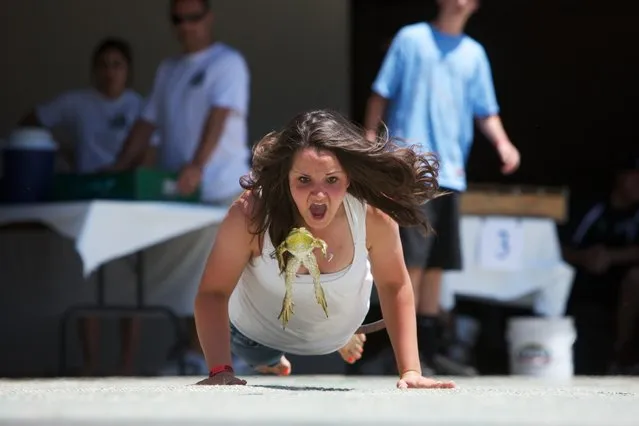
Breanna Ziehlke encourages her frog to get on with it at the Calaveras County Fair & Jumping Frog Jubilee. (Photo by Sol Neelman)

Since 2005, photographer Sol Neelman, has photographed people having fun. More specifically, Neelman has documented the wacky and wildly diverse world of “weird sports”. Photo: Breanna Ziehlke encourages her frog to get on with it at the Calaveras County Fair & Jumping Frog Jubilee. (Photo by Sol Neelman)
Details
07 Apr 2014 09:17:00
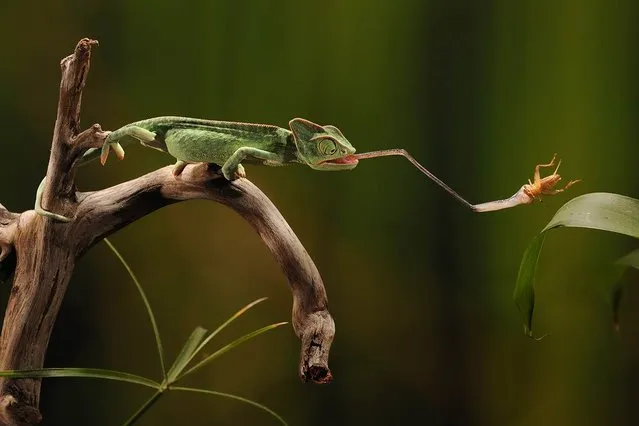
A veiled chameleon extends its tongue to catch a cricket

“Scott Linstead is an internationally published, freelance wildlife photographer/writer. His clients include Natural History Magazine, Hewlett Packard, Ranger Rick Magazine and a number of wildlife publications in North America and Europe. Scott's column on the techniques of bird photography appears in every issue of Outdoor Photography Canada”.

Photo: A veiled chameleon extends its tongue to catch a cricket. Canadian wildlife photographer Scott Linstead, formerly an aerospace engineer and high school teacher, uses a device called Phototrap “to not only photograph the elusive, but also the unimaginably quick”. (Photo by Scott Linstead)
Details
22 May 2012 11:32:00
Fluffy toy panda bears as part of the art installation “Panda mie” by Italian restaurant owner Giuseppe “Pino” Fichera sit over beers at his restaurant “Pino's” to raise awareness of the COVID-19 lockdown's business impact on gastronomy in Frankfurt, Germany, November 24, 2020. (Photo by Kai Pfaffenbach/Reuters)

Fluffy toy panda bears as part of the art installation “Panda mie” by Italian restaurant owner Giuseppe “Pino” Fichera sit over beers at his restaurant “Pino's” to raise awareness of the COVID-19 lockdown's business impact on gastronomy in Frankfurt, Germany, November 24, 2020. (Photo by Kai Pfaffenbach/Reuters)
Details
26 Nov 2020 00:07:00
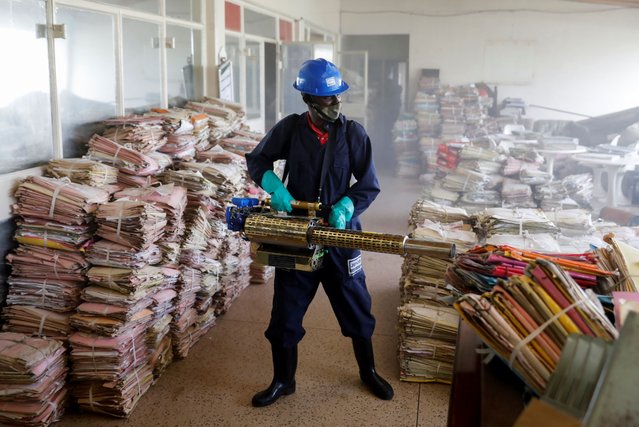
A sanitation worker fumigates using sodium hypochlorite in an archive room to fight the spread of the coronavirus disease (COVID-19) in the Milimani commercial courts in Nairobi, Kenya, July 17, 2020. (Photo by Baz Ratner/Reuters)

A sanitation worker fumigates using sodium hypochlorite in an archive room to fight the spread of the coronavirus disease (COVID-19) in the Milimani commercial courts in Nairobi, Kenya, July 17, 2020. (Photo by Baz Ratner/Reuters)
Details
20 Jul 2020 00:07:00
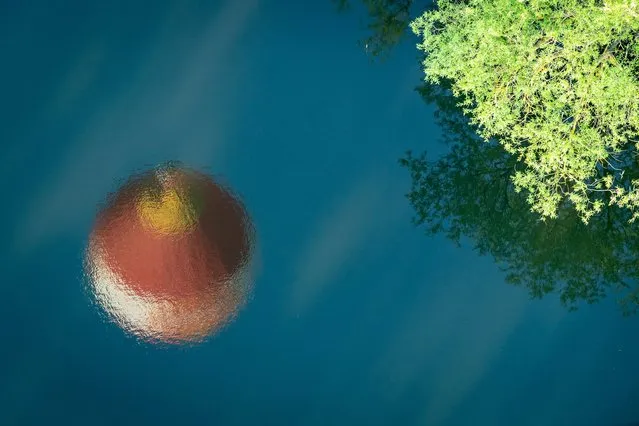
A hot air balloon competition called “Grudziadzkie Zawody Balonowe” is held in Lisie Katy, central-northern Poland, 14 May 2021. The compe​tition is held for the eighteenth time. (Photo by Tytus Zmijewski/EPA/EFE)

A hot air balloon competition called “Grudziadzkie Zawody Balonowe” is held in Lisie Katy, central-northern Poland, 14 May 2021. The compe​tition is held for the eighteenth time. (Photo by Tytus Zmijewski/EPA/EFE)
Details
18 Aug 2021 08:30:00
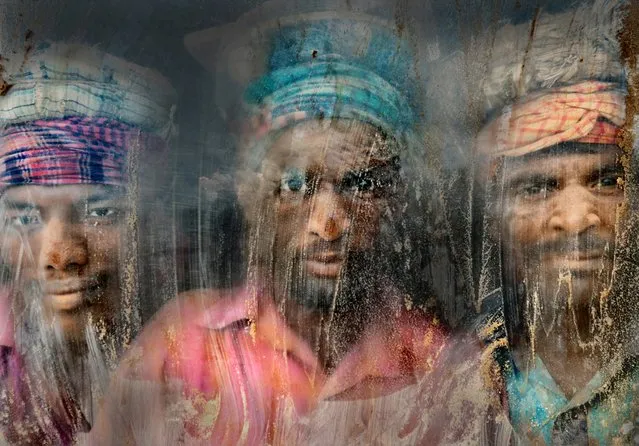
Gravel Workmen of Chittagong, Bangladesh, by Faisal Azim. Gravel workmen look through a glass window at a gravel-crushing yard in Chittagong. Full of dust and sand, it is an extremely unhealthy environment for working, but still hundreds of people work here for their livelihoods. (Photo by Faisal Azim/2016 Atkins CIWEM Environmental Photographer of the Year)

From Tibetan monks playing basket ball with ice thawing high up in the Himalayas, to the pollution that hides behind the Taj Mahal, here’s pick from 60 exceptional environmental photographs, by photographers and filmmakers from 70 countries, that will go on show at the Royal Geographical Society in London from 29 June to 21 August. The winners will be announced on 28 June. Here: Gravel Workmen of Chittagong, Bangladesh, by Faisal Azim. Gravel workmen look through a glass window at a gravel-crushing yard in Chittagong. Full of dust and sand, it is an extremely unhealthy environment for working, but still hundreds of people work here for their livelihoods. (Photo by Faisal Azim/2016 Atkins CIWEM Environmental Photographer of the Year)
Details
01 Jun 2016 12:25:00
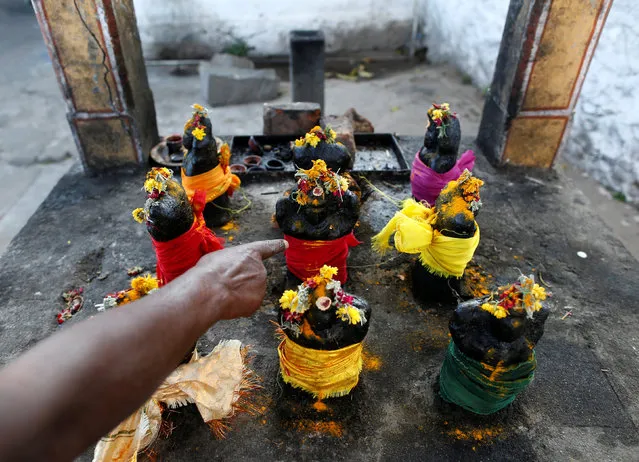
Paramasivan points to the statue of sun god Surya at a temple outside the Kodaikanal Solar Observatory, India, February 5, 2017. (Photo by Danish Siddiqui/Reuters)

Paramasivan points to the statue of sun god Surya at a temple outside the Kodaikanal Solar Observatory, India, February 5, 2017. In the early morning darkness, Devendran P. walks up a hill to a solar observatory in India's southern hill town of Kodaikanal, trudging the same path his father and grandfather walked in a century-old family tradition of studying the sun. (Photo by Danish Siddiqui/Reuters)
Details
24 Feb 2017 00:03:00