Loading...
Done
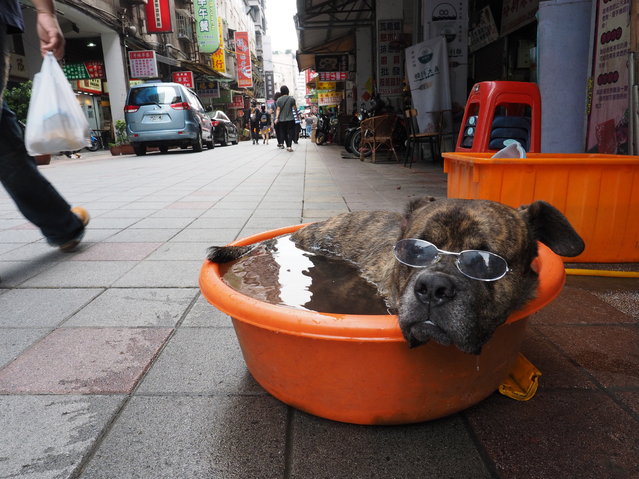
A dog sits in a plastic basin filled with water in Taipei, Taiwan, 05 May 2018. Betel nut seller Mr Luo, the dog's owner, said he puts his dog Ah Dai (Stupid Guy) in the water-filled basin whenever the weather get hot. Luo has a dozen pairs of glasses for Ah Dai, so the dog wears different glasses every day and many tourists take photos of Ah Dai. (Photo by David Chang/EPA/EFE)

A dog sits in a plastic basin filled with water in Taipei, Taiwan, 05 May 2018. Betel nut seller Mr Luo, the dog's owner, said he puts his dog Ah Dai (Stupid Guy) in the water-filled basin whenever the weather get hot. Luo has a dozen pairs of glasses for Ah Dai, so the dog wears different glasses every day and many tourists take photos of Ah Dai. (Photo by David Chang/EPA/EFE)
Details
13 May 2018 00:03:00
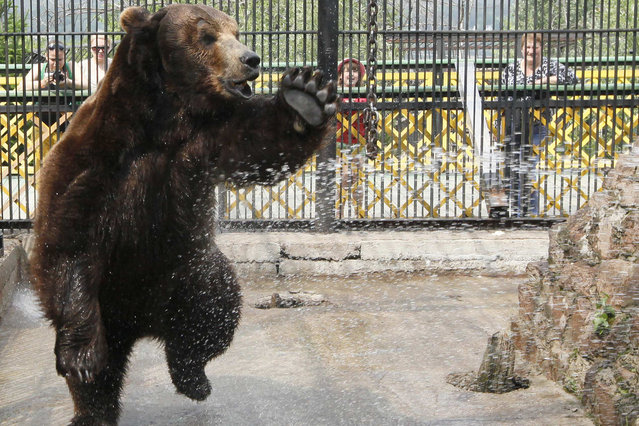
Buyan, a male Siberian brown bear, is given a shower by a zoo employee in his enclosure at the Royev Ruchey zoo in Russia's Siberian city of Krasnoyarsk June 24, 2014. The Siberian city has been experiencing temperatures of around 30 degrees Celsius over the last week. (Photo by Ilya Naymushin/Reuters)

Buyan, a male Siberian brown bear, is given a shower by a zoo employee in his enclosure at the Royev Ruchey zoo in Russia's Siberian city of Krasnoyarsk June 24, 2014. The Siberian city has been experiencing temperatures of around 30 degrees Celsius over the last week. (Photo by Ilya Naymushin/Reuters)
Details
28 Jun 2014 14:01:00
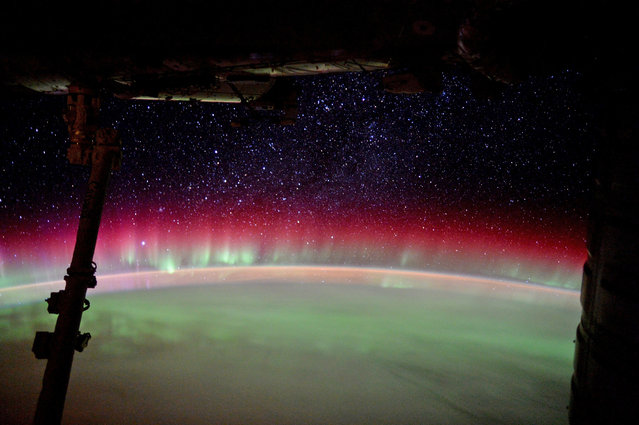
ESA astronaut Tim Peake posted this stunning image on his social media channels, commenting: “Station passed through magnificent aurora Australis last night”. Tim is set to return to Earth on 18 June 2016, bringing his six-month Principia mission to the ISS to an end. During his stay he performed more than 30 scientific experiments for ESA and taking part in numerous others from ESA's international partners. ESA and the UK Space Agency have partnered to develop many exciting educational activities around the Principia mission, aimed at sparking the interest of young children in science and space. (Photo by Tim Peake/ESA/NASA)

ESA astronaut Tim Peake posted this stunning image on his social media channels, commenting: “Station passed through magnificent aurora Australis last night”. Tim is set to return to Earth on 18 June 2016, bringing his six-month Principia mission to the ISS to an end. During his stay he performed more than 30 scientific experiments for ESA and taking part in numerous others from ESA's international partners. ESA and the UK Space Agency have partnered to develop many exciting educational activities around the Principia mission, aimed at sparking the interest of young children in science and space. (Photo by Tim Peake/ESA/NASA)
Details
31 Dec 2016 10:21:00
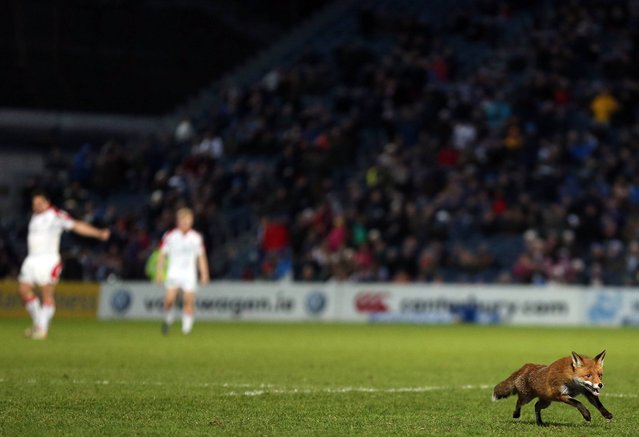
A fox runs out onto the pitch before the start of the second half. Celtic League 2012/13, Round 19, Leinster v Ulster, RDS, Ballsbridge, Dublin, March 30, 2013. (Photo by Paul Mohan)

A fox runs out onto the pitch before the start of the second half. Celtic League 2012/13, Round 19, Leinster v Ulster, RDS, Ballsbridge, Dublin, March 30, 2013. (Photo by Paul Mohan)
Details
06 Apr 2013 12:52:00
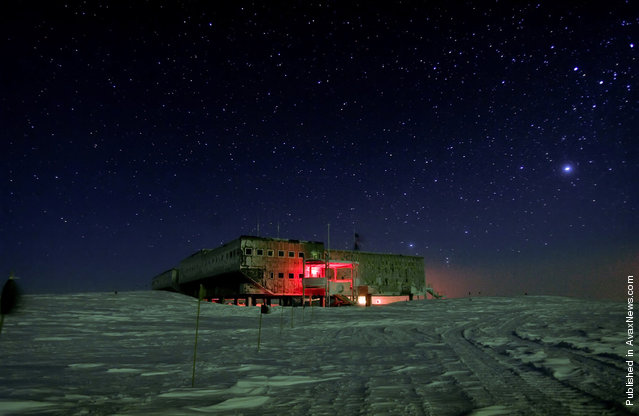
Amundsen-Scott South Pole Station experiences months of darkness. The sun dips below the horizon on March 21, after which follows several weeks of twilight before complete darkness results

Amundsen-Scott South Pole Station experiences months of darkness. The sun dips below the horizon on March 21, after which follows several weeks of twilight before complete darkness results. Photo taken on June 25, 2009. (National Science Foundation/Jeremy Johnson)
Details
08 Apr 2012 13:07:00
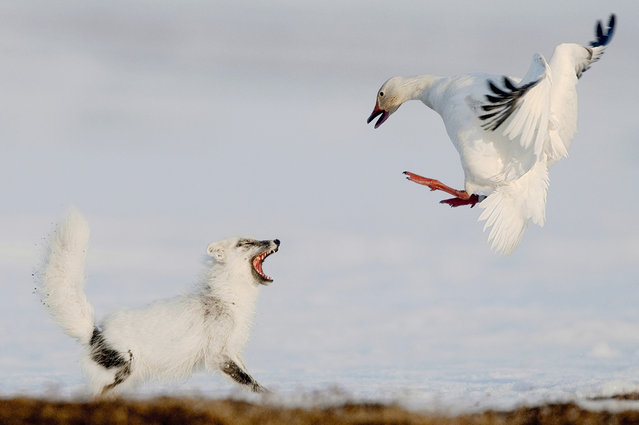
Commended. In late May, about a quarter of a million snow geese arrive from North America to nest on Wrangel Island, in northeastern Russia. They form the world's largest breeding colony of snow geese. Photographer Sergey Gorshkov spent two months on the remote island photographing the unfolding dramas. (Photo by Sergey Gorshkov/Veolia Environnement Wildlife Photographer)

Commended. In late May, about a quarter of a million snow geese arrive from North America to nest on Wrangel Island, in northeastern Russia. They form the world's largest breeding colony of snow geese. Photographer Sergey Gorshkov spent two months on the remote island photographing the unfolding dramas. Arctic foxes take advantage of the abundance of eggs, caching surplus eggs for leaner times. But a goose (here the gander) is easily a match for a fox, which must rely on speed and guile to steal eggs. “The battles were fairly equal”, notes Sergey, “and I only saw a fox succeed in grabbing an egg on a couple of occasions, despite many attempts”. Surprisingly, “the geese lacked any sense of community spirit”, he adds, “and never reacted when a fox harassed a neighboring pair nesting close by”. (Photo by Sergey Gorshkov/Veolia Environnement Wildlife Photographer)

Details
16 Jun 2015 12:30:00
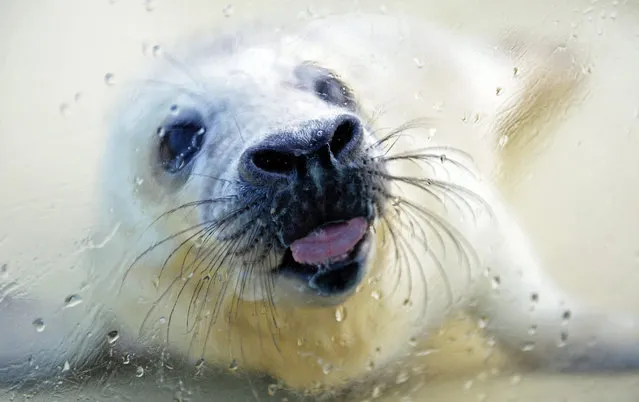
Grey seal pup “Nikolaus” licks a window at the seal enclosure in Friedrichskoog, Germany, 19 December 2014. The pup was abandoned by his mother and would not have a chance at survival without human help. Nikolaus will be fed at the enclosure for two to three months until he has reached the minimum weight of 45 kilograms for being released. (Photo by Daniel Reinhardt/EPA)

Grey seal pup “Nikolaus” licks a window at the seal enclosure in Friedrichskoog, Germany, 19 December 2014. The pup was abandoned by his mother and would not have a chance at survival without human help. Nikolaus will be fed at the enclosure for two to three months until he has reached the minimum weight of 45 kilograms for being released. (Photo by Daniel Reinhardt/EPA)
Details
20 Dec 2014 12:18:00
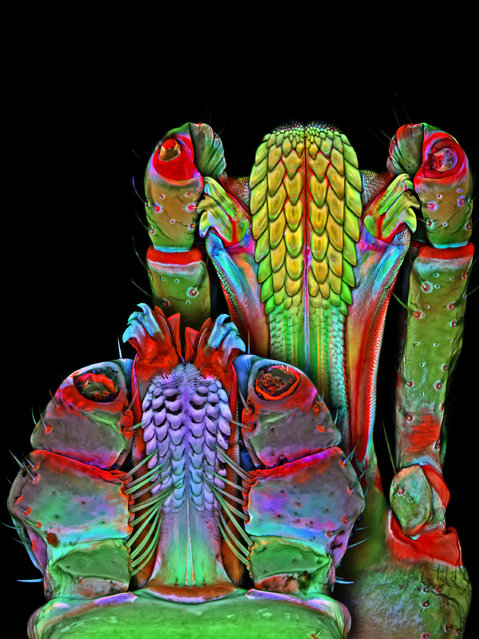
Underside of the Brown dog tick and Lonestar tick mouthparts; Confocal, 100X. Janelia Farm Research Campus, Howard Hughes Medical Institute (HHMI), Ashburn, Virginia, USA. (Photo by Dr. Igor Robert Siwanowicz/Nikon Small World 2014)

Now celebrating its 40th year, Nikon Small World is widely regarded as the leading forum to recognize proficiency and photographic excellence of photography taken under the microscope. To select the winners, competition judges analyzed entries from all over the world covering subjects ranging from chemical compounds to up-close-and-personal looks at biological specimens. The 2014 winners will be revealed on October 30th. In 2014, the competition received over 1,200 entries from more than 79 countries around the world. (Photo by Dr. Igor Robert Siwanowicz/Nikon Small World 2014)
Details
17 Oct 2014 13:10:00