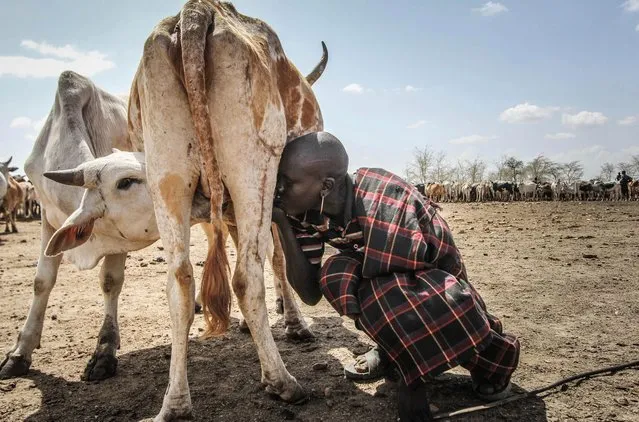
Cattle are the most important way of livelihood for the Karamojong: they provide milk, meat, blood and money when sold, Karamoja, Uganda, February 2017. (Photo by Sumy Sadurni/Barcroft Images)
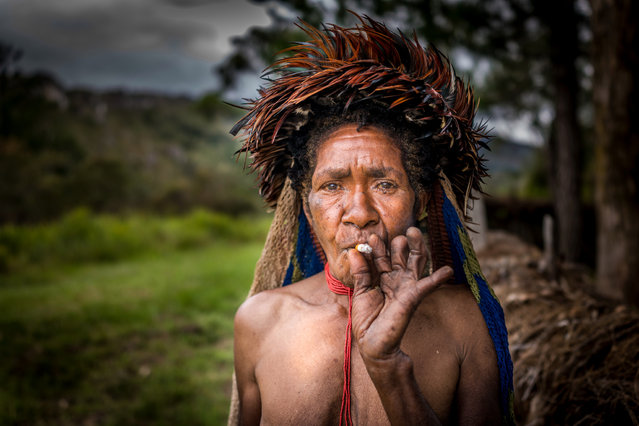
Dani tribeswoman smokes a cigarette and shows her amputated fingers in, Western New Guinea, Indonesia, August 2016. Deep in the highlands of Western New Guinea, Indonesia, lives one of the world’s most isolated tribes. Known as the Dani people, the tribe was unwittingly discovered by American philanthropist, Richard Archbold, after an expedition in 1938. (Photo by Teh Han Lin/Barcroft Images)
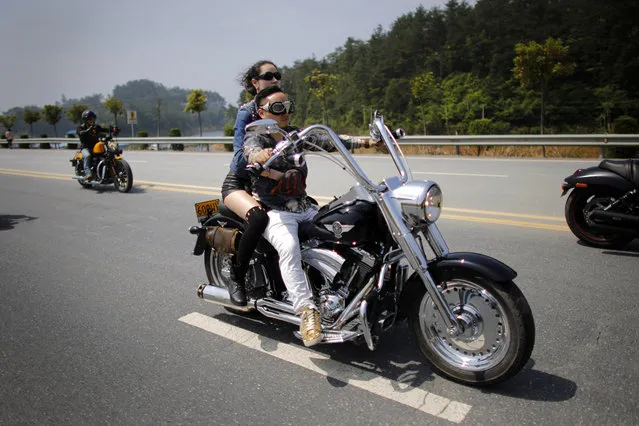
“A girl arrives at the parking lot wearing tiny leather shorts and sits on the back of a bike with a horse power of more than 1,000 CC. Next to her a man gets ready to ride, wearing a skeleton mask. It’s more than a fashion show, it’s an extravaganza on two wheels along Chinese roads”. – Carlos Barria. Photo: A couple rides their motorcycle at the Qian Dao Lake rally, on May 11, 2013. (Photo by Carlos Barria/Reuters)
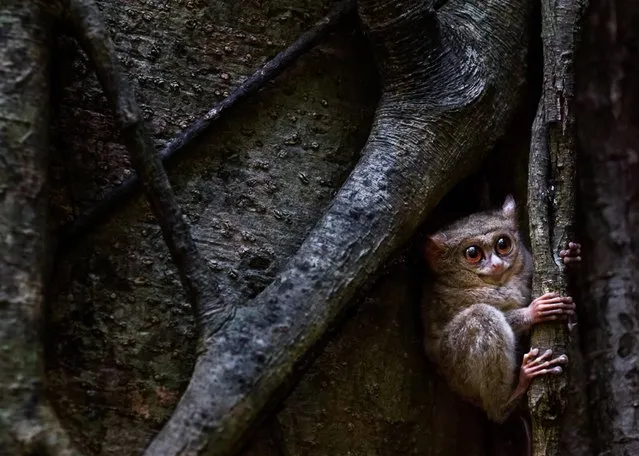
From rural life in India to a chick growing inside its embryo and a sea turtle eating a purple jellyfish, the Society of Biology has released their stunning photography competition shortlist. Here: “Spectral Tarsier”. Tangkoko, Northern Sulawesi, Indonesia: Spectral tarsier by Wolfgang Weinhardt. (Photo and caption by Wolfgang Weinhardt/UK Society of Biology Photography Award 2014)
Armed with only paper, graphite and coloured pencils – plus his vivid imagination – the artist creates remarkable drawings that leap from the page when photographed. The 32-year-old, from Alkmaar in Holland, began experimenting with anamorphic 3D drawing five years ago. Photo: Ramon Bruin’s 3D illustration of two twins drawing each other. (Photo by Ramon Bruin/Medavia)
A humanoid robot named “Yangyang” shows a facial expression during its demonstration at the Global Mobile Internet Conference (GMIC) 2015 in Beijing, China, April 29, 20155. The android was produced jointly by China's Shanghai Yangyang Intellegent Robot Science Service center and Japanese professor Hiroshi Ishiguro, with the aim of popularising robotics among the young. (Photo by Kim Kyung-Hoon/Reuters)
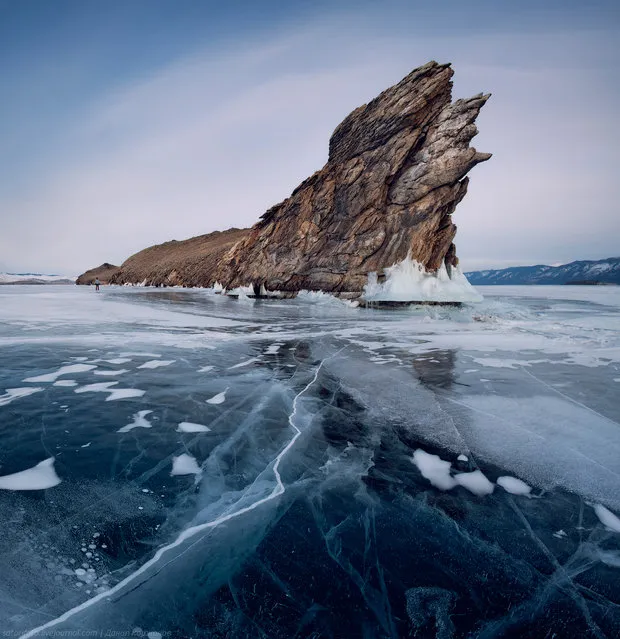
Lake Baikal is the world's oldest lake, at 25 million years (possibly older), and deepest, averaging 744.4 metres (2,442 ft).
Located in the south of the Russian region of Siberia, between Irkutsk Oblast to the northwest and the Buryat Republic to the southeast, it is the most voluminous freshwater lake in the world, containing roughly 20% of the world's unfrozen surface fresh water.