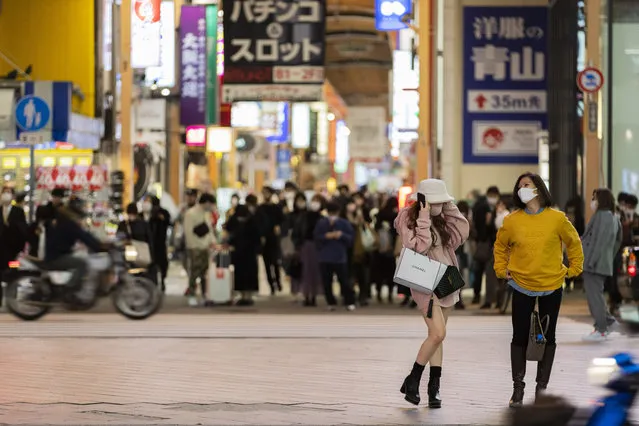
People wearing face masks to help curb the spread of the coronavirus wait to walk across a traffic intersection in Osaka, western Japan, Thursday, November 26, 2020. (Photo by Hiro Komae/AP Photo)
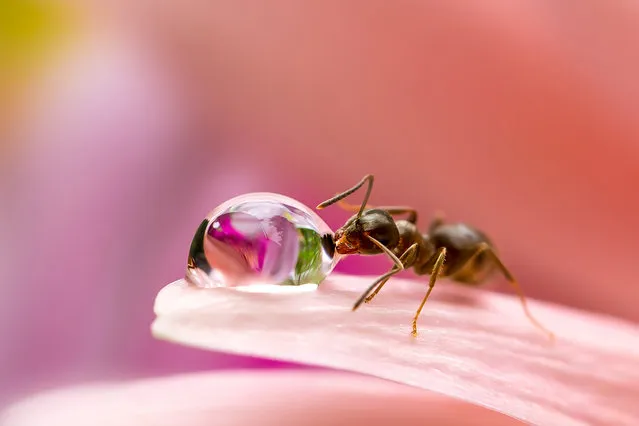
A macro view of an ant taking a sip from a water droplet on the edge of a flower in Obihiro, Japan. Animal-Lover Miki Asai has gone a step beyond feeding bread to the ducks – by syringe-feeding water to tiny ants. The office worker from Obihiro City, Japan, squirts droplets near the tiny insects and then uses a macro lens to capture quenching their thirst. The amateur photographer started capturing these images near her house in July 2013 after spotting an ant struggling in the rain. (Photo by Miki Asai/Barcroft Media)
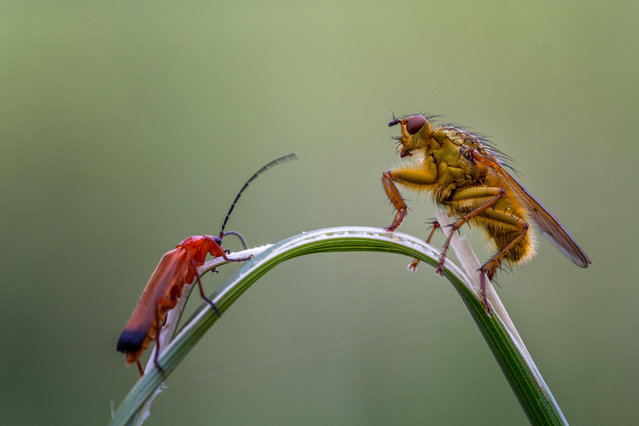
A hogweed bonking beetle and yellow dung fly in a stalk standoff (the fly gave in), in Burley-in-Wharfedale, Yorkshire, England. (Photo by Rebecca Cole/Alamy Stock Photo)
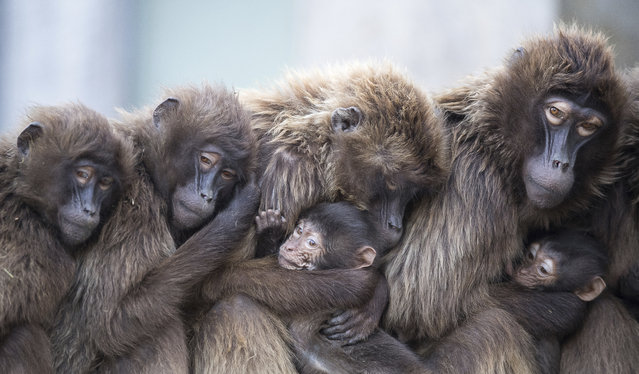
In this January 3, 2018 photo several female Gelada baboons, also known as bleeding-heart baboons, cuddle with their youngs in order to keep warm at the Wilhelma zoo in Stuttgart, Germany. (Photo by Sebastian Gollnow/DPA via AP Photo)
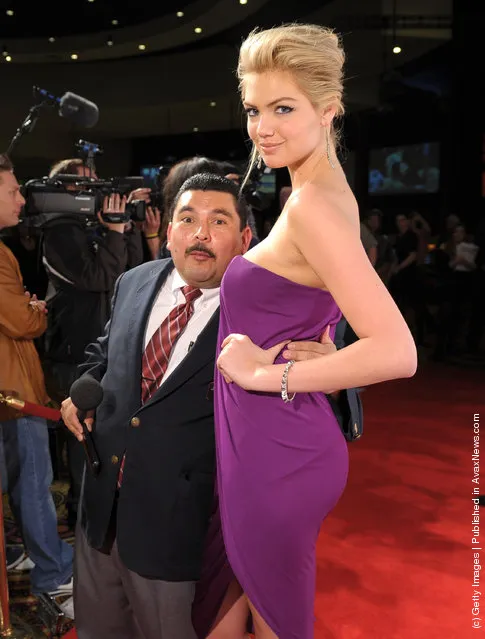
Guillermo Rodriguez and Sports Illustrated Swimsuit Issue cover model Kate Upton arrive at Club SI Swimsuit hosted by the Pure Nightclub at Caesars Palace at the Pure Nightclub at Caesars Palace on February 16, 2012 in Las Vegas, Nevada. (Photo by Michael Loccisano/Getty Images for Sports Illustrated)
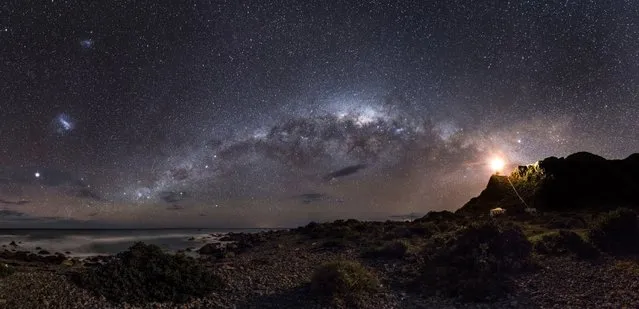
The Royal Observatory just announced its Astronomy Photographer Of The Year 2013 winners. Australian photographer Mark Gee was chosen among a thousand amateur and professional photographers around the globe to win the top title. His work is part of an exhibition of the winning photographers, which opened on Sept. 19 at the Royal Observatory Greenwich. The Royal Observatory shared with us the winners and notable mentions of the competition. Their descriptions of the prizewinners can be found below the images.
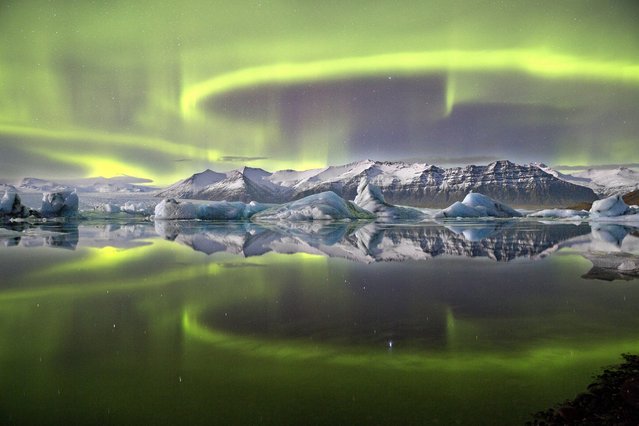
“Aurora over a glacier lagoon”. A vivid green overheaded aurrora pictured in Iceland's Vatnajokull National Park reflected almost symetrically in Jokulsrlon Glacier lagoon. A complete lack of wind and currrent combin in this sheltred lagoon scene to crete an arresting mirror effect giving the image a sensation of utter stillness. Despite theis there is motion on a suprising scale, as the loops and arcs of the aurora are shaped by the shifting forces of the Earth's magnetic field. James Woodend of Great Britain won the grand prize with the image, beating out more than 2,500 other entries. The Astronomy Photographer of the Year 2014 contest is judged by the Royal Observatory Greenwich and BBC Sky at Night magazine. (Photo by James Woodend/The Astronomy Photographer of the Year 2014 Contest)