Loading...
Done
Kreuzberg Vegetable Battle

A female participant armed with a bottle of ketchup attacks in the annual Vegetable Battle in Kreuzberg district near Oberbaumbruecke Bridge on August 28, 2011 in Berlin, Germany. The event pits Kreuzberg district residents againts Friedrichshain district residents for control of the Oberbaumbruecke, and the two sides pelt each other with rotten vegetables, other foods, ketchup, water guns and styrofoam bats until one side has pushed the other from the bridge. The event had originally been cancelled for today, but so many participants showed up anyway and began battling on the Kreuzberg side, where the situation escalated and began to threaten traffic, that police relented and let them later battle it out on the bridge. Kreuzberg claimed victory. (Photo by Sean Gallup/Getty Images)
Details
29 Aug 2011 15:02:00
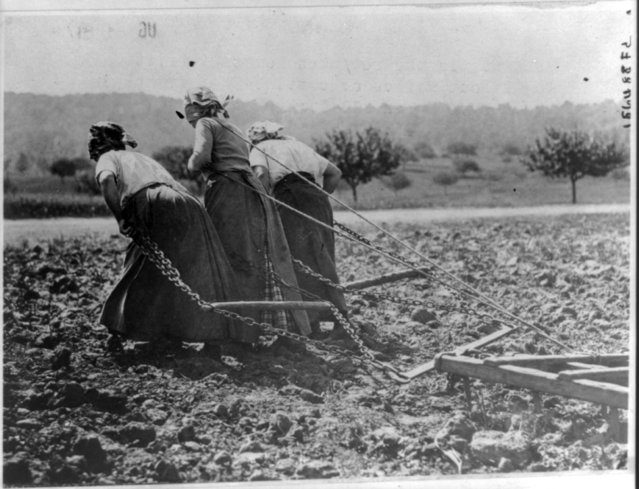
Peasants in the re-taken Somme District work in the fields, circa 1916- 1917, in this Library of Congress handout photo. (Photo by Reuters/Bain Collection/Library of Congress)

Peasants in the re-taken Somme District work in the fields, circa 1916- 1917, in this Library of Congress handout photo. For women 100 years ago, opportunities to work beyond the home and take part in political life were very limited. As the 20th century progressed, hard-won progress included gradually improved voting rights, while the upheaval of war pushed doors ajar as women worked as part of the war effort. U.S. Library of Congress archive photos show women's workplaces ranging from a flour mill in England to a coal mine in Belgium or Lincoln Motor Co.'s welding department in Detroit. International Women's Day is celebrated on March 8. (Photo by Reuters/Bain Collection/Library of Congress)
Details
03 Mar 2016 11:39:00
Abdulahi Yaroow, 13, smokes a cigarette while chewing khat at the same time in Mogadishu August 10, 2014. (Photo by Thomas Mukoya/Reuters)

Abdulahi Yaroow, 13, smokes a cigarette while chewing khat at the same time in Mogadishu August 10, 2014. Grown on plantations in the highlands of Kenya and Ethiopia, tonnes of khat, or qat, dubbed “the flower of paradise” by its users, are flown daily into Mogadishu airport, to be distributed from there in convoys of lorries to markets across Somalia. Britain, whose large ethnic Somali community sustained a lucrative demand for the leaves, banned khat from July as an illegal drug. This prohibition jolted the khat market, creating a supply glut in Somalia and pushing down prices, to the delight of the many connoisseurs of its amphetamine-like high. (Photo by Thomas Mukoya/Reuters)
Details
28 Aug 2014 10:35:00
A man walks along an empty street near the central financial district in Hong Kong September 30, 2014. Tens of thousands of pro-democracy protesters extended a blockade of Hong Kong streets on Tuesday, stockpiling supplies and erecting makeshift barricades ahead of what some fear may be a push by police to clear the roads before Chinese National Day. (Photo by Carlos Barria/Reuters)

Reuters photographer Bobby Yip took a series of portraits of people taking part in the “Occupy Central” protests in Hong Kong, and asked them why they had joined the demonstrations. China rules Hong Kong under a “one country, two systems” formula that accords the territory limited democracy. Tens of thousands of mostly student protesters are demanding Beijing give them full democracy, with the freedom to nominate election candidates. The unrest is the worst in Hong Kong since China resumed its rule over the former British colony in 1997. (Photo by Carlos Barria/Reuters)
Details
30 Sep 2014 09:10:00
Children dressed in festival costume sit on the huge paper doll of historical Japanese figure named Hashi-Benkeii on the carts during the Mikuini annual festival on May 20, 2014 in Sakai, Japan. The annual festival takes place from May 19-21 and is attended by thousands of visitors. During the festival people dressed in traditional Japanese costumes pull carts carrying 6 meter high dolls of Japanese historical figures through the narrow streets. The origins of the festival are unclear but its history can be traced back more than 250 years. (Photo by Buddhika Weerasinghe/Getty Images)

Children dressed in festival costume sit on the huge paper doll of historical Japanese figure named Hashi-Benkeii on the carts during the Mikuini annual festival on May 20, 2014 in Sakai, Japan. The annual festival takes place from May 19-21 and is attended by thousands of visitors. During the festival people dressed in traditional Japanese costumes pull carts carrying 6 meter high dolls of Japanese historical figures through the narrow streets. The origins of the festival are unclear but its history can be traced back more than 250 years. (Photo by Buddhika Weerasinghe/Getty Images)
Details
21 May 2014 08:49:00
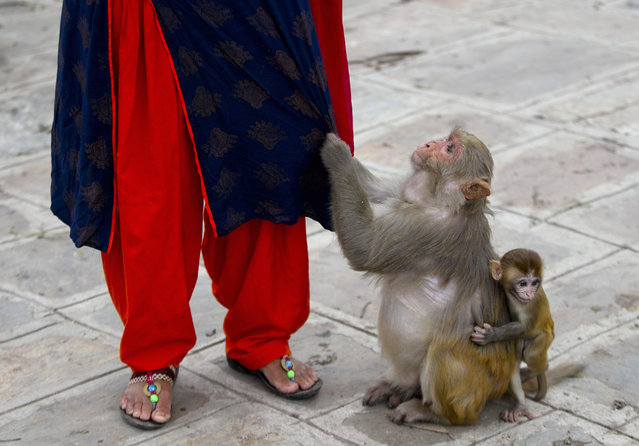
In this July 8, 2019, photo, a monkey pulls on the clothes of Saraswati Dangol as she arrives to feed monkeys in the forest near Pashupatinath temple in Kathmandu, Nepal. For the past four years, Dangol has been bringing the bread every day to feed the monkeys. As soon as they see her with her white sack, they gather around her, some patiently waiting for their turn while others less patiently snatching the bread from her hands. Many of Dangol's regulars are elderly, or are mother or baby monkeys who are unable to fight for their share of food in the wild. (Photo by Niranjan Shrestha/AP Photo)

In this July 8, 2019, photo, a monkey pulls on the clothes of Saraswati Dangol as she arrives to feed monkeys in the forest near Pashupatinath temple in Kathmandu, Nepal. For the past four years, Dangol has been bringing the bread every day to feed the monkeys. As soon as they see her with her white sack, they gather around her, some patiently waiting for their turn while others less patiently snatching the bread from her hands. Many of Dangol's regulars are elderly, or are mother or baby monkeys who are unable to fight for their share of food in the wild. (Photo by Niranjan Shrestha/AP Photo)
Details
26 Jul 2019 00:03:00
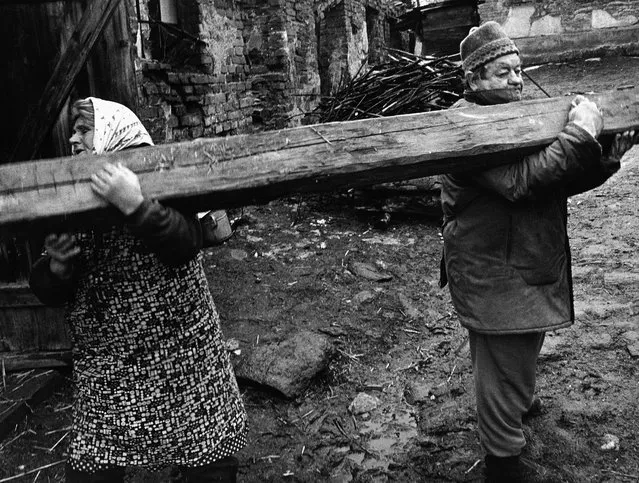
A love story with two log choppers. “In 1993, I was working on a project about life in the Olomouc region of Czechoslovakia. One day, I came to the village of Dlouhá Loučka-Křivá and went into a courtyard where I saw two old people, a husband and wife, sawing firewood for winter. They were working quietly, concentrating. I watched them fetch a beam from a wrecked barn, but they didn’t discuss how they planned to carry it to the saw. The woman faced one way, the man the other. When they realised, the woman eventually turned and followed her husband. The picture I took is the picture of many relationships – when each partner wants something different, but they have to come to an agreement, pull together eventually”. (Photo by Jindrich Streit)

A love story with two log choppers. “In 1993, I was working on a project about life in the Olomouc region of Czechoslovakia. One day, I came to the village of Dlouhá Loučka-Křivá and went into a courtyard where I saw two old people, a husband and wife, sawing firewood for winter. They were working quietly, concentrating. I watched them fetch a beam from a wrecked barn, but they didn’t discuss how they planned to carry it to the saw. The woman faced one way, the man the other. When they realised, the woman eventually turned and followed her husband. The picture I took is the picture of many relationships – when each partner wants something different, but they have to come to an agreement, pull together eventually”. (Photo by Jindrich Streit)
Details
04 Aug 2016 12:34:00
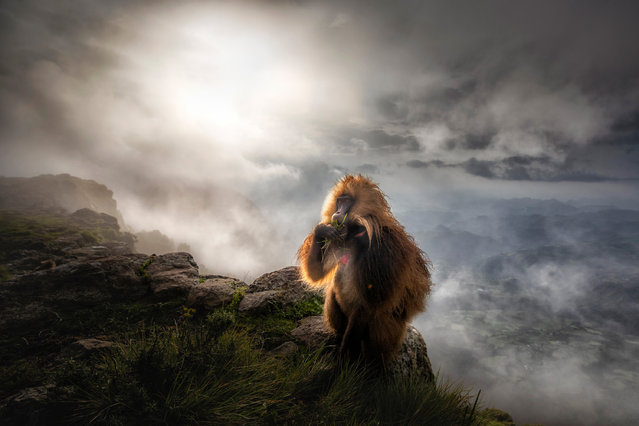
Highly commended, mammals: Gelada after the storm – Marco Gaiotti (Italy). “Gelada baboons are the only monkey species in the world that feed on grasses. They are native to the tableland of Ethiopia. Every morning large family groups wander from their sleeping places in the steep rock face, up to 1,000 metres high, to the feeding grounds at the tablelands. This image clearly depicts their feeding strategy: they pull out bunches of grass, sort the stalks and then lift them to their mouth. This shot was taken towards the end of the rainy season after a heavy storm”. (Photo by Marco Gaiotti/2019 GDT European Wildlife Photographer of the Year)

Highly commended, mammals: Gelada after the storm – Marco Gaiotti (Italy). “Gelada baboons are the only monkey species in the world that feed on grasses. They are native to the tableland of Ethiopia. Every morning large family groups wander from their sleeping places in the steep rock face, up to 1,000 metres high, to the feeding grounds at the tablelands. This image clearly depicts their feeding strategy: they pull out bunches of grass, sort the stalks and then lift them to their mouth. This shot was taken towards the end of the rainy season after a heavy storm”. (Photo by Marco Gaiotti/2019 GDT European Wildlife Photographer of the Year)
Details
31 Oct 2019 00:03:00