A man demonstrates outside Republican presidential candidate Donald Trump's news conference at Trump Tower in New York, U.S., May 31, 2016. (Photo by Shannon Stapleton/Reuters)
Photographer John Maher, once the drummer with punk bank Buzzcocks, travelled to the Outer Hebrides to photograph abandoned crofters’ cottages – many of which, like this one, have seemingly been untouched since. Here: “Peat Fire”. Taken in March 2013 on the east coast of Harris. The fire is from muir-burning, when farmers burn off grasses and heather to improve grazing for their sheep. (Photo by John Maher/The Guardian)
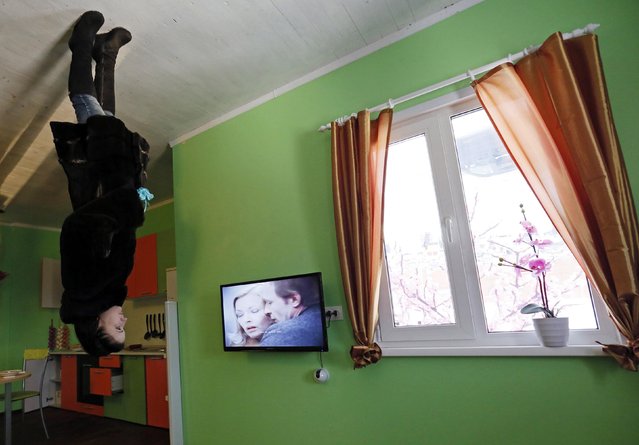
A picture rotated 180 degrees shows visitors walking inside an “Upside-down House” attraction at the VVTs the All-Russia Exhibition Center in Moscow, on January 14, 2014. The attraction to experience a new perspective of a house standing upside down was opened first time in Russia, the show organisers said. (Photo by Alexander Nemenov/AFP Photo)
Measuring just five feet at its widest point, the ultra-thin home was unveiled in the Polish capital of Warsaw on Sunday, October 21, 2012. Photo: The Keret House is squeezed into the space between two apartment buildings in Warsaw. There's a four-inch gap between the apartment buildings to either side. A perforated steel facade was used to allow in more light. (Photo by Andrea Meichsner/The New York Times)
The 150-square-metre Villa Ypsilon was designed by London- and Brussels-based firm LASSA, which is headed up by architects Theo Sarantoglou Lalis and Dora Sweijd.
Urban photographer Roman Robroek spent five years scouring the continent for the grandest examples of forgotten architectural beauty. Here: Watch your step on this Polish spiral staircase. (Photo by Roman Robroek/South West News Service)
Sled dogs in Svalbard, Norway live in little houses built a foot or two off the ground so they remain accessible even after snowstorm. Raising the floor above the cold ground also keeps the dogs warmer in the winter.
This project features a house covered (inside and out) with thousands of round mirrors that makes it nearly camouflaged. The round mirrors have different shapes and size because each one was handcut by the artist. Visitors are in for a unique experience when the mirrors interactive with nature, glistening as it reflects sunlight while gently flickers when the wind blows.